



Why sulfur prices drive dicalcium phosphate costs
The hidden input behind dicalcium phosphate
Dicalcium phosphate (DCP) is a workhorse of animal feed, food fortification, and agriculture. But behind almost every tonne sits an input most DCP buyers never purchase directly: sulfur. Beroe’s September 2026 should-cost model for DCP shows that the choice of digesting acid, rather than the phosphate rock itself, decides whether DCP behaves like a stable commodity or a volatile one.
How much cheaper is the hydrochloric acid route?
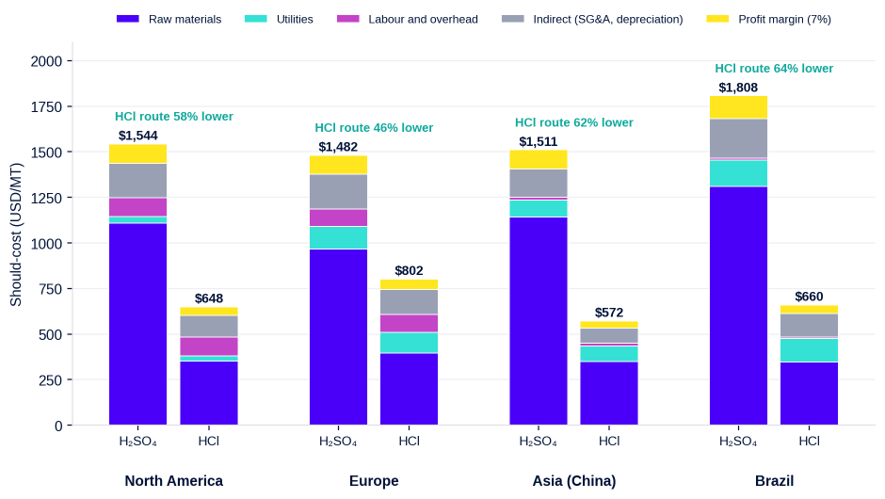
Procurement teams should treat the acid route as a sourcing variable, not a technical footnote. At September 2026 prices, DCP made via the hydrochloric acid (HCl) route is modeled 46 to 64 percent below the sulfuric acid route, a gap of roughly USD 680 to 1,150 per metric ton.

How DCP is made and why sulfur supply matters
Why sulfur supply follows the energy market
DCP is made by digesting phosphate rock with a strong acid and precipitating calcium phosphate from the liquor. In the dominant wet process that acid is sulfuric acid, made by burning sulfur. Sulfur is not mined for its own sake: it is a by-product of oil refining and gas processing, so its supply follows the energy industry, not phosphate demand.
Import-dependent Asia and Latin America, India especially, are most exposed when sulfur and phosphate prices jump together.
What this blog covers
This blog compares the sulfuric acid and HCl routes across four regions on cost, parity, yield, and EHS risk, and closes with a procurement action plan.
How much of DCP cost comes from sulfur?
On the sulfuric acid route, raw materials account for 65 to 76 percent of the estimated DCP price, and sulfur alone for 45 to 57 percent. A single by-product feedstock, whose output cannot respond to price, sets more than half the cost of the finished product.
Why DCP sulfur risk is rising in 2026
- Why is DCP cost so volatile? More than half of sulfuric-route should-cost rests on sulfur, whose supply is fixed by oil and gas output and reacts instantly to crude volatility and geopolitical shocks.
- Why is the risk higher now? The closure of the Strait of Hormuz from late February 2026 stranded Middle East sulfur exports; roughly half of seaborne sulfur trade passes through it [1]. Between February and June 2026, US sulfur rose from USD 500 to USD 1,148 per metric ton.
- Why does it matter beyond price? The same chokepoints carry Saudi phosphates, about 19 percent of global diammonium phosphate and monoammonium phosphate (DAP/MAP) exports in 2025.

How the hydrochloric acid route to DCP works
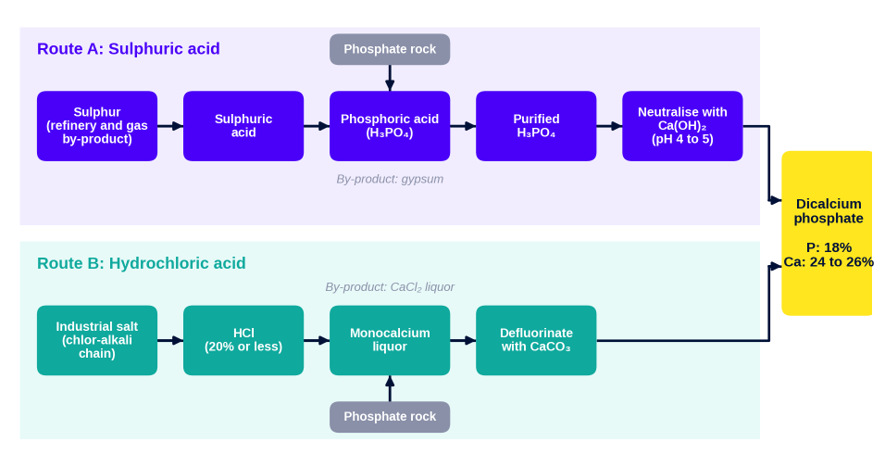
The solution is an existing, proven route overlooked while sulfur was cheap. Both routes start with the same phosphate rock and end with the same product: DCP at about 18 percent phosphorus and 24 to 26 percent calcium. What differs is the acid in the middle.

Figure 1: Two routes to dicalcium phosphate
Source: Beroe analysis; Industry expert 1 [3]
- Route A, sulfuric acid. Sulfuric acid digests rock into phosphoric acid (H₃PO₄), leaving gypsum. The acid is purified and neutralized with calcium hydroxide to precipitate DCP.
- Route B, hydrochloric acid. Salt feeds the chlor-alkali process; the chlorine makes HCl. Dilute HCl digests the rock into a monocalcium liquor, which is defluorinated before DCP is precipitated, skipping phosphoric acid entirely.
HCl suits food, feed, and agricultural DCP grades, but it is not a feasible route to triple superphosphate (TSP) [2].
DCP should-cost comparison by region and route
How big is the cost gap between the two routes?
Beroe modeled a 50,000 metric ton (MT) per year plant at 85 percent utilization and a 7 percent margin in four regions, holding everything except the acid chain constant.
Figure 2: DCP should-cost by region and route, USD/MT (September 2026)
Source: Beroe DCP cost model (September 2026 inputs); Industry expert 1 [1]
Table 1: DCP should-cost by region and route, USD/MT (September 2026)
| Region | Sulfuric acid route | HCl route | Gap | HCl lower by |
| North America | 1,544 | 648 | 895 | 58% |
| Europe | 1,482 | 802 | 680 | 46% |
| Asia (China) | 1,511 | 572 | 939 | 62% |
| Brazil | 1,808 | 660 | 1,149 | 64% |
Raw materials explain the difference: sulfur adds USD 660 to 1,035 per metric ton of DCP on the sulfuric route; salt adds only USD 21 to 84 on the HCl route.
Sulfur price volatility from 2022 to 2026
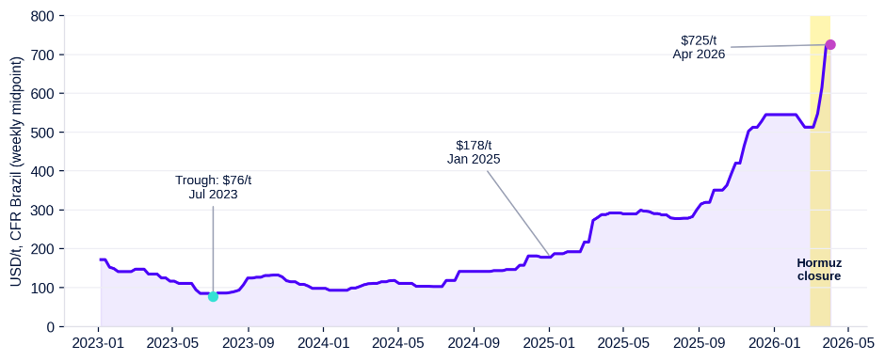
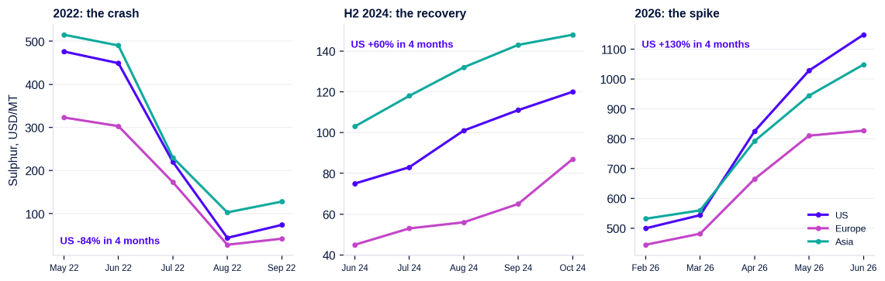
In three years, sulfur has crashed, recovered, and spiked, each time faster than an annual contract can adjust. Sulfur delivered to Brazil moved from about USD 76 per metric ton in July 2023 to about USD 725 by April 2026, and high prices led Mosaic to idle its Brazilian superphosphate plants at the end of 2025 [3].
Figure 3: Sulfur dry bulk, cost and freight (CFR) Brazil, weekly midpoint, USD/MT (January 2023 to April 2026)
Source: Argus sulfur dry bulk CFR Brazil assessments, as compiled in the Beroe DCP cost model [4]
Source: Industry expert 1; Beroe analysis [3]
- 2022 – the crash: US sulfur fell from USD 476 in May to USD 44 in August during the Russia Ukraine crisis.
- Second half of 2024 – the recovery: US sulfur rose from USD 75 to USD 120 between June and October.
- 2026 – the spike: With Hormuz closed, US sulfur rose from USD 500 in February to USD 1,148 in June, as Middle East surplus was stranded and other regions tightened [2].
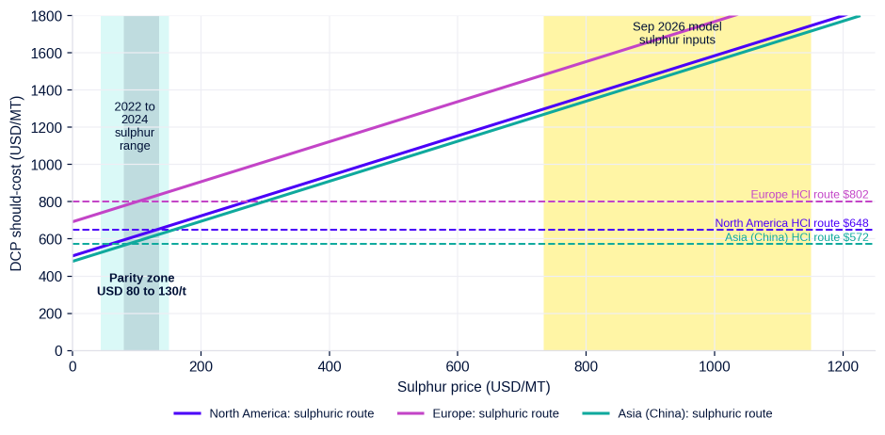
At what sulfur price do the two routes reach cost parity?
The HCl route is not always cheaper. Every USD 1 per metric ton move in sulfur shifts sulfuric-route DCP should-cost by about USD 1.08, while the HCl route barely moves. The routes reach parity at roughly USD 80 to 130 per metric ton of sulfur. At September 2026 levels of USD 734 to 1,150, the HCl advantage is at its widest.
Figure 5: Sulfur price at which the two routes reach cost parity
Source: Beroe DCP cost model, sulfur price sensitivity, other September 2026 inputs held constant [1]

How do the two routes compare on yield and safety?
Both routes share a theoretical yield of about 727 kg of DCP per metric ton of 30 percent phosphorus pentoxide (P₂O₅) rock and recover about 650 to 700 kg in practice. The trade-off is safety: HCl is volatile and can release corrosive fumes, so the HCl route carries higher acute exposure risk.
Table 2: Yield and EHS comparison of the two routes
| Parameter | Sulfuric acid route | HCl route |
| Practical DCP yield | ~650 to 700 kg/MT rock | ~650 to 690 kg/MT rock |
| Major by-product | Gypsum | CaCl₂-containing liquor |
| Acute worker exposure | Moderate to high | High |
| Toxic gas or fume potential | Low to moderate | Moderate to high |
| Fluoride-related environmental risk | Moderate | Moderate to high |
| Overall EHS risk | Moderate to high | High |
Source: Industry expert 1 [3]
Expert view from an HCl-route DCP producer

How procurement teams should respond to sulfur price risk
Action 1: Capture savings with HCl-route supply
Build an HCl-route share into the supply base, sized to what EHS qualification and specification allow. The modeled gap equals about USD 0.7 to 1.1 million per 1,000 MT of DCP, a should-cost benchmark rather than a guaranteed price.
- Substitution: Move qualified volume to HCl-route producers where specifications permit.
- Negotiation: Use route-specific should-cost models so sulfuric-route suppliers pass through sulfur decreases as readily as increases.
Action 2: Budget for sulfur price swings
- Direct materials: Budget sulfuric-route volume on sulfur bands, using the USD 1.08 sensitivity.
- Capital: Fund supplier qualification, including on-site EHS audits of fume control and effluent treatment.
- Operating: Provision for freight and war-risk premiums on Hormuz and Bab el-Mandeb flows.
Action 3: Manage supply risk at the chokepoints
- Map the route: Add acid route and rock source to every DCP supplier profile.
- Watch the trigger: Review route mix when sulfur crosses the USD 80 to 130 parity band.
- Watch the chokepoints: Track Middle East sulfur and Saudi phosphate flows as leading indicators.
Key takeaways for DCP buyers
DCP cost is decided less by the rock than by the acid that digests it. At September 2026 inputs, the HCl route is modeled 46 to 64 percent cheaper, matches sulfuric-route yield, and is largely insulated from sulfur shocks, though it demands stronger EHS controls. Buyers who tag suppliers by route, index contracts to sulfur, and qualify HCl-route capacity turn a hidden cost driver into a lever they can pull.
References
[1] Argus , “Sulphur Export Caught Up In Conflict Market,” 2026. [Online]. Available: https://www.argusmedia.com/en/news-and-insights/latest-market-news/2794920-sulphur-exports-caught-up-in-conflict-shorten-market.
[2] S&P Global Commodity Insights, “Global Sulfur Prices Likely To React Slowly If Stratit Of Hormuz Reopens,” June 2026. [Online]. Available: https://www.spglobal.com/energy/en/news-research/latest-news/agriculture/062226-global-sulfur-prices-likely-to-react-slowly-if-strait-of-hormuz-reopens-sources.
[3] S&P Global Commodity Insights, “Mosaic Idles Brazil SSP Plants,” December 2025. [Online]. Available: https://www.spglobal.com/energy/en/news-research/latest-news/fertilizers/121625-mosaic-idles-brazil-ssp-plants-suspends-sulfur-purchases-on-high-prices.
Author

Shabana Farheen


Jose Nicolas Marquez Peirano
Related Reading



20 Oct, 2026
How data center construction is revolutionizing the construction procurement landscape