


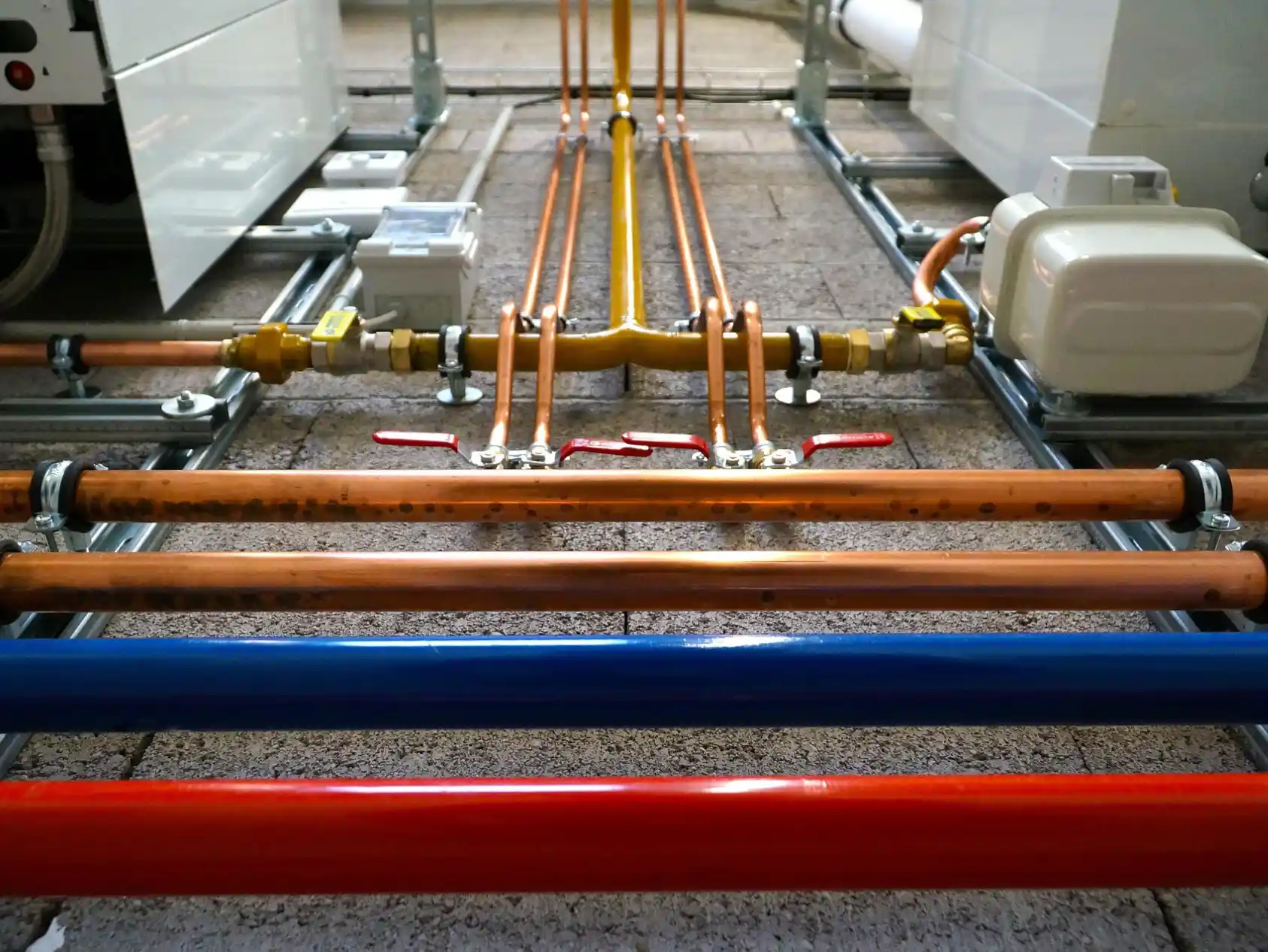
Industrial boiler procurement is moving from equipment-price procurement to lifecycle performance, flexibility and future readiness. For decades, industrial boiler procurement has been built around a familiar set of parameters such as steam capacity, operating pressure, fuel type, efficiency, emissions, delivery schedule, warranty and purchase price. Those parameters will remain important. The boiler should also not be evaluated in isolation. The actual cost of steam depends on the wider steam system like condensate recovery, feedwater temperature, blowdown, heat recovery, steam distribution losses and process demand. An RFQ evaluated purely at the boiler-package level can miss significant cost and efficiency drivers that sit downstream of the boiler itself. However, a boiler purchased in 2030 could remain in operation for decades. During that period, the economics of fuel, electricity, emissions compliance, digital systems and maintenance could change substantially.
This raises an important procurement question: “If the asset is expected to operate for decades, should an RFQ issued in 2030 be designed around today’s operating assumptions?” The answer may require a different approach. Rather than treating the boiler as a piece of capital equipment, procurement teams could increasingly evaluate it as a long-term energy, operational and technology asset. The 2030 RFQ should go beyond asking, “What is the price and rated efficiency of the boiler?” It should ask, “How will this boiler perform, cost, adapt and remain supportable throughout its operating life?”
From a boiler specification to a lifecycle specification
A conventional RFQ places heavy emphasis on technical specifications and upfront commercial terms. A future-oriented RFQ may expand the evaluation to cover the whole life of the asset.
Figure 1: Illustrative boiler operating life
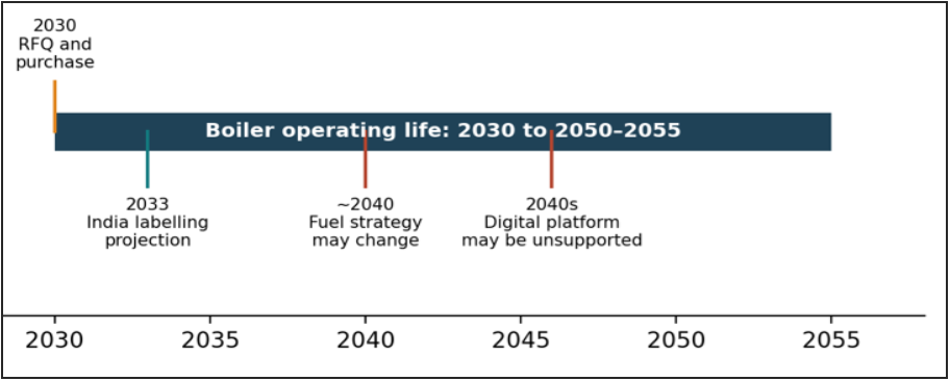
Source: ARXIV [10]
Table 1: 2030 RFQ addition
| Dimension | What the RFQ should add |
|---|---|
| Performance | Results across the actual load profile, not one rated point |
| Energy | Lifecycle energy consumption |
| Fuel | Fuel flexibility and conversion options |
| Environment | Emissions performance and future regulatory requirements |
| Digital | Monitoring, data access and cybersecurity |
| Operations | Maintenance, availability and retrofit options |
| Supplier | Long-term support commitments |
Sources: ABMA, US DOE, IEA 2025, Indian Boilers Act 2025, ISA [3], [1], [5], [7], [6], [13]
This does not mean every buyer should specify hydrogen capability, electrification, or advanced digital systems. Instead, the RFQ should require suppliers to quantify the implications of these options, so procurement can decide based on the site’s actual operating profile. The objective is not to predict the future, but to ensure that the boiler purchased in 2030 is not constrained by assumptions that were valid only at the time of purchase.
1) Stop asking only for rated efficiency
A supplier may quote a headline thermal or combustion efficiency, but industrial boilers do not necessarily run continuously at rated load. Actual demand fluctuates because of:
- Production schedules and seasonal demand
- Plant shutdowns and batch processes
- Start-up and shutdown cycles
- Changes in steam consumption
- Boiler configuration and modularity
- Steam quality requirements
Some boiler manufacturers have highlighted the importance of expected service duty, capacity factor and load profile when considering boiler design life, operating costs and maintenance. [3]

A 2030 RFQ could request guaranteed performance at 25%, 50%, 75%, and 100% load, along with the assumptions used to calculate each value. The chart below shows why: two bids can share an identical headline number and still burn very different amounts of fuel.
Figure 2: Same rated efficiency, different real-world performance (illustrative)
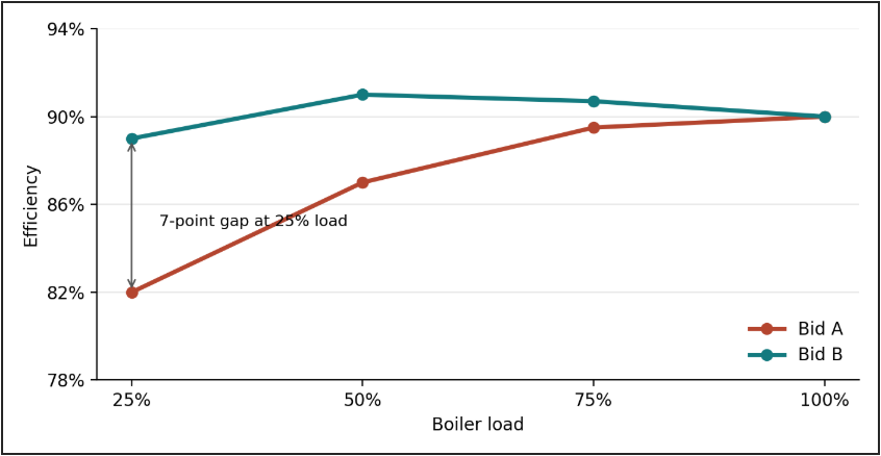
Sources: Beroe Analysis
Suppliers should state guaranteed efficiency and fuel consumption at 25%, 50%, 75% and 100% load, with test standard and assumptions. [12] Suppliers can then be compared on operating performance rather than a single headline number.
2) Make lifecycle cost more important than purchase price
The largest financial mistake in boiler procurement can occur when the purchase price receives more attention than the cost of operating the asset. The procurement should consider explicitly consider lifecycle cost rather than first cost. Its examples evaluate lifetime energy consumption and cost and use boiler lifetimes of 20–25 years. [1]
The cheaper bid is not always the cheaper boiler.
Figure 3: Illustrative 20-year cost index
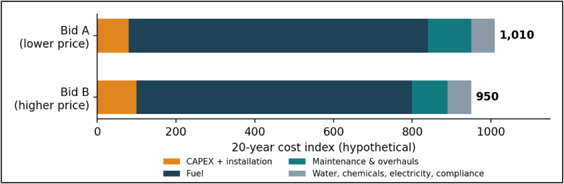
Sources: US DOE [1]
For a future RFQ, the commercial comparison moves from boiler price + installation to Total Cost of Ownership:
Table 2: TCO cost framework
| Cost element | Included in TCO |
|---|---|
| CAPEX | Equipment, installation, commissioning |
| Running costs | Fuel, electricity, water, chemicals |
| Maintenance | Routine maintenance, spare parts, major overhauls |
| Digital and compliance | Software or digital services, compliance costs |
| Risk | Expected downtime |
| Credit (−) | Energy recovery benefits |
Sources: US DOE, Indian Boilers Act 2025 [1], [7], [6]
Suppliers should also disclose the assumptions behind their TCO calculations so bids can be compared on a consistent basis:
Table 3: TCO assumptions suppliers should disclose
| Assumption to disclose | Why it matters |
|---|---|
| Annual operating hours | Scales every running cost |
| Load profile | Determines real efficiency |
| Fuel price | Usually, the largest cost line |
| Efficiency | Drives fuel consumption |
| Maintenance frequency | Affects cost and availability |
| Major overhaul timing | Creates large future cash outflows |
| Expected component life | Sets replacement timing |

3) Treat fuel flexibility as an option, not an assumption
Fuel strategy could become one of the most difficult variables for a boiler purchased in 2030. Natural gas may remain dominant for many applications, but industrial energy strategies are also evolving around electrification, renewable electricity, biomass and potentially hydrogen or other alternative fuels.
The electricity uses for industrial process heat to increase significantly through 2030, while electric boilers and other electric technologies are already commercially available for relevant applications. It also identifies energy security and reduced exposure to volatile fossil-fuel prices as potential benefits of electrification. [5], [13]
At the same time, hydrogen-blended boiler operation is being actively investigated. [9] This does not mean every boiler should be hydrogen-ready. Procurement should ask suppliers to quantify the options:
Table 4: Fuel flexibility RFQ components
| Requirement | Supplier response |
|---|---|
| Current fuel capability | Specify |
| Dual-fuel capability | Specify |
| Alternative-fuel capability | Specify |
| Hydrogen blending capability (where applicable) | Specify |
| Burner modification required | Cost + downtime |
| Controls modification | Cost + downtime |
| Efficiency impact | Quantify |
| Emissions impact | Quantify |
| Future conversion cost | Provide as priced option |
| Warranty implications | Specify |
Sources: MDPI [9]
This creates what could be called fuel flexibility as an option value. The buyer does not have to pay for every future capability today, but should understand: “What will it cost if the fuel strategy changes five or ten years after commissioning?”
4) Compliance today should not be the only regulatory question
A boiler purchased in 2030 could operate well beyond 2040, so compliance needs to be considered over the asset’s lifecycle. India offers a useful example.
Table 5: Regulatory developments in India
| Development in India | Implication for buyers |
|---|---|
| Boilers Act, 2025 came into operation on 1 May 2025 | New legal framework governs the asset from day one |
| 2026 consultation with states, manufacturers, users and third-party inspection authorities, covering ageing-boiler remnant-life assessment and advanced boiler technologies | Expect attention on long-term condition assessment |
| 2026 advisory encouraging fuel diversification and alternate fuels | Fuel strategy is a policy topic, not only a cost topic |
| Packaged-boiler Standards & Labelling programme with 1–5 star ratings based on thermal efficiency; increasing penetration projected through 2033 | Efficiency information becomes easier to compare, and expectations may rise |
Source: Indian Boilers Act, PIB [8], [7]
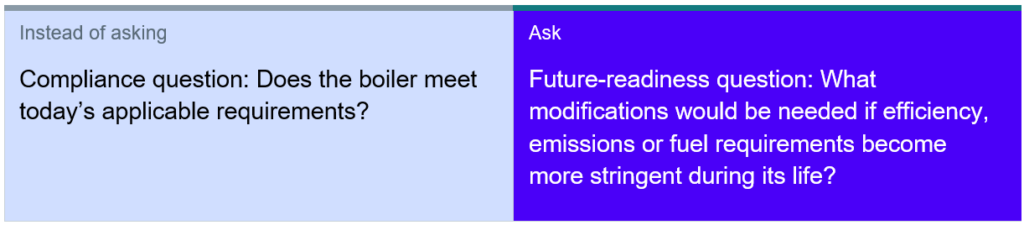
A future RFQ could request current regulatory compliance, guaranteed emissions performance, efficiency certification and testing methodology, plus upgrade requirements, retrofit cost estimates and expected downtime for major upgrades. The objective is not to predict future regulations but to understand the cost of adapting to them.
5) Digitalization should become part of the RFQ
The boiler may remain a thermal system, but the way it is monitored and operated is increasingly digital. The testing of an advanced boiler combustion-control and monitoring system demonstrates continuous monitoring of oxygen, carbon monoxide and nitrogen oxide concentrations, with real-time performance feedback. [2]
Table 6: 2030 RFQ data architecture:
| Operational data | Connectivity | Analytics |
|---|---|---|
| Steam flow | PLC / SCADA integration | Efficiency monitoring |
| Steam pressure | Industrial communication protocols | Abnormal-condition detection |
| Fuel consumption | Data export | Combustion optimization |
| Feedwater temperature | API availability | Predictive maintenance |
| Flue-gas temperature | Historian integration | Performance trending |
| Oxygen concentration | ||
| Burner firing rate | ||
| Alarm history, operating hours, maintenance events |

6) The new procurement question: Who owns the data?
If the boiler generates years of operational data, the RFQ should settle the ownership and continuity
Table 7: Who owns the data? — Questions to settle up front
| Question | What the buyer needs |
|---|---|
| Who owns the data? | Explicit contractual ownership |
| Can it be exported? | Open formats and API access |
| Can it move to another platform? | Portability without penalty |
| What if the supplier’s platform changes? | Continuity and migration commitments |
| What happens when software support ends? | Defined end-of-support policy |
| Can we operate without the supplier’s cloud? | Local operation fallback |
This matters because industrial control systems can have very long lives. IEC 62443-2-1:2024 explicitly recognizes that industrial automation and control systems can last more than 20 years and that legacy systems may eventually contain unsupported hardware and software. [6] The mechanical asset may still be operational even when its digital infrastructure becomes obsolete. [11]
A future RFQ should consider hardware (controllers, sensors and panels), software (firmware, applications and platforms), and cybersecurity (patches and vulnerability management) lifecycles, rather than treating software as an incidental component of the boiler package.
7) Cybersecurity moves into boiler supplier qualification
If a boiler is connected to a plant’s operational technology environment, remote access and software support become procurement considerations. IEC 62443 provides a framework for cybersecurity of industrial automation and control systems and specifically addresses requirements for asset owners. [6]
Table 8: Cybersecurity requirements to ask suppliers to specify
| Area | Ask the supplier to specify |
|---|---|
| Access | Remote-access architecture, authentication requirements, user-access controls |
| Updates | Software-update procedures, security patch support |
| Risk management | Vulnerability-management process, backup and recovery arrangements |
| Lifecycle | End-of-support policy, data storage arrangements |
Source: IEC [6]
If this boiler is expected to operate for 20 years, how will the supplier support its digital systems for 20 years? That is very different from asking whether the boiler has a modern control interface at the time of purchase.
8) Move from warranty to measurable performance
Traditional boiler contracts emphasize delivery, commissioning and warranty. A future model could add measurable operational commitments, depending on the application.
| Technical specification What the supplier must build | Performance specification What the boiler must deliver | Lifecycle specification How that performance must be maintained |
Table 9: Possible performance commitments
| Possible commitment | Example measure |
|---|---|
| Steam output | Rated tons/hr at defined pressure and temperature |
| Efficiency | Verified at agreed load points |
| Fuel consumption | Per unit of steam delivered |
| Availability | Percentage of scheduled operating hours |
| Emissions | Guaranteed limits under stated conditions |
| Response time | Load-following or start-up time |
| Spare-parts availability | Committed lead times |
| Service response | Hours to site attendance |
Source: Beroe Analysis, ASME [4]
The concept is not to eliminate warranties but to complement them. ASME’s performance-test framework already provides standardized approaches for testing and reporting, which can help establish objective acceptance criteria. [4]
9) Ask suppliers what happens if the energy strategy changes
Perhaps the most important addition to a 2030 RFQ is a future-conversion section. Instead of assuming the energy environment stays unchanged, procurement teams should ask suppliers to price optional scenarios.
Table 10: Future-conversion scenario
| Scenario | Question for the supplier |
|---|---|
| A. Existing fuel strategy continues | What is the expected lifecycle cost? |
| B. Alternative fuel becomes available | What equipment changes are required? |
| C. Greater electrification becomes attractive | Can the system operate within a hybrid steam-generation architecture? |
| D. Emission requirements become more stringent | What retrofit would be required? |
Source: Beroe Analysis
For each scenario, the supplier should complete the same response template, which makes the cost of adaptation visible before the contract is awarded:
Table 11: The 2030 RFQ: What changes?
| Area | Traditional RFQ | 2030-oriented RFQ |
|---|---|---|
| Cost basis | Equipment price | Lifecycle cost |
| Efficiency | Rated efficiency | Efficiency across load profile |
| Capacity | Maximum capacity | Actual load profile + turndown |
| Fuel | Single fuel specification | Current + potential future fuel options |
| Compliance | Current compliance | Current compliance + upgrade pathway |
| Controls | Basic controls | Digital performance monitoring |
| Software | Supplier software | Data ownership + interoperability |
| Commitments | Warranty | Measurable performance requirements |
| Maintenance | Preventive maintenance | Lifecycle reliability strategy |
| Support | Equipment support | Long-term service and software support |
| Qualification | Technical | Technical + digital + cybersecurity |
The objective is not to make RFQs unnecessarily complicated. It is to make them better aligned with the economic life of the asset.
Table 12: Proposed boiler procurement scorecard
A buyer could structure its evaluation around several dimensions:
| Evaluation dimension | Question procurement should answer |
|---|---|
| Technical performance | Does the boiler meet the required steam profile? |
| Load performance | How does efficiency change with load? |
| Lifecycle economics | What is the 10–20 year TCO? |
| Energy efficiency | What fuel consumption is guaranteed? |
| Fuel flexibility | What future fuel options are technically feasible? |
| Emissions | What is guaranteed and under what conditions? |
| Digital capability | What data and analytics are available? |
| Cybersecurity | How will the connected system be protected and supported? |
| Reliability | What availability and service commitments exist? |
| Future readiness | What happens if the energy or regulatory environment changes? |
| Supplier capability | Can the supplier support the asset throughout its life? |
The exact weighting should remain site-specific. A refinery, pharmaceutical plant, food manufacturer and textile plant will not have identical requirements.
What procurement can start doing today
The 2030 RFQ does not require procurement teams to wait until 2030. Several changes can be introduced into current tenders.
- Ask for efficiency at multiple load levels. Do not rely solely on the rated-efficiency figure.
- Require standardized TCO assumptions. Make suppliers disclose the assumptions behind lifecycle-cost calculations.
- Request future fuel-conversion options. Even when you do not intend to convert, understand the technical and economic implications.
- Separate compliance from future adaptability. Ask what is compliant today and what can be upgraded later.
- Add digital requirements. Specify the data you need rather than accepting whatever the supplier chooses to expose.
- Include cybersecurity in supplier qualification, particularly where boiler controls connect to plant OT networks.
- Request lifecycle-service assumptions. Understand spare parts, major maintenance, software support and service response.
- Ask for retrofit costs as optional items. Create transparency around future adaptation costs before the boiler is purchased.
Conclusion: The RFQ needs to outlive the boiler’s first fuel strategy
The industrial boiler of 2030 does not necessarily need to be hydrogen-powered, electric, AI-enabled or fully autonomous. Those outcomes will depend on application, economics, regulation, infrastructure and available technology at each site.
What procurement can control is the quality of the specification and the visibility of future risks. A boiler purchased in 2030 could operate for decades, during which fuel markets can change, energy systems can evolve, regulations can tighten and digital platforms can become obsolete.
So, the future RFQ should not simply ask, “What is the most efficient boiler we can buy today?” It should ask, “What boiler system gives us the required performance today while preserving the ability to adapt tomorrow?” The biggest shift may not be from gas to hydrogen, or from mechanical to digital controls. It may be from buying equipment to buying lifecycle flexibility. The 2030 boiler RFQ should not attempt to predict the next 20 years, but it should ensure that the buyer is not locked into today’s assumptions for the next 20 years.
References
[1] Purchasing Energy Efficient Boilers [Online]. Available: https://www.energy.gov/cmei/femp/purchasing-energy-efficient-boilers [Accessed 29 September 2026].
[2] Boiler Combustion Control and Monitoring System [Online]. Available: https://www.energy.gov/cmei/femp/boiler-combustion-control-and-monitoring-system [Accessed 29 September 2026].
[3] Specification Design Life Requirements and Implications Relative to Boilers [Online]. Available: https://www.abma.com/assets/docs/Tech_Resources/2015%20-%20specification%20design%20life%20requirements_2010.pdf [Accessed 29 September 2026].
[4] Performance Test Codes [Online]. Available: https://www.asme.org/codes-standards/publications-information/performance-test-codes [Accessed 29 September 2026].
[5] Renewable Heat [Online]. Available: https://www.iea.org/reports/renewables-2025/renewable-heat [Accessed 29 September 2026].
[6] Understanding IEC 62443 [Online]. Available: https://www.iec.ch/blog/understanding-iec-62443 [Accessed 29 September 2026].
[7] The Boilers Act, 2025 [Online]. Available: https://prsindia.org/files/bills_acts/acts_parliament/2025/The_Boilers_Act,_2025.pdf [Accessed 29 September 2026].
[8] Packaged Boiler under BEE’s S&L Program [Online]. Available: https://static.pib.gov.in/WriteReadData/specificdocs/documents/2024/mar/doc202431316701.pdf [Accessed 29 September 2026].
[9] Numerical Simulation and Field Experimental Study of Combustion Characteristics of Hydrogen-Enriched Natural Gas [Online]. Available: https://www.mdpi.com/2227-9717/12/7/1325 [Accessed 29 September 2026].
[10] Multi-model assessment of heat decarbonization options in the UK using electricity and hydrogen [Online]. Available: https://arxiv.org/pdf/2206.02483 [Accessed 29 September 2026].
[11] Control Updates Line Longevity [Online]. Available: https://www.pattiengineering.com/blog/controls-upgrades-line-longevity/ [Accessed 29 September 2026].
[12] Determining & Testing Boiler Efficiency for Commercial/Institutional Packaged Boilers [Online]. Available: https://www.abma.com/assets/docs/Tech_Resources/2015%20-%20commercial_boiler_efficiency.determine.test_2008.pdf [Accessed 29 September 2026].
[13] Energy Efficiency 2025 [Online]. Available: https://www.iea.org/reports/energy-efficiency-2025/industry [Accessed 29 September 2026].
Author

Goutham CB


Faishal Ahmed
Related Reading

12 Nov, 2026
Rig reactivation vs. newbuild: Which offshore drilling strategy makes economic sense?