Abstract
For corporate procurement teams, the first question when sourcing carbon credits is often: what is the price per tonne? The quoted price may not equal the value of the underlying carbon asset and can reflect transaction history, intermediary economics, diligence, market conditions, and purchasing structure. This blog examines what buyers may and may not see behind the headline price and the questions that can strengthen procurement decisions.
Introduction
For many corporate procurement teams seeking carbon credits, the first question is almost always: what is the price per tonne? Procurement teams must manage cost, risk, supplier terms, and budgets. But a quoted carbon price is not necessarily the same as the price of the underlying carbon asset.
The quoted price should begin, not conclude, the buyer’s investigation. Consider pricing transparency; intermediary economics; credit types and portfolios; spot, forward, and offtake purchasing; delivery and durability risk; insetting; provenance; due diligence; and retirement. The starting point should be: what does the carbon price represent?
A trading price is not the same as price discovery
Carbon markets frequently borrow the language of financial markets. Buyers hear about credits “trading” at a particular price, recent activity, market ranges, and purchasing volumes. Such language implies transparent pricing, standardized instruments, and robust price discovery.
Verified carbon markets are different. Transactions may occur directly, through brokers or traders, privately over the counter (OTC), through marketplaces, under long-term agreements, or within project-finance relationships. Much of this history remains invisible to buyers. The reported price may be accurate, but what does it reveal?
A credit may move through several hands before reaching the company that purchases and retires it. Along the way, there may be commissions, brokerage fees, spreads, inventory gains, origination costs, or other margins, and one intermediary may source through another. The quoted price can therefore be only the outermost layer of a longer chain of trades, counterparties, and economics.
The buyer may see only “carbon credit: $X per tonne”—a price combining the asset and transaction-pathway economics.
What the buyer-facing carbon price can sit on top of

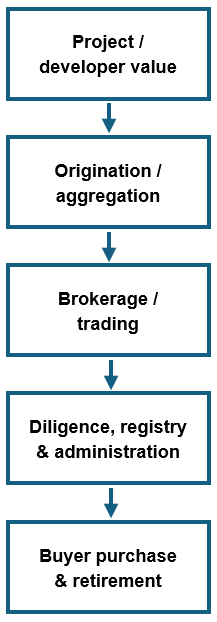
Which intermediary charges add value?
Intermediation is not inherently a problem. Sourcing, diligence, execution, market access, and financing can add value; unexplained resale margins require scrutiny. Carbon Market Watch found average fees of 15.5% among the roughly 10% of intermediaries that disclosed them, though this is not a representative market benchmark.[1]
| Credit type | Potentially valuable services | Charges needing justification |
|---|---|---|
| Renewable energy | Sourcing, registry checks, execution | Repeated resale; undisclosed spreads |
| Forestry / REDD+ | Project, land-tenure, and permanence diligence | Premiums without risk-review evidence |
| Clean cookstoves | Methodology and monitoring review | Markup without diligence evidence |
| Engineered removals | Technical assessment; delivery-risk financing | Unexplained fees beyond stated financing/services |
Table 1. Qualitative screening guidance, not project-type-specific percentage thresholds
Trading activity can also send misleading signals
If a credit trades frequently or its price rises, a buyer may infer that the asset is desirable, scarce, or being validated by sophisticated participants. Sometimes that may be true.
But transaction activity can occur for other reasons. A trader may be compensated on tonnes transacted. A holder may sell inventory at a narrow margin, or even a loss, to free capital; another may hold credits expecting future scarcity or stronger demand. Credits may move between intermediaries before reaching a final buyer, while changing preferences around characteristics such as vintage can also affect activity.
What often remains unknown is which factors produced the price or activity being used as a market signal. The trade may close; what differs is why. Trading should therefore be one signal among many rather than the primary basis for corporate demand or pricing decisions. Secondary trading can create liquidity and higher observed prices without necessarily strengthening the economics of the project that created the asset. For developers, revenue visibility that supports project development, financing, and scale may matter more than secondary-market turnover.
This is where procurement needs to become more investigative. Before relying heavily on market price signals, buyers should understand whether observed activity reflects final demand, intermediary trading, inventory strategy, or something else.
The visible market may not be the whole market
Not every carbon transaction is visible. Private OTC transactions, bilateral arrangements, offtakes, forward purchases, financing relationships, and inventory positions may not appear in information available to an ordinary corporate buyer. Public pricing is also fragmented across exchanges, marketplaces, market-intelligence providers, subscription services, and intermediary reports. No universal carbon ticker reveals the full trading history, transaction economics, or developer proceeds.
MSCI reported that nearly 90% of trades it observed in Q1 2025 were OTC or bilateral, while prices for credits from the same project and vintage varied by an average of 11% in 2025.[2] Transaction history remains fragmented. Certain intermediaries may have greater visibility through financing or origination, but buyers should not assume this. Intermediation can add value; buyers should understand its role, services, and economics.[2]
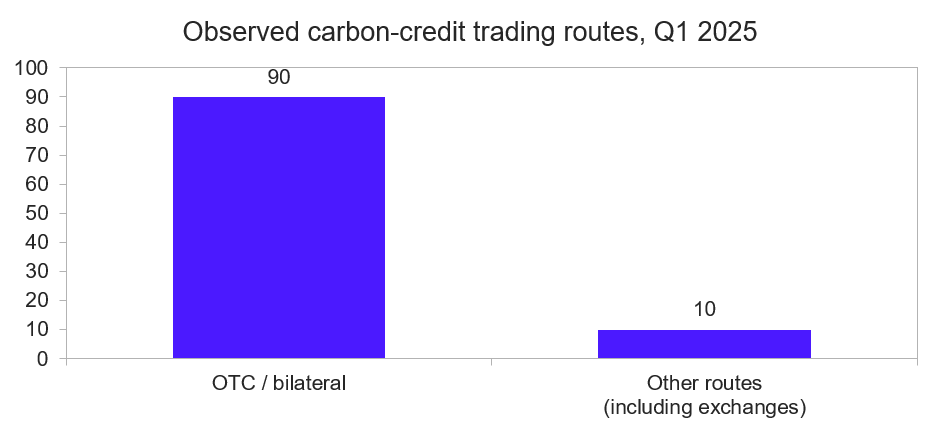
Source: MSCI [2].
New demand signals add another layer
The demand landscape is also evolving. Article 6 of the Paris Agreement is creating new international carbon-market pathways, while governments, including Canada, are examining how participation may operate.[3][4] Effects remain uncertain, but policy signals can influence behavior before rules or demand become clear. Participants may hold assets, sell others, free capital, hedge exposure, or pursue future supply they believe could become strategically important. Historical prices cannot fully predict procurement value under future demand conditions.[3][4]
Carbon procurement is broader than buying a tonne
Carbon procurement needs to move beyond a search for the lowest available price. Buyers need clearer expectations for intermediaries. Strategic pathways can include different credit types, portfolio approaches, spot and forward purchasing, offtake agreements, insetting, and other structures carrying different combinations of price, risk, impact, and delivery considerations.
Some buyers will purchase issued credits for near-term retirement; others may build portfolios or pursue insetting within their value chains. Carbon-removal buyers may consider forward purchases or offtakes that provide projects with demand certainty while securing future supply. For emerging removal credits, purchasing can interact directly with project development: projects moving from the pilot stage toward commercial scale may face a financing gap when traditional capital is difficult to secure without credible future demand.
Frontier provides a practical example. It reported refining its carbon-removal offtake template across seven deals representing more than $300 million in contracts, using predictable contracted revenue to support project bankability while protecting buyers through project specifications, conditions precedent, and payment linked to delivery.[5] A tonne bought for immediate retirement and a tonne contracted years ahead can therefore represent very different commercial propositions.
Buyers should still scrutinize price and project-development risk. The question becomes: what type of carbon strategy are we trying to execute, and what role is this purchase intended to play?
Start by asking different questions
No procurement team needs to become a carbon-market trading desk overnight, or at all. Buyers can change the process by expecting greater transparency around the transaction.
| Questions buyers should ask | Who to ask | Illustrative response | Further review |
|---|---|---|---|
| Where did the credits come from? | Seller | Through our trading network. | Request project and registry details. |
| Does the intermediary own them or act as an agent? | Broker | We facilitate the transaction. | Clarify legal counterparty and delivery obligations. |
| Is another intermediary involved? | Broker | A sourcing partner is involved. | Clarify role, services, and extra charges. |
| Have the credits traded previously? | Trader | Yes; prior prices are confidential. | Trading is not proof of value; compare attributes. |
| What services, fees, spreads, or other economics sit between the underlying asset and the final price? | Broker | Execution included; registry fees extra. | Request an all-in quotation and fee schedule. |
| Can these specific credits be independently traced to a registry issuance record? | Seller | Serial numbers will follow. | Check issuance status and unique identifiers. |
| Who will retire the credits and provide registry evidence of retirement? | Seller | We will send confirmation. | Reconcile with registry retirement record. |
| What contractual remedies apply if credits are delayed or not delivered? | Developer | Delivery depends on future issuance. | Check milestones, replacement/refund provisions. |
Table 2. Answers are hypothetical; cited sources support due-diligence concerns, not the examples.
These questions strengthen due diligence without dismissing valuable intermediary work. For final buyers, the core question is: How did this credit get here?
Conclusion
Carbon-credit pricing is more than a number attached to a tonne. The quoted price may reflect the underlying asset, multiple counterparties, intermediary services and margins, liquidity conditions, policy expectations, and the structure through which the buyer accesses supply. Trading activity can provide useful information, but neither a recent transaction nor a market range explains the full economics or strategic value of a purchase.
For procurement teams, the practical response is greater transparency and sharper questioning. Buyers should connect price with provenance, transaction history, intermediary role, credit characteristics, delivery and durability risk, and the purpose of the purchase. The question is not simply “What is the price per tonne?” but “What does this price represent, how did the credit get here, and does the purchase structure fit our carbon strategy?”
References
[1] Carbon Market Watch, February 2, 2023. [Online]. Available: https://carbonmarketwatch.org/wp-content/uploads/2023/02/CMW-briefing-on-intermediaries-1.pdf
[2] MSCI, “Investor-Grade Tools to Aid the Global Carbon Market,” 2025. [Online]. Available: https://www.msci.com/research-and-insights/blog-post/investor-grade-tools-to-aid-the-global-carbon-market.
[3] UNFCCC, “Article 6 of the Paris Agreement.” [Online]. Available: https://unfccc.int/process-and-meetings/the-paris-agreement/article6.
[4] Environment and Climate Change Canada, “Federal Government developing framework for greater international cooperation on carbon markets,” September 24, 2026. [Online]. Available: https://www.canada.ca/en/environment-climate-change/news/2026/09/federal-government-developing-framework-for-greater-international-cooperation-on-carbon-markets.html.
[5] Frontier, “Publishing Frontier’s Offtake Agreement Template,” August 15, 2024; template updated December 10, 2025. [Online]. Available: https://frontierclimate.com/writing/offtake-agreement-template.
Author

Gokul Ragupathy


AJ Bird
Related Reading