
For a long time, corporate buyers treated all carbon credits as more or less the same thing – that is no longer true. Avoidance credits, which stand for emissions that were prevented, and removal credits, which stand for carbon pulled out of the air, have split apart on price, credibility, and treatment under corporate climate rules. The Science Based Targets initiative (SBTi) stated in June 2026 that from 2035, large companies will be able to neutralize their ongoing emissions only with removal credits. This blog looks at what that means for buyers, and how they can build a portfolio that fits a company’s net-zero date, screening for quality, and locking in durable supply before it gets more expensive.
How offsets became a procurement problem
Most procurement teams did not come to carbon credits by choice. A net-zero pledge went out, a target got validated, and a line item appeared for offsets. Credits were cheap, supply looked endless, and the certificate said one ton, so one ton went into the report.
That period is over – investigations found that a large share of forest-protection credits did not hold up, prices for the weakest credits collapsed, and boards started asking what their offset budgets had bought. The clearest line now runs between avoidance and removal, and it carries real money, real reputational risk, and a deadline.
Same ton on paper, very different promises
Forest-protection, cookstove, biochar, and direct-air-capture credits are all sold as carbon credits, but they are not doing the same job. An avoidance credit represents an emission that did not happen, such as a forest left standing that would otherwise have been cleared. A removal credit represents carbon dioxide taken out of the atmosphere and stored in trees, soil, rock, or underground.[4]
For years both traded as a ton of carbon, and buyers rarely looked past the label. But avoidance credits do not take a company’s leftover emissions back out of the air, and a net-zero claim rests on doing exactly that. The table below lays out the contrast.
| Category | Avoidance | Removal |
|---|---|---|
| What it claims | Emissions that were prevented against a baseline, for example a forest left standing. | Carbon physically taken out of the air and stored in soil, rock, or reservoirs. |
| Typical price (2026) | Often below 15 EUR per ton; some legacy credits under 5 USD. | Biochar ~100 to 200 EUR; DAC and rock weathering above 250 EUR. |
| Role after 2035 (SBTi) | Does not count toward neutralizing ongoing emissions. | The only credit type that counts toward neutralization. |
| Main risk | Baseline inflation and weak additionality; reputational exposure. | Cost and limited supply; permanence must be verified. |
The SBTi’s deadline
Over 11,000 organizations worldwide have SBTi-validated targets,[2] so when it changes its rules on credits, it moves the whole market. In June 2026, the SBTi published Version 2 of its Corporate Net-Zero Standard, effective February 1, 2027, and mandatory for new targets from 2028.[1][2] Until 2034, both reduction and removal credits count toward ongoing emissions. From 2035, large companies must neutralize a rising share of ongoing emissions using removals alone, from a minimum of one percent up to full coverage by their net-zero year. Avoidance will not count toward that requirement.[3]
The SBTi has described the 2035 removal share as an intended requirement it may still review. But as a planning signal, it is about as loud as they come: any buyer with a net-zero date in the 2040s is already inside the build-up window. Quality rules are tightening in parallel. The Integrity Council for the Voluntary Carbon Market’s Core Carbon Principles label, or CCP, is now the quality benchmark, but as of late 2025, only around four percent of issued credits had earned it.[5]
One caution: the CCP label vouches for a crediting program and its methodology, not for an individual project. So most serious buyers add independent ratings from firms such as BeZero or Sylvera. [5]
Procurement implication
The removals-versus-avoidance question is a planning obligation with a date attached. Treat 2035 as the point your current sourcing should already be moving toward, because durable removal capacity has to be contracted years ahead of need.
Why the cheapest ton can cost the most
The two credit types no longer live in the same price range. Analysts expect the blended cost of a credible portfolio to move from today’s 40 to 60 euros a ton toward 60 to 90 euros by 2028.[6]
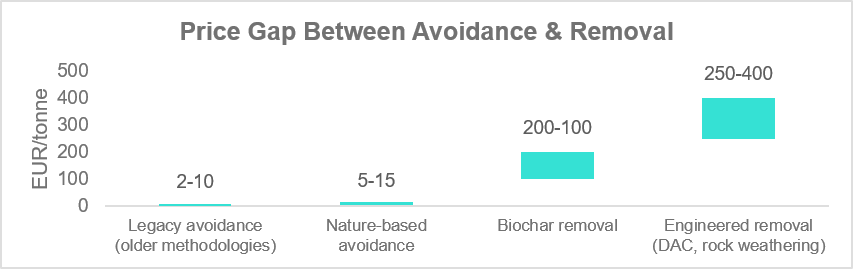
The longer view is steeper. BloombergNEF’s removal-led scenario points to prices near 42 dollars a ton in 2030 and above 250 dollars by 2037.[6] And a cheap avoidance credit that later gets downgraded does not just lose its value; it can pull a company’s public claim down with it. The price gap is about the risk you carry after you pay, not only what you pay.
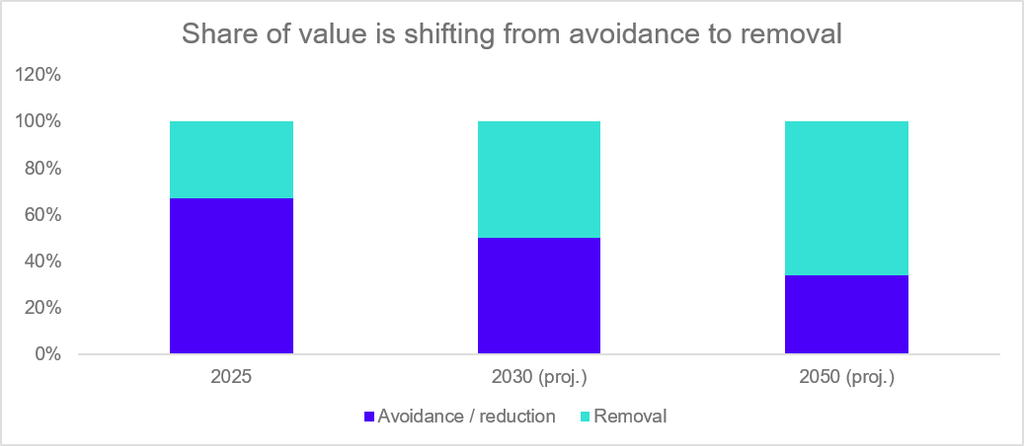
Avoidance still accounted for roughly 91 percent of 2024 retirements, but removals already lead the forward market, with offtake deals reaching about 12.25 billion dollars in 2025, up from around 4 billion in 2024.[16] MSCI expects removals’ share of market value to grow from about a third in 2024 to roughly half by 2030 and around two-thirds by 2050, as the chart below shows. The question is not whether removal overtakes avoidance, but when.
A cautionary tale and a buying spree
Take the avoidance side first, because it is the cautionary one. A synthesis of independent evaluations covering 44 REDD+ forest-protection projects found they had claimed more than ten times the avoided deforestation the data could justify.[7] Verra, the largest registry, saw its issuance fall from 131.4 million credits in 2021 to roughly 10 million by 2025.[8] When the Pacajai project was suspended, Philip Morris, Mastercard, and BlackRock were among the companies named in the public registry as having retired their credits.[9]
But this should not condemn the whole category. The over-crediting evidence concerns older methodologies, where baselines were set once and could drift far from reality. Newer ones are designed to close that gap. Verra’s VM0042 agricultural methodology, approved for the CCP label, recommends reassessing baselines every five years,[13][14] and Gold Standard’s latest agriculture methodology builds in dynamic adjustments and digital verification.[15] The lesson from REDD+ is that the baseline method matters more than the label.
Now the removal side. Microsoft contracted on the order of 45 million tons of durable removals in 2025, and by early 2026 accounted for close to 90 percent of the durable removal market. Its deals included a ten-year, one-million-ton offtake with the biochar firm Liferaft and a 1.4-billion-dollar agreement with Stockholm Exergi for bioenergy with carbon capture, signed to lock in price and give developers the confidence to build.[10]
Microsoft’s buying accelerated because its own emissions rose by more than 23 percent, driven mostly by AI and cloud.[10] Most buyers will never operate at that scale, but the logic – to match the liability with durable removal and contract it early – is what the rules are about to require of everyone else.
There is a catch. In 2026, Microsoft paused new removal purchases and later reportedly cut them by around 80 percent as AI spending surged.[11][12] A market built around one buyer is only as steady as that buyer’s plans.
Four tests for a portfolio you can defend
So, what does a buyer do with all this? Build a portfolio on purpose, one that fits the company’s net-zero date and holds up when someone outside starts asking questions. Four tests help structure that decision.
There is an internal argument to win too. Finance will ask why the offset budget went up. The honest answer is that the cheaper option carried a hidden cost – the risk of a public claim falling apart – that the market has now priced in. Framed as risk management, the shift will resonate better with a board.
|
1. Match the mix to the timeline
The removal share should rise on a planned path toward your net-zero year, not in a late, costly correction. In practice: work backward from your target year and start the removal build-up now. |
2. Treat quality as the floor
Prefer CCP-labeled or equivalent credits, and test each project for additionality, permanence, and credible measurement. In practice: a credit you cannot defend in two years is a liability, not an asset. |
|
3. Separate durable from short-lived removal
Rock and geological storage last. Forests can burn. Hold both, and tilt toward permanence as the target year nears. In practice: weight long-lived removals higher the closer you get to net zero. |
4. Cap avoidance, and be honest about it
Avoidance still funds real near-term action, but it should not stand in for reductions you have not made. In practice: set a ceiling on its share and state its role plainly. |
| Underpinning all four: keep the paperwork. A registry record showing standard, vintage, and CCP status, held with the reason you bought, turns a defensible choice into a defensible claim. | |
Price is not a proxy for quality in either direction. A higher price does not make a credit better, and a lower one does not make it weak. Judge each pathway on what it delivers and how much of it can realistically be built.
Direct air capture, for example, is durable and easy to measure, but expensive and dependent on large amounts of clean energy. Biochar uses established technology and agricultural residues, is likely to scale faster, and costs considerably less per ton. It also brings co-benefits, such as better soil health, improved management of waste biomass, and, in many designs, useful heat. Options with the greatest scale and the widest benefits deserve more weight than headline price or technological prestige would give them.
Lock in supply before the 2035 rush
Durable removal supply is limited and slow to come online. Wait until 2035 is nearly here, and you are buying whatever is left, at whatever it costs, against every other company facing the same obligation.
Forward procurement is the way around this. A multi-year offtake signed now locks in supply at today’s price and gives the developer the demand signal it needs to build. A mid-sized buyer needs only a plan for the removals it will owe and the habit of contracting a slice early rather than all of it late.
But the 2026 slowdown shows forward buying should be staged. Spreading commitments across several suppliers and pathways and avoiding contracts priced on the assumption that costs will only rise, limits exposure to a market that can move against you.
Today’s mix, tomorrow’s claim
The voluntary carbon market is settling around three things: quality, durability, and claims that can be traced and defended. The removals-versus-avoidance decision is where all three meet. It is not an ideological choice but a practical one.
For a procurement leader, the guidance comes down to a few plain moves. Build the portfolio deliberately, not by default. Weight it toward removals on a path that fits your target year. Cap avoidance, and use it honestly. Contract durable supply early, in stages. None of this needs the budget of a hyperscaler. The credits a company commits to now are the claim it will be asked to defend later.
REFERENCES
[1] Science Based Targets initiative, Deep Dive: The Role of Carbon Credits in the SBTi Corporate Net-Zero Standard V2, 2026. Available: https://sciencebasedtargets.org/blog/deep-dive-the-role-of-carbon-credits-in-sbti-corporate-net-zero-standard-v2
[2] Sylvera, SBTi Corporate Net-Zero Standard V2: What Does It Mean for the Carbon Market, 12 August 2026. Available: https://www.sylvera.com/blog/sbti-corporate-net-zero-standard-v2-what-does-it-mean-for-the-carbon-market
[3] BNP Paribas Global Markets, Carbon Credits and the SBTi Corporate Net-Zero Standard V2.0, 23 July 2026. Available: https://globalmarkets.cib.bnpparibas/sbti-net-zero-standard-carbon-credits/
[4] Senken, Carbon Removal vs Avoidance, 20 May 2026. Available: https://www.senken.io/blog/carbon-removal-vs-avoidance
[5] ClimateSeed, What are the Trends in the Voluntary Carbon Market in 2026, 4 March 2026. Available: https://climateseed.com/blog/trends-voluntary-carbon-market
[6] Senken, Understanding Carbon Markets: Carbon Credit Prices in 2026, 2026. Available: https://www.senken.io/academy/understanding-carbon-markets/carbon-credit-price
[7] E. Mitchard et al., Learning Lessons from Over-crediting to Ensure Additionality in Forest Carbon Credits, Nature Communications, 11 April 2026. Available: https://www.nature.com/articles/s41467-026-71552-3
[8] OPIS, Project REDD+ Struggles Amid Quality Push: Future of Voluntary Carbon Credits, 21 November 2025. Available: https://www.opis.com/blog/project-redd-struggles-amid-quality-push-future-of-voluntary-carbon-credits/
[9] REDD-Monitor, Verra Suspended the Pacajai REDD Project, 13 May 2026. Available: https://reddmonitor.substack.com/p/verra-suspended-the-pacajai-redd
[10] ESG Today, Microsoft Signs 1 Million Ton Carbon Removal Deal with U.S. Biochar Company Liferaft, 25 March 2026. Available: https://www.esgtoday.com/microsoft-signs-1-million-ton-carbon-removal-deal-with-u-s-biochar-company-liferaft/
[11] Heatmap News, Scoop: Microsoft Is Pausing Carbon Removal Purchases, April 2026. Available: https://heatmap.news/carbon-removal/microsoft-carbon-removal-pause
[12] BigGo Finance, citing BloombergNEF, Microsoft Slashes Carbon Removal Purchases 80% as AI Spending Surges, 14 August 2026. Available: https://finance.biggo.com/news/af96ca4c-c74a-461b-87ae-578d3d2daabf
[13] Verra, VM0042 Improved Agricultural Land Management, v2.2. Available: https://verra.org/methodologies/vm0042-improved-agricultural-land-management-v2-2/
[14] Integrity Council for the Voluntary Carbon Market, Integrity Council Approves First Sustainable Agriculture Methodologies from CAR and Verra, 30 October 2025. Available: https://icvcm.org/integrity-council-approves-first-sustainable-agriculture-methodologies-from-car-and-verra/
[15] Gold Standard, Five Methodologies Launched for Consultation, April 2026. Available: https://www.goldstandard.org/news/five-methodologies-launched-for-consultation-april-2026
[16] MSCI Carbon Markets, Carbon Credits Come of Age in 2025, 2025 (avoidance ~91% / removal ~9% of retirements; removal value outlook to 2030 and 2050). Available: https://www.msci.com/research-and-insights/blog-post/carbon-credits-come-of-age-in-2025
Author

Gokul Ragupathy


Ajay John George David
Related Reading

03 Nov, 2026
Engineering the blast: Innovation, safety, and sustainability in modern mining explosives

20 Oct, 2026
The sulfur trap - How the hydrochloric acid route can cut dicalcium phosphate costs