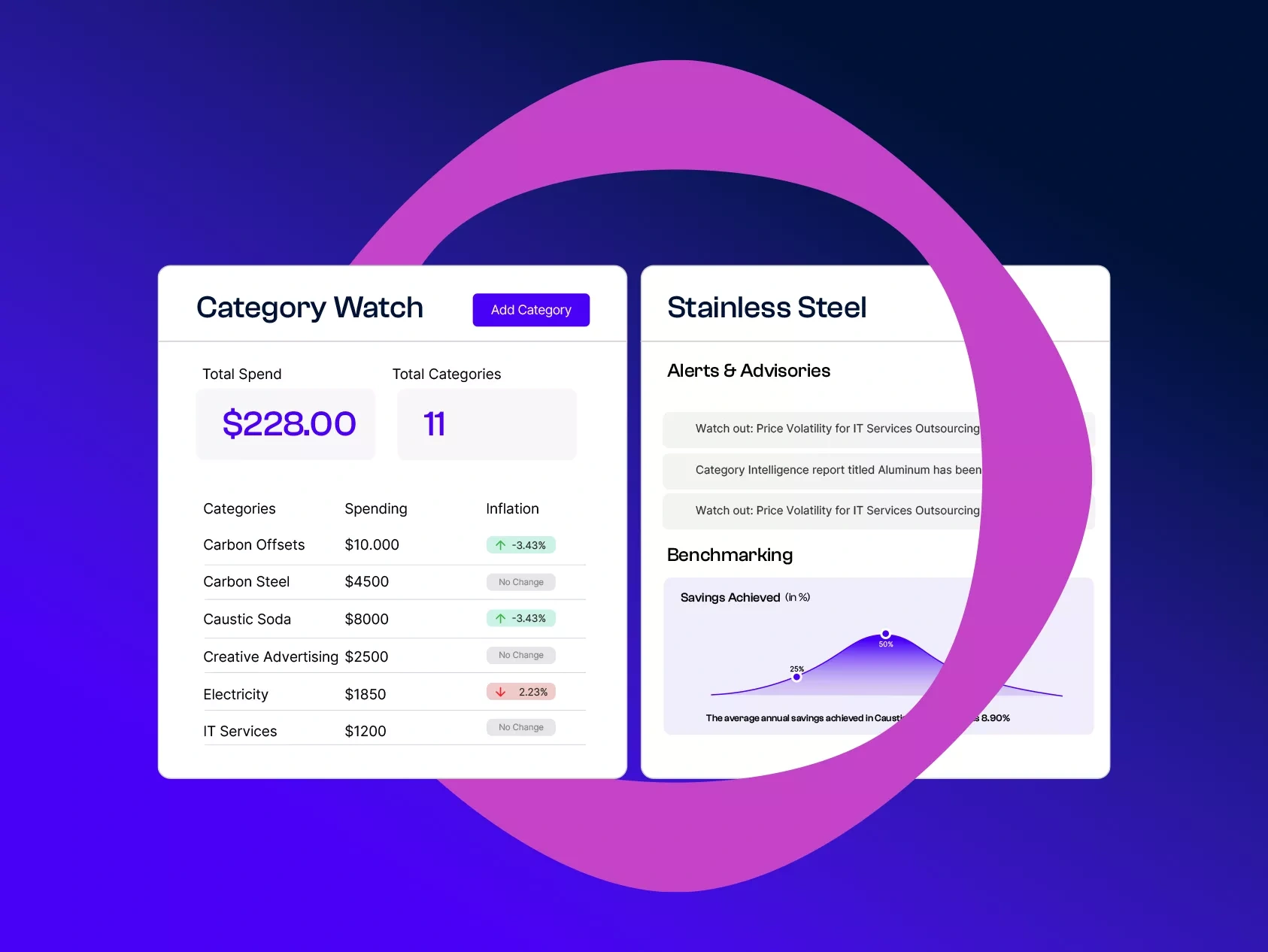
Procurement leaders are sitting on more data than ever, but the process behind making decisions that directly impact business outcomes isn’t always more straightforward as a result. Spend reports arrive late, supplier landscapes shift without warning, and category strategies built on last quarter’s assumptions are already out of date by the time they reach the leadership table. Meanwhile, cost pressures are intensifying, supply chains remain fragile, and boards expect procurement to deliver more than savings: they expect foresight.
The root of the problem is the quality of intelligence procurement teams are basing decisions on – specifically, the absence of consistent, category-level intelligence that connects market dynamics to sourcing decisions in real time. Without it, procurement defaults to reactive mode: responding to disruptions rather than anticipating them, negotiating without leverage, and making high-stakes category decisions on fragmented or outdated data.
Category intelligence changes that equation. It is the foundation on which strategic procurement is built, and increasingly, it is the capability that separates CPOs who lead the conversation from those who are led by it.
What Is Category Intelligence?
Category intelligence is the process of collecting, analysing, and applying data related to specific procurement categories to improve sourcing strategies, reduce costs, and manage risks. It combines spend data, market trends, and supplier insights to enable more informed, strategic decision-making.
Rather than treating procurement as a single function, category intelligence recognises that every spend category – from direct materials to logistics to professional services – has its own market dynamics, risk profile, cost drivers, and supplier landscape. It provides the category-specific depth that generic market research cannot.
In practical terms, category intelligence answers the questions procurement leaders actually need answered: What is driving price movement in this category? Which suppliers are gaining or losing market position? Where are the emerging risks?
Key Components of Category Intelligence
Effective category intelligence is built on several interconnected layers:
Spend and demand analysis
A granular view of what the organisation is buying, from whom, at what price, and in what volumes, broken down by category, sub-category, and business unit. This is the baseline without which no strategic conversation is possible.
Market and pricing intelligence
Continuous monitoring of commodity prices, input cost indices, capacity dynamics, and macroeconomic factors that influence category pricing. This is what enables procurement to move from reactive negotiation to anticipatory positioning.
Supplier intelligence
A structured, real-time view of the supply base – financial health, geographic exposure, operational capacity, compliance standing, and competitive positioning. This feeds both risk management and negotiation strategy.
Regulatory and risk intelligence
Tracking policy changes, trade developments, ESG requirements, and geopolitical shifts that could affect category availability, cost, or compliance obligations.
Benchmarking and should-cost modelling
The ability to compare internal pricing and contract terms against external market reality, and to model what a category should cost given current input conditions.
Why CPOs Need Category Intelligence
CPOs are under pressure from multiple directions simultaneously: finance wants cost reduction, operations wants supply security, sustainability teams want responsible sourcing, and the board wants visibility into supply chain risk. Delivering on all of these demands without category-level intelligence is structurally impossible.
Here is what category intelligence makes possible that generic procurement data cannot:
Strategic category planning
With a clear view of market dynamics and cost drivers, procurement can develop category strategies that are grounded in reality rather than assumption – with a defensible rationale for sourcing decisions, timing, and supplier selection.
Proactive risk management
Category intelligence surfaces emerging risks before they become supply disruptions. A shift in a key supplier’s financial position, a regulatory change in a source country, or a capacity tightening in a critical sub-tier.
Stronger negotiation position
Knowing what a category should cost – and being able to demonstrate it with data –fundamentally changes the negotiation dynamic. Category intelligence replaces gut feel with grounded, evidence-based positioning.
Faster, more defensible decisions
When intelligence is current, specific, and traceable to credible sources, procurement leaders can move faster and defend their decisions more confidently – be it in supplier negotiations, in stakeholder conversations, or in board-level reviews.
Measurable competitive advantage
Category intelligence enables procurement to connect sourcing decisions to commercial outcomes – tracking whether strategies are delivering the expected cost, risk, and quality impact over time.
Types of Category Intelligence Solutions
The category intelligence landscape spans a range of approaches, each with different strengths depending on organizational maturity and use case:
Research and advisory platforms provide structured category reports, market outlooks, and analyst-curated insights across specific spend categories. These are particularly valuable for categories where deep specialist knowledge is required and where the cost of building that capability in-house is prohibitive.
Spend analytics tools focus on structuring and classifying internal procurement data, providing visibility into what is being spent, with whom, and how. These are often the first layer of category intelligence infrastructure.
Supplier intelligence platforms aggregate data on supplier financial health, risk signals, compliance status, and market positioning. They are essential for vendor rationalisation, risk monitoring, and supply base development decisions.
Market data and pricing intelligence services track commodity prices, input cost indices, and supply-demand dynamics in near real time. These are most critical for categories with significant exposure to volatile raw materials or traded commodities.
Integrated category management platforms combine multiple data sources – spend, market, supplier, risk – into a single environment, reducing the fragmentation that makes category intelligence difficult to act on. Platforms like Beroe Live.ai take this further by layering AI-driven market monitoring and predictive analytics on top of curated category research, giving procurement teams a single destination for both strategic insight and real-time market signals.
Key Factors to Consider When Choosing Category Intelligence Tools
Not all category intelligence tools are created equal, and the right choice depends on the specific needs of your organization, categories, and procurement operating model. When evaluating options, consider:
Category coverage and depth
Does the solution cover the categories that matter most to your business, with genuine analytical depth, or only surface-level summaries? For highly technical or niche categories, specialist depth matters more than breadth.
Data freshness and update frequency
Intelligence that reflects last year’s conditions may be worse than no intelligence at all if it creates false confidence. Understand how frequently data is refreshed and how quickly market signals are incorporated.
Source credibility and traceability
Can claims be traced back to credible primary sources? For decision-grade intelligence, this is non-negotiable. Unverifiable assertions create liability rather than value.
Integration with the existing systems
A category intelligence solution that sits outside your existing procurement technology stack will struggle to drive adoption. Consider how it connects with your ERP, contract management, and sourcing platforms.
Actionability of outputs
The test of any intelligence solution is whether it supports a decision. Look for outputs that include clear implications, recommended actions, and directional guidance, not just data and charts.
Analyst support and expert access
For high-stakes decisions, data alone is rarely sufficient. The ability to access procurement or category specialists who can interpret signals in the context of your specific situation is a meaningful differentiator.
AI-Driven Category Intelligence: What Makes It Different?
The emergence of AI-driven category intelligence represents a genuine step change, not simply in speed, but like what is possible.
Traditional category intelligence was constrained by what analysts could physically monitor, aggregate, and synthesise. Coverage was broad but shallow, or deep but narrow. Updates were periodic. Customisation was expensive and slow.
AI changes the underlying economics and capabilities of intelligence production in several important ways:
Automated data aggregation and classification.
AI can continuously monitor and structure data from thousands of sources – news feeds, regulatory publications, supplier filings, pricing databases, trade data – across every relevant category simultaneously. What previously required weeks of analyst time can be produced in minutes.
Predictive analytics for demand and pricing trends
Machine learning models trained on historical patterns and leading indicators can identify directional signals in pricing, demand, and supply dynamics before they are visible in lagging datasets. This moves category intelligence from descriptive to genuinely predictive.
Real-time insights rather than static reporting
AI-powered platforms can surface alerts and updated intelligence as conditions change – not just on a quarterly publication cycle. For procurement teams managing volatile categories, this timeliness can be the difference between protecting margin and absorbing unexpected cost.
Continuous learning and optimization
Unlike static models, AI systems can incorporate new data, refine their signals over time, and adapt to changing market structures. Intelligence improves as conditions evolve.
The critical caveat is that AI-driven category intelligence is only as good as the data, methodology, and human expertise behind it. Volume is not the same as quality. The most effective AI-driven approaches combine the scalability of machine intelligence with the contextual judgement of category specialists – ensuring that outputs meet a genuine decision-grade standard, not just a speed and volume threshold.
Beroe Live.ai is built on this principle: combining AI-powered data aggregation across thousands of sources with analyst-validated category insights, so procurement teams get intelligence that is both fast and defensible.
Checklist: How to Evaluate Category Intelligence Solutions
Use this checklist when assessing any category intelligence tool or provider:
Coverage and relevance
- Does it cover your priority categories with genuine depth?
- Is the geographic coverage aligned with your sourcing markets?
- Does it address the specific sub-categories and cost drivers relevant to your business?
Data quality and integrity
- Are sources credible, named, and traceable?
- How frequently is data refreshed?
- Is there a clear methodology for resolving conflicting data?
Actionability
- Do outputs include clear implications and recommended actions?
- Can intelligence be customised to your organization’s specific context?
- Is there guidance on negotiation approach, timing, and risk mitigation?
Technology and integration
- Does the platform integrate with your existing procurement systems?
- Is the user experience accessible to category managers, not just data specialists?
- Does it offer alerting and real-time monitoring capabilities?
Expert access and accountability
- Can you access category specialists for high-stakes decisions?
- Is there a named analyst or transparent methodology behind key outputs?
- Is there accountability for the accuracy and quality of intelligence provided?
Frequently Asked Questions
Category intelligence in procurement is the systematic collection, analysis, and application of data specific to individual spend categories – such as raw materials, logistics, or IT services. It combines market trends, supplier data, spend analysis, and risk signals to help procurement teams make more informed, strategic sourcing and category management decisions.
Category intelligence improves sourcing decisions by replacing assumptions and intuition with evidence. It gives procurement teams a clear view of market pricing dynamics, supplier positioning, and emerging risks – enabling better negotiation preparation, more accurate should-cost modelling, and earlier identification of supply chain vulnerabilities.
Category intelligence tools include spend analytics platforms, market and pricing intelligence services, supplier risk monitoring solutions, procurement research and advisory platforms, and integrated category management systems. Increasingly, these tools are AI-powered, enabling real-time data aggregation, predictive analytics, and automated alerting across multiple categories simultaneously.
For most procurement organizations managing complex or volatile categories, yes. AI-driven category intelligence dramatically expands the volume of data that can be monitored, accelerates the speed at which insights are produced, and enables predictive signals that static reporting cannot provide. The key is to ensure that AI output is validated by domain expertise and meets a decision-grade standard for high stakes decisions – speed without accuracy creates risk rather than value.
CPOs should invest in category intelligence because procurement strategy is only as strong as the intelligence behind it. Without category-level visibility into market dynamics, cost drivers, supplier health, and emerging risks, procurement defaults to reactive decision-making. Category intelligence enables CPOs to lead with foresight, defend decisions with evidence, and deliver measurable value – in cost, risk, and supply resilience – to the wider organization.
Related Reading