
The global workforce is undergoing a major transformation as organizations shift from traditional employment models to more flexible and dynamic talent strategies. In 2026, contract workers have become a key part of workforce planning, helping organizations respond to economic uncertainty, technological change, and evolving skill needs. This reflects a broader move toward agile workforce models that combine permanent employees with contingent talent.
Drawing on industry, staffing, and regulatory insights, this blog explores the key market drivers, adoption trends, and the role of technology in managing this workforce. It also reviews regulatory developments in the European Union and the United States, along with their implications for managing contingent labor. Finally, it highlights key challenges, best practices for procurement leaders, and a forward-looking view on how contract work will shape the future of work.
Global Trends and Market Dynamics
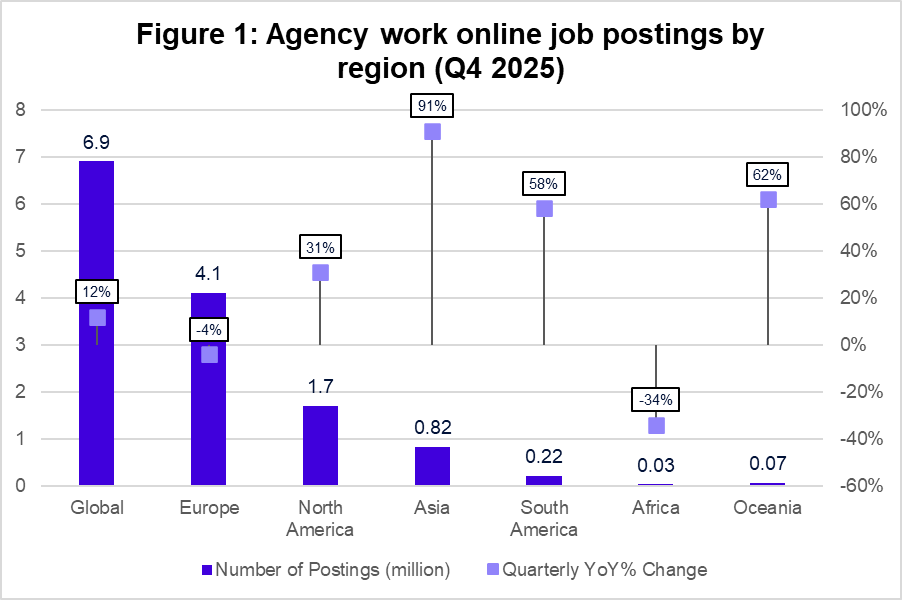
The global labor market in 2026 is defined by hybrid workforce models that blend full-time employees with contingent talent. Driven by macroeconomic uncertainty, digital transformation, and specialized skill demands, organizations are increasingly adopting flexible staffing as a strategic tool rather than a stopgap measure [7]. The following chart illustrates the distribution of agency work and highlights regional variations in job postings and growth dynamics.
Source: World Employment Confederation
Technological Orchestration
Technology is the backbone of modern contingent workforce management. VMS and AI-driven talent platforms now manage the full contractor lifecycle from sourcing and onboarding to performance tracking and payment, providing real-time visibility for informed decision-making [6].
Key next-generation orchestration capabilities include:
- AI-powered candidate matching: ML algorithms score candidates from agency, direct-source, and gig pools in real time, reducing time-to-fill [8].
- VMS as data foundation and middleware: VMS platforms with open APIs unify ATS, HRIS, ERP, and finance data into a single workforce view for AI-driven decisions.
- Predictive workforce analytics: AI forecasting predicts contingent demand 90–180 days ahead using project pipelines, seasonal trends, and attrition data [8].
- Total talent management integration: Unified dashboards spanning permanent, contract, freelance, and SOW spend replace fragmented, siloed tracking [2].
Shifting Regulatory Environment for Contingent Labor in 2026
Both the EU and the US are advancing significant regulatory changes affecting temporary and contract labor, making compliance a strategic priority in 2026.
European Union: The EU Platform Work Directive (2024/2831) came into force in December 2024 and must be transposed by December 2026 [4]. It establishes a rebuttable presumption of employment where control indicators are met and mandates human oversight of algorithmic decisions affecting workers.
United States: The regulatory environment for contract labor in the United States remains dynamic, with significant shifts at both federal and state levels. Federal enforcement of the 2024 Department of Labor (DOL) independent contractor rule has been paused, with authorities reverting to a more flexible “economic reality” test while a revised rule is under consideration in 2026 [5].
Complexities of the Contingent Workforce Management in 2026
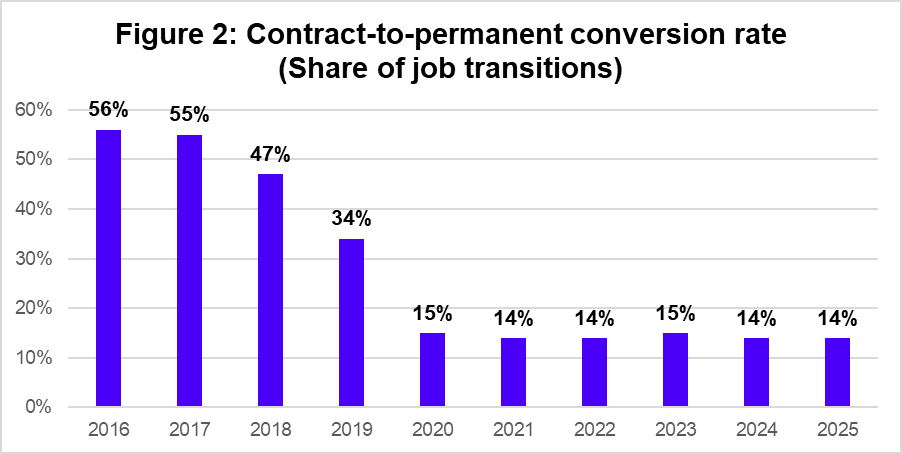
- Dynamics of contract-to-permanent conversion: While the contingent workforce model offers significant advantages in terms of flexibility and cost efficiency, the declining trend in contract-to-permanent conversion rates has fallen from over 50% pre-2019 to roughly 14-15% today. Organizations increasingly treat contract roles as standalone solutions rather than permanent pipelines, enhancing agility but creating risks to knowledge continuity [1].
Source: LinkedIn Economic Graph
Worker misclassification and co-employment risk: Direct control over contractor activities can trigger reclassification by EU and UK authorities, exposing organizations to retrospective benefit liabilities, pension contributions, and potential discrimination claims.
Fragmented technology and data governance: Contingent workers managed across disconnected platforms, agencies, and spreadsheets create fragmented workforce visibility, slowing hiring cycles and increasing overspend and misclassification risk [2].
Looking Ahead to the Future of Contract Work
Contract work will continue to grow in strategic importance. As hybrid models mature, the boundary between permanent and contract roles is blurring, with contingent workers increasingly contributing to high-value, knowledge-driven functions and innovation [9]. The table below compares the near-term outlook and indicates the expected direction into 2026 based on the observed shift from pre-pandemic to post-pandemic usage.
Table 2: Agency / Contingent Worker Usage by Industry with Near-Term Outlook
| Industry Sector | Pre-Pandemic (%) | Post-Pandemic (%) | Near-Term Outlook | Near Term Outlook |
| Administrative & Support Services | 81% | 93% | +12 pp | Stay Strong |
| Financial Services | 55% | 90% | +35 pp | Stay Strong |
| Hospitals and Health Care | 78% | 86% | +8 pp | Gradual rise |
| Manufacturing | 62% | 93% | +31 pp | Stay Strong |
| Professional Services | 73% | 82% | +9 pp | Gradual rise |
| Technology, Information, and Media | 65% | 75% | +10 pp | Stay Strongh7 |
Best Practices for Managing a Contingent Workforce for Procurement Managers
Procurement managers must treat contingent workforce management as a strategic function. Leading practices include:
- Build a total talent management infrastructure: Integrate VMS with HR, finance, and ERP to achieve unified visibility across all worker categories.
- Embed classification governance into programme design: Assess worker classification at every engagement start; use VMS alerts to monitor tenure and flag reclassification risk.
- Build talent communities for critical skills: Curate pools of alumni contractors and referrals to accelerate re-engagement and reduce agency dependency.
- Leverage data analytics as a strategic tool: Track spend, fill rates, and attrition data; share quarterly dashboards with HR and finance to align contingent strategy with business goals.
Conclusion
Contract workers have evolved from a flexible labor option into a critical strategic asset. Organizations must balance flexibility, cost efficiency, and access to skills with challenges such as integration, compliance, and engagement. Procurement and HR leaders should leverage contingent talent through modern platforms and skills-based sourcing, recognizing that contract workers are adopting AI skills faster than the broader workforce.
The EU Platform Work Directive must be implemented by December 2026, while US classification rules continue to evolve. Organizations that build strong compliance governance early will scale their contingent programs with confidence. Those that treat contract workers as talent assets, managed with the same data-driven approach as permanent employees, will gain the greatest competitive advantage as flexibility becomes essential.
About Beroe
Beroe is a global SaaS-based procurement intelligence and analytics provider. We deliver intelligence, data, and insights that enable companies to make smarter sourcing decisions leading to lower cost, reduced risk, and greater profits. Beroe has been a trusted source of intelligence for more than 15 years and presently partners with 10,000 companies worldwide, including 400 of the Fortune 500 companies.
Learn more about Beroe https://www.beroeinc.com
References
[1] P. Kory Kantenga, “The State of Staffing & Search,” LinkedIn & ASA, 2026.[Online].
[2] K. Alvarez, “Why 2026 marks a turning point for contingent programs,” SIA, February 2026. [Online].
[3] “Why Are Companies Increasingly Using Contingent Workers?” AMS, 2026. [Online].
[4] “EU Employment Law Changes 2026,” Workwell Global, 2026. [Online].
[5] “US Employment Law Updates 2026,” Workwell Global, 2026. [Online].
[6] “Global Staffing Industry Trends 2026,” Workwell Global, 2026. [Online].
[7] W. Burgess, “Contingent Workforce Statistics You Need to Know in 2025,” Conexis VMS, 2025. [Online].
[8] D. Chaplin, “How workforce models are evolving in 2026,” SIA, January 2026. [Online].
[9] “The Future of Contingent Labor,” Compunnel Inc., [Online].
[10] “The Rise of Contract & Flexible Talent: Building Your 2026 Workforce Strategy,” Mavenside, February 2026. [Online].
[11] “Hiring in Human Resources (Contract): Guide and Trends in 2026,” Robert Walters, November 2025. [Online].
[12] Rob, “Why Temporary Recruitment Is a Strategic Workforce Tool in 2026,” PE Global, February 2026. [Online].
Author

Balakrishnan B

Related Reading

20 Oct, 2026
The sulfur trap - How the hydrochloric acid route can cut dicalcium phosphate costs