Beroe Live.ai
 Abi - AI Assistant
 1. Category Watch
 Category Insights
 Alerts & Advisories
 Benchmarking
 Geopolitical Alerts
 Sourcing Location Optimizer
 2. Supplier Watch
 Supplier Discovery
 Supplier Risk Monitoring
 Supply Chain Disruptions
 3. Inflation Watch
 Cost & Price Intelligence
 Commodity Analytics
 4. Risk Watch
 Supplier Risk Monitoring
 Supply Chain Disruptions
 Geopolitical Alerts
 DataHub
 Global Sourcing Analyst
 All Resources
 News
News Events
 Webinar
 White Paper
 In The Press
 Leadership
 Beroe Live.ai


Across Asia, the Middle East, Africa, Australia, and Eastern Europe, healthcare systems are scaling, industrial policies are evolving, and governments are prioritizing domestic innovation, manufacturing resilience, and regulatory reform. These regions collectively referred to here as the “East” represent not just incremental biopharma expansion opportunities but structural growth frontiers. However, expansion into these markets is not a straightforward replication of Western commercialization models. Regulatory divergence, localization mandates, tender-driven procurement systems, reimbursement variability, and geopolitical realignments create a fundamentally different operating environment. In this context, competitive advantage will depend on the ability to architect strategic collaboration across regulatory, procurement, manufacturing, digital, and public-sector ecosystems. In the East, collaboration is not a support function, but a market entry strategy. [1] [2] [3] Healthcare demand across Eastern markets is accelerating under the weight of several converging macro drivers:
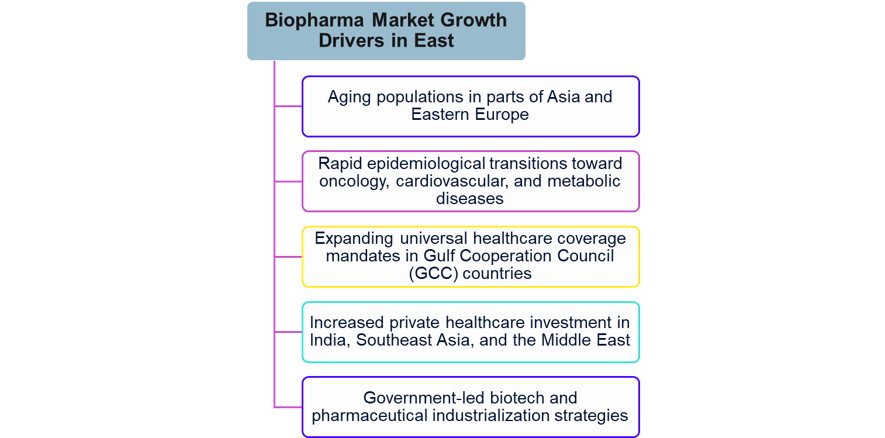
Figure 1: Biopharma Market Growth Drivers in East
Source: World Pharma Today [4]
Structural Complexities That Redefine Expansion Strategy
While growth potential is significant, Eastern markets are characterized by structural friction that challenges traditional expansion playbooks.
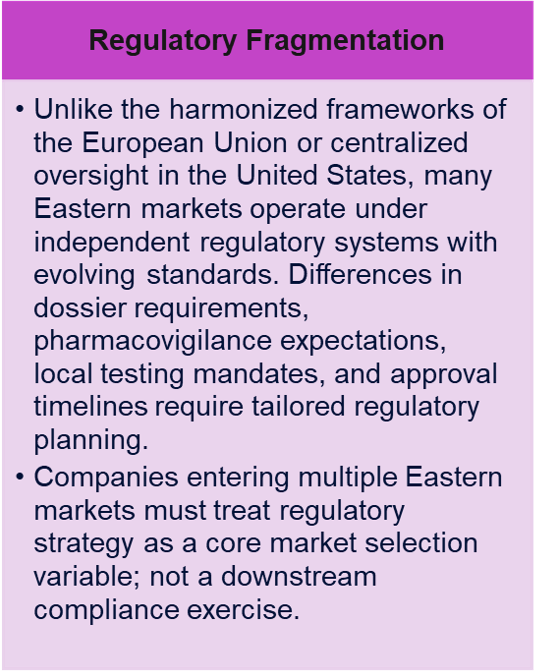
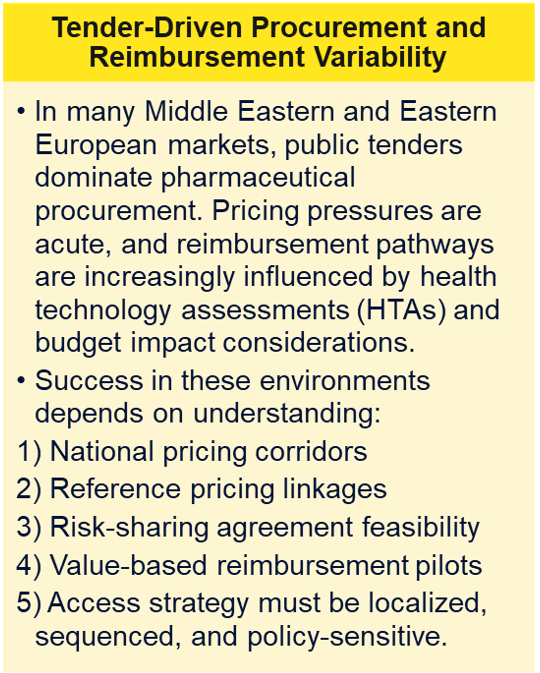
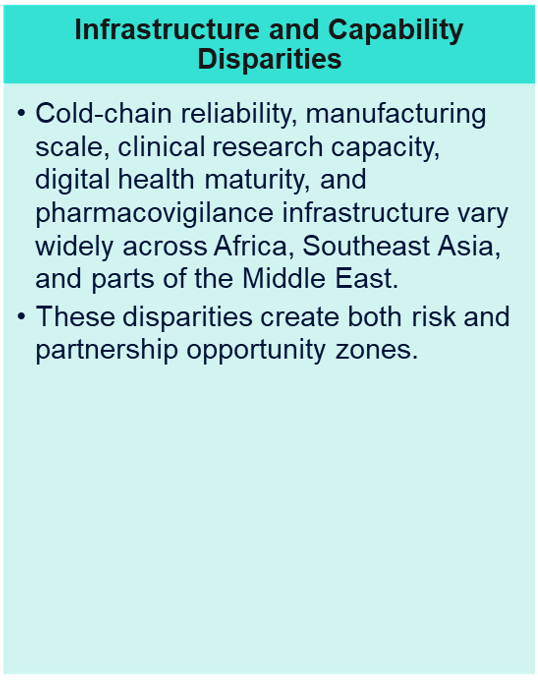
Figure 2: Challenges in the Expansion Strategy in Eastern Biopharma Markets
Source: APAC, IQVIA, Business Wire [6], [2], [7]
Why Strategic Collaboration Is the Core Growth Lever
The complexity of Eastern markets necessitates a shift from transactional market entry models toward ecosystem-driven strategies.
1. Local Partnership as Risk Mitigation
Distribution-only relationships are increasingly insufficient. Companies must evaluate multi-layer partnerships that include:
- Regulatory advisory alliances
- Regional CRO collaborations
- Manufacturing or fill-finish joint ventures
- Local pharmacovigilance partnerships
These structures mitigate compliance risk, improve tender positioning, and strengthen government alignment [8].
2. Manufacturing and Localization Alliances
Industrial policies in Saudi Arabia, the UAE, Turkey, and Egypt increasingly incentivize or mandate local production. Technology transfer and co-manufacturing agreements enhance credibility with regulators and policymakers while improving supply chain resilience. Strategic sourcing decisions now intersect directly with market access. [9] [10]
3. Public-Private Partnerships (PPPs)
Governments across the East are open to PPPs [11] in areas such as:
- Vaccine production
- Oncology center development
- Rare disease screening initiatives
- Digital health infrastructure
The Procurement Imperative: From Cost Control to Ecosystem Orchestration
Procurement in Eastern markets must evolve from centralized cost optimization towards ecosystem orchestration.
Traditional Procurement Lens vs. Eastern Market Reality
Traditional procurement models emphasize global supplier consolidation, volume leverage, and standardized contracting. In contrast, Eastern markets demand:
- Regionally adaptive sourcing
- Supplier evaluation based on regulatory capabilities
- Risk-adjusted value assessment
- Policy-aware supplier selection
- Technology transfer readiness
Procurement leaders must now evaluate suppliers not only on price and quality but also on:
- Local government relationships
- Compliance infrastructure
- Data localization adherence
- Supply resilience
Procurement plays a critical role as a strategic market entry function, necessitating a thorough evaluation of suppliers based on several key criteria. Suppliers must demonstrate readiness for regulatory inspections from major authorities such as the FDA, EMA, and WHO, alongside an ability to facilitate technology transfer. Additionally, expertise in biologics manufacturing is essential, particularly in light of geopolitical supply risks that could impact stability. As the landscape of procurement evolves, strategic sourcing emerges as a decisive factor in various operational aspects. It significantly influences the speed of localization efforts, enhances eligibility for government tenders, and reinforces long-term supply resilience. [12] [2] [13] [14]
Regional Collaboration Archetypes:
| Region | What’s shifting | Where collaborations are most critical | Possible market friction |
|---|---|---|---|
| Asia (India, China, South Korea, Southeast Asia) | • Asia is increasingly a dual engine: (1) global R&D and innovation (China, Korea), and (2) manufacturing scale combined with cost advantage (India). • A strong “build and partner” pattern is emerging: global pharma taps Asian CDMOs for capacity, while Asian biopharma partner outward for late-stage development and commercialization. | • Scale manufacturing / external capacity (Korea’s mega-biologics capacity; India’s vaccine and biologics scale). • Co-development and cross-border licensing as Asian innovators increasingly feed global pipelines (e.g., major oncology/ADC deals). • “Make-in-country” partnerships in India (manufacturing partnerships tied to access and endemic disease burden). | • Regulatory and access heterogeneity across APAC (different evidence expectations, HTA maturity, local clinical data preferences). • Increasing emphasis on data localization and local trial footprints in certain markets. |
| Middle East (Saudi Arabia, UAE, Qatar, Oman, etc.) | • The Middle East is moving from “import dependence” toward industrial policy and localization (manufacturing, fill-finish, packaging, tech transfer). • Governments are using healthcare transformation programs to accelerate public-private partnership (PPP) models, especially around resilience and local capability. | • Localization JVs / manufacturing transfer and supply agreements tied to national objectives (e.g., Saudi Arabia local production ambitions). • Government–industry research partnerships (Abu Dhabi’s push for RWE, clinical research, and precision medicine partnerships). • Regional commercialization partnerships to access fragmented MENA markets efficiently. | • Tender-heavy procurement and evolving reimbursement systems. • Regulatory modernization is progressing, but market-by-market nuances still drive timelines and evidence needs. |
| Africa | • Africa’s biopharma collaboration momentum is heavily shaped by vaccine/biomanufacturing capacity building and health security, often supported by multilaterals and global partnerships. • Partnerships increasingly combine infrastructure, tech transfer, and clinical development rather than pure commercial distribution. | • mRNA manufacturing networks and tech transfer initiatives (WHO-backed programs and company-led networks). • Outbreak preparedness partnerships that redesign manufacturing cost and cold-chain requirements for LMIC contexts. | • Variability in regulatory capacity, cold chain, and lab infrastructure. • Complex funding environments and long timelines for capacity ramp. |
| Australia | • Australia is increasingly positioned as an APAC development hub (clinical trials and regulatory credibility) plus a strategic node for sovereign manufacturing in vaccines/advanced platforms. • Government-backed partnerships are catalyzing mRNA ecosystem building and domestic production. | • Public-private manufacturing ecosystem partnerships (Moderna and Australian government/Victoria; onshore mRNA capability). • Platform licensing and next-gen vaccine technology collaborations (e.g., CSL Seqirus access to mRNA platform technologies). | • High expectations on evidence quality and procurement scrutiny (even when governments pursue strategic manufacturing investments). |
| Israel | • Israel remains a high-density innovation ecosystem (especially digital health/biotech adjacency) and participates in global regulatory and development initiatives to accelerate access and align standards. | • Regulatory collaboration frameworks that accelerate review pathways and align with global clusters (e.g., participation in FDA initiatives). • Commercialization partnerships for biosimilars and specialty products spanning Israel and broader regions. | • Small market size and price-sensitive reimbursement, creating tight negotiation dynamics with major health funds. • Regulatory and procurement complexity, with evolving alignment to global standards but variable timelines and evidence expectations. |
| Eastern Europe (Poland, Czech Republic, Hungary, Romania, etc.) | • Eastern Europe is evolving as a manufacturing and external supply extension of Europe, with growing interest in biologics/advanced modalities and selective innovation clusters (e.g., Czech biotech, Hungarian pharma). • The region increasingly attracts partnerships in ADC platforms, licensing, and manufacturing footprint expansion. | • Platform and pipeline partnerships (Czech-based SOTIO’s antibody/ADC collaborations). • Cross-border BD alliances for accessing global pipelines and capital (e.g., Richter’s partnerships to expand footprint). • Market access/commercial licensing in Central/Eastern Europe. | • Price sensitivity, reference pricing dynamics, and variable reimbursement speed across countries. • For some markets, expansion is driven as much by industrial footprint as by commercial growth. |
Figure 3: Regional collaboration Archetypes
Source: EY, IQVIA, Logic Consulting, Middle East Events, Pharma Board Room; [15] [2] [13] [16] [14]
Asia accounts for more than 40% of the global clinical trials, establishing itself as a key center for the development of biologics and advanced therapies. In alignment with this trend, Saudi Arabia’s Vision 2030 focuses on promoting pharmaceutical localization, with ambitious plans to significantly enhance domestic drug manufacturing by the decade’s end. Furthermore, the African CDC (Africa Centres for Disease Control and Prevention) has initiated the Partnership for African Vaccine Manufacturing (PAVM), which is geared towards the goal of producing 60% of the continent’s vaccines locally by the year 2040. This operational strategy reflects a broader movement within these regions to bolster local capacities in drug production and healthcare innovation. [1] [2] [13]
Recent key biopharma collaborations in the East
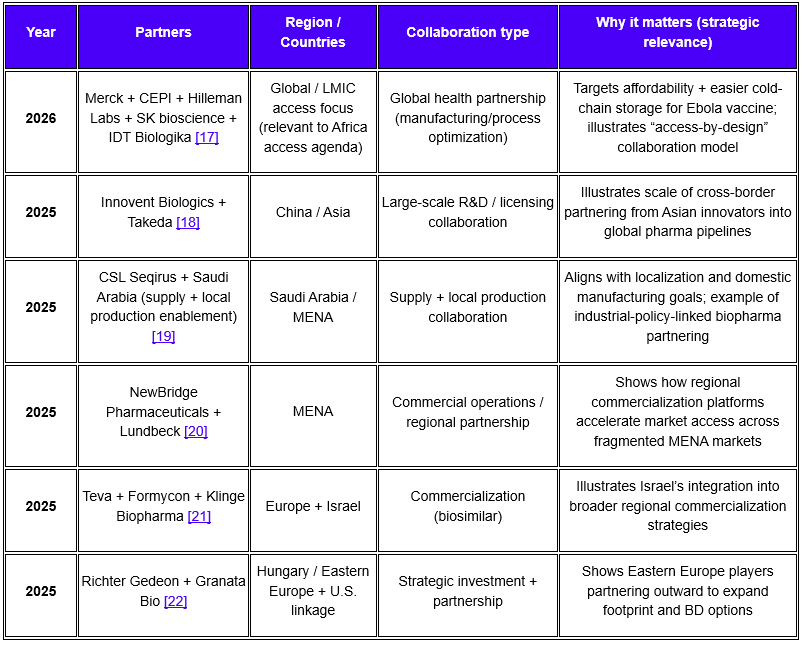
Figure 4: Key Biopharma Partnerships
Strategic Recommendations for Biopharma Leaders
- Adopt an Ecosystem Entry Model: Market entry in Eastern regions should move beyond single-distributor or purely commercial arrangements. Companies should proactively map and engage regulatory authorities, local manufacturers, CROs, digital health partners, and government stakeholders early in the planning process. An ecosystem approach improves alignment with national priorities and reduces downstream compliance, access, and supply chain risks.
- Embed Regulatory Strategy in Market Prioritization: Regulatory complexity varies significantly across Eastern markets, making approval pathways a critical determinant of launch sequencing. Companies should assess data localization requirements, local clinical trial expectations, pharmacovigilance infrastructure, and review timelines before committing capital. Regulatory planning must shape commercial strategy, not follow it.
- Align with National Industrial and Healthcare Policy: Many Eastern markets are embedding healthcare within broader economic diversification agendas. Understanding localization mandates, technology transfer expectations, and domestic manufacturing incentives is essential to securing government goodwill and long-term positioning. Partnerships that support national capacity-building goals are more likely to receive regulatory and procurement support.
- Strengthen Local Intelligence Infrastructure: Competitive landscapes in these regions are evolving rapidly, particularly with the rise of regional innovators and biosimilar manufacturers. Continuous monitoring of regulatory updates, reimbursement reforms, tender dynamics, and pipeline activity is essential to remain adaptive. Local intelligence reduces strategic blind spots and enhances negotiation leverage in tender-driven environments.
- Develop Flexible Commercial Structures: Tender-heavy procurement systems and reference pricing mechanisms require adaptable commercial models. Companies should balance public tender participation with private sector growth channels where feasible. Incorporating value-based agreements or risk-sharing structures may strengthen positioning in markets with tightening healthcare budgets.
- Build Policy-Sensitive Supply Chains: Geopolitical shifts and industrial policies increasingly influence sourcing decisions. Diversifying API suppliers, exploring regional manufacturing hubs, and integrating local fill-finish capacity can reduce exposure to trade disruptions and compliance delays. Supply chain design should reflect not only cost efficiency but also regulatory and political stability
- Sequence Market Expansion Strategically: Rather than entering multiple markets simultaneously, companies should prioritize sequencing based on regulatory efficiency, infrastructure readiness, and partnership maturity. For example, Australia may serve as a clinical development hub, GCC markets as PPP scale-up environments, India as a manufacturing anchor, and Eastern Europe as a regional EU-adjacent access platform. Strategic sequencing enhances capital efficiency and operational focus. [2] [12] [14]
Alignment as the New Growth Currency
The East is not a uniform expansion landscape; it is a mosaic of policy-driven, rapidly evolving healthcare ecosystems. In this environment, speed without alignment creates fragility. Portfolio breadth without partnership depth creates exposure.
The organizations that will lead the next decade of biopharma growth are those that:
- Integrate regulatory and procurement strategy early
- Co-create value with governments
- Architect resilient, localized supply networks
- Treat collaboration as infrastructure, not optional enhancement
Biopharma expansion in the East will not be defined by the fastest market entrants, but by organizations capable of building deeply integrated innovation, manufacturing, and policy ecosystems.
References:
- McKinsey, https://www.mckinsey.com/industries/life-sciences/our-insights/the-emerging-epicenter-asias-role-in-biopharmas-future
- IQVIA, https://www.iqvia.com/-/media/iqvia/pdfs/mea/white-paper/localization-of-pharmaceutical-manufacturing-in-middle-east-and-north-africa-region.pdf
- UPA, https://upa.gov.eg/international-collaborations-and-strategic-alliances/
- World Pharma Today, https://www.worldpharmatoday.com/articles/whats-driving-the-growth-of-the-biopharma-sector-across-south-east-asia/
- Nature, https://www.nature.com/articles/d43747-025-00130-1\
- APAC, https://www.apac-asia.com/groups/ra/publications.html
- Business Wire, https://www.businesswire.com/news/home/20250710194113/en/State-of-the-Biopharmaceutical-Industry-Mid-Year-2025-Report—Emerging-Industry-Trends-Regulatory-and-Macroeconomic-Trends-Emerging-Technologies-Watch-Outs—ResearchAndMarkets.com
- Mc Kinsey, https://www.mckinsey.com/industries/life-sciences/our-insights/building-a-shared-vision-for-pharma-r-and-d-supplier-partnerships
- Pharma Business Partners, https://pharmabp.com/insight/the-localization-imperative-navigating-the-new-localization-requirements-in-saudi-arabia/
- Manhom, https://manhom.com/en/news/globalpharma-inks-4-strategic-mous-during-make-it-in-the-emirates-2025-to-boost-pharma-localization-and-innovation-in-the-uae/
- World Health Expo, https://www.worldhealthexpo.com/insights/medical-laboratory/building-biotech-hubs-the-middle-east-s-biomanufacturing-evolution
- BioSpectrum Asia, https://www.biospectrumasia.com/article/pdf/25270
- Logic consulting, https://logic-consulting.com/wp-content/uploads/2025/10/Pharma-Investment-Map-in-the-Middle-East-Africa.pdf
- Pharma Board Room, https://pharmaboardroom.com/articles/localised-manufacturing-for-economic-diversity-health-security/
- Ernst & Young, https://www.ey.com/en_us/newsroom/2025/06/ey-2025-biotech-beyond-borders-report-biopharma
- Middle East Events, https://www.middleeastevents.com/blog/globalpharma-inks-4-strategic-mous-during-make-it-in-the-emirates-2025-to-boost-pharma-localization-and-innovation-in-the-uae/
- Reuters, https://www.reuters.com/business/healthcare-pharmaceuticals/merck-partners-with-global-health-coalition-develop-affordable-ebola-vaccine-2026-01-21/
- Reuters, https://www.reuters.com/business/healthcare-pharmaceuticals/chinas-innovent-signs-114-billion-cancer-therapy-deal-with-japans-takeda-2025-10-22/
- Fierce Pharma, https://www.fiercepharma.com/manufacturing/csl-vax-unit-pact-supply-saudi-arabia-cell-based-flu-shots
- New Bridge Pharmaceuticals, https://www.nbpharma.com/news
- Pearce IP, https://www.pearceip.law/2025/01/13/teva-and-klinge-formycon-partner-to-commercialise-aflibercept-biosimilar-in-eu-and-israel/
- IntelliNews, https://www.intellinews.com/hungary-s-richter-expands-us-footprint-with-strategic-investment-in-biopharma-company-380994/
- BioNTech, https://investors.biontech.de/news-releases/news-release-details/biontech-and-cepi-expand-partnership-strengthen-africas-mrna
- Takeda, https://www.takeda.com/newsroom/newsreleases/2024/collaboration-to-accelerate-access-to-dengue-vaccine/
- Sotio, https://sotio.com/news-publications/news/sotio-enters-into-multi-target-antibody-agreement-with-biocytogen-to-expand-adc-pipeline
- Samsung Biologics, https://samsungbiologics.com/media/company-news/samsung-biologics-and-pfizer-announce-collaboration-for-manufacturing-of-biosimilars-portfolio
- Fierce Pharma, https://www.fiercepharma.com/pharma/samsung-biologics-just-days-after-pfizer-deal-inks-novartis-production-pact-worth-391m
- BioSpectrum Asia, https://www.biospectrumasia.com/analysis/86/23075/big-pharma-sets-sights-on-middle-east-.html
- Yahoo Finance, https://finance.yahoo.com/news/orgenesis-announces-collaboration-agreement-sctbio-113000359.html
- Moderna, https://s29.q4cdn.com/435878511/files/doc_news/2022/03/23/Moderna-Finalizes-Strategic-Partnership-with-Australian-Government-2022.pdf
- CSL Seqirus, https://www.cslseqirus.us/news/csl-enters-licensing-agreement-arcturus-therapeutics-next-gen-mrna-vaccine-technology
- Eversana, https://www.eversana.com/2021/07/29/israel-embarks-on-partnership-with-fdas-project-orbis-generic-drug-cluster/
- Biofrontera, https://www.biofrontera.com/en/investors/financial-announcements/corporate-news/pta-news-biofrontera-ag-biofrontera-enters-into-license-and-supply-agreement-with-medac-for-the-marketing-of-ameluzr-in-poland
Author

Aiswariya Chidambaram

Aishwarya Natarajan
Related Reading

22 Jul, 2026
Why AI will make primary research more valuable: A pharma R&D procurement intelligence perspective

20 Jul, 2026
Rebalancing engineering design delivery - onshore vs. offshore strategies in construction procurement