
Skills deficits pose challenges for developers and engineering firms
The engineering and design services market is expected to grow at a CAGR of 7-8% between 2026 and 2030, with engineering and design services making up 10-20% of the total construction cost in certain complex projects.[1] However, owner-developers and engineering firms face growing skills gaps – almost 73% of firms worldwide have problems finding talented engineering personnel.[2] To meet demand, businesses are using flexible delivery strategies and innovative procurement methods to balance local expertise with global resources, driven by labor costs, skill constraints, and technology.
Which delivery models are construction organizations using?
- Onshore delivery, done in the project location, ensures quality control and compliance but has higher costs and potential scaling issues.
- Offshore delivery (where certain packages are outsourced to low-cost geographies), reduces costs and enhances scalability but risks communication and quality problems.
- Hybrid delivery merges onshore oversight with offshore execution for balanced cost and quality, relying on effective governance and knowledge sharing.
Table 1: Onshore vs. offshore delivery model
| Parameter | Onshore | Offshore |
|---|---|---|
| Labor Cost | High | Low |
| Potential Savings | Low | High |
| Time Zone Alignment | High | Low |
| Regulatory Compliance | Low | High |
| Scalability | Low | High |
| IP / Data Security Risk | Low | Moderate |
| Quality Assurance | High | Moderate |
Source: Beroe Analysis
What structural deficits are facing the global construction industry?
The global construction industry is facing a structural workforce deficit that shows no signs of abating. The U.S. civil engineer and architect outlook from 2024 to 2034 is expected to have a growth rate of 4-6%. Each year, around 186,500 openings are predicted in these occupations due to job growth and the need to replace workers who leave permanently.[3] The United Kingdom faces a comparable structural issue. The UK civil engineering sector faced worsening skills shortages between 2022 and 2024, with skills-shortage vacancies rising 84% from 3,200 to 5,900. This contrasts with the wider economy, where hard-to-fill vacancies due to skill gaps fell by over 50% to 250,500.[4] Table 2 compares civil engineering billing rates in the US, Germany, and the UK with lower rates in offshore countries like Brazil, the Philippines, and India, where rates are less than half of those in Europe and North America. Due to skill shortages and rising costs in the West, the engineering and design services procurement model is shifting.
Table 2: Comparison of billing rates/hr for civil engineers
| Country | USD/hr | Comparison to | ||
| US | UK | Germany | ||
| US | 113.57 | 1.00 | 1.03 | 1.04 |
| UK | 110.79 | 0.98 | 1.00 | 1.01 |
| Germany | 109.17 | 0.96 | 0.99 | 1.00 |
| Brazil | 37.19 | 0.33 | 0.34 | 0.34 |
| India | 14.48 | 0.13 | 0.13 | 0.13 |
| Philippines | 11.96 | 0.11 | 0.11 | 0.11 |
Note: The billing rates include compensation, insurance, and bonuses.[5]
Digital enablement supports efficiencies, but also requires new skillsets
- Building Information Modeling: Building Information Modeling (BIM) has transformed engineering design by enabling global collaboration in digital environments. Tools like Revit improve coordination and documentation, enhancing project efficiency. AI-enabled BIM can reduce design time by 50% and material costs by 20% through optimization.[6] [7] Cloud-based BIM platforms and CDEs enable seamless collaboration for onshore and offshore teams with real-time data access and better project governance.
- AI-powered design and documentation: AI is revolutionizing design through automation of take-offs, compliance checks, structural design, and cost estimation, enhancing accuracy and enabling offshore teams to produce quality documentation. Integrating AI with BIM and cost systems aligns quantities with databases, cutting errors and boosting efficiency, in turn broadening outsourcing opportunities.[8]
Picking the right strategy for engineering design jobs
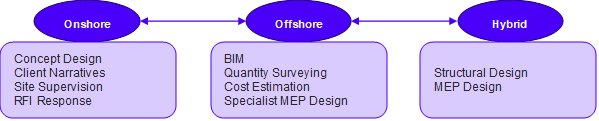
Not all engineering design jobs suit offshore delivery. Effective outsourcing begins with a work package taxonomy that matches design jobs to delivery models based on complexity, regulation, coordination, and IP sensitivity. Figure 1 illustrates suitable delivery models for design packages.
Figure 1: Delivery models for packages
Source: Beroe Analysis
Key offshore countries
Major regions dominate the global offshore engineering design industry due to technological expertise and talent availability. India remains the leader with a strong STEM talent pool and delivery centers like AECOM and Jacobs. The Philippines excels in architectural drafting and BIM, bolstered by good English proficiency. Latin American countries benefit from time-zone compatibility with North America, while Eastern European nations offer strong engineering skills and alignment with Europe. Procurement teams should prioritize talent quality, communication, scalability, compliance, and total cost of ownership over labor costs.
What does an implementation path for offshore delivery look like?
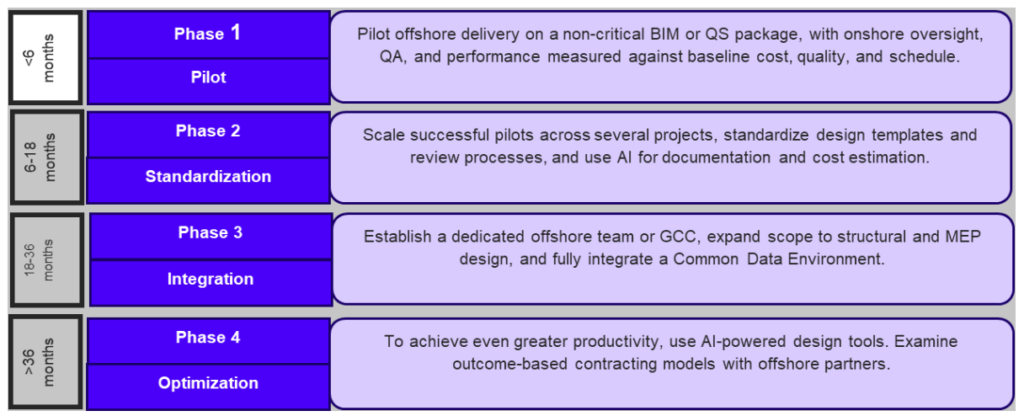
Organizations new to offshore delivery receive the best results by implementing a phased adoption plan that gradually builds capabilities rather than trying a wholesale transformation. Figure 2 gives the phased implementation approach for adopting offshore delivery in engineering design services.
Figure 2: Implementation approach
Source: Beroe Analysis
Procurement considerations for the offshore model delivery
Careful monitoring of quality, security, and regulatory requirements is necessary for offshore engineering delivery.
The real reason offshore delivery goes wrong: Clients often blame offshore BIM failures on skills gaps, but the real issue is unclear success criteria. Each project should start with an EIR document outlining required digital information. Without it, offshore teams work on assumptions, causing mismatched expectations. Following ISO 19650 ensures clear requirements and accountability, leading to better outcomes and reduced rework costs.
The problem with how offshore BIM quality is measured: In offshore BIM delivery, clash detection is key, but lower clash counts can be deceptive. A 90% reduction in clashes may still lead to rejection if foundational data is poor. Important indicators for predicting acceptance without revisions include first-time acceptance rates, formal queries from construction, and the fabrication team’s ability to use drawings directly. While difficult to measure during procurement, these indicators are vital for evaluating engagement value.
A role that is rarely in the contract but always needed: Most construction projects appoint someone for model coordination, but few clarify who structures the information for post-completion use. One role creates a buildable model, while the other produces an Asset Information Model that complies with the COBie standard for facility management. Without clear roles, the owner risks receiving an unusable model at handover, leading to significant data collection costs impacting the facilities management budget.
Data security is almost always underspecified in offshore contracts: Standard confidentiality agreements often inadequately address the risks of sharing sensitive project files offshore, especially in healthcare and government sectors. Varying regional legal requirements, like GDPR and U.S. export controls, necessitate that procurement contracts mandate ISO 27001-compliant data hosting and define access permissions, transfer protocols, and deletion policies before project initiation.
Why rate is the wrong primary evaluation criterion: Choosing offshore BIM and VDC providers solely on hourly rates can increase overall costs due to poor delivery. Lower rates often overlook expenses from revisions, miscommunication, and incomplete handovers. To estimate total costs, assess providers on quality processes, senior accountability, and past successes, as those without effective governance may prioritize marketing over delivery.
The hidden cost of appointing a large offshore firm: Procurement teams assume larger offshore firms have lower delivery risk, yet their size introduces structural risks. Large firms reallocate resources, disrupting client relationships and productivity as new members need to learn projects. Contracts rarely address this cost, emphasizing deliverables over team stability. To mitigate risks, procurement should require senior staff, minimum commitment periods, and documented knowledge transfer for personnel changes.
The geography switching problem: Large offshore firms reassign experienced teams to maximize value in response to opportunities, often burdening original clients with training costs for new teams. This benefits firms with shared resources but disrupts continuity for those with focused practices.
Strategically managing the shift
Engineering design delivery is moving from onshore to offshore due to long-term fundamentals rather than trends. Offshore design delivery has become crucial in construction procurement due to labor shortages, growing labor prices, and technological infrastructure that removes geographical restrictions. While only 27% of AEC companies currently use AI, and 43-52% still rely on paper-based procedures, 94% of AI users intend to increase adoption despite worries about data security and AI laws, improving hybrid onshore-offshore delivery efficiency and fostering digital cooperation.[9] The question of whether offshore engineering delivery is effective is no longer relevant to leaders in construction procurement since the evidence is overwhelming. Now, the emphasis is on strategically managing the shift and making sure procurement rules strictly regulate hybrid delivery in order to manage its risk profile.
References
[1] R. Yuen, “Monograph,” 13 February 2026. [Online].
Available: https://monograph.com/blog/architectural-engineering-fee-estimating-guidelines.
[2] O. O’Mahony, “Manpower,” 27 May 2026. [Online].
Available: https://www.manpowergroup.ie/blog/2026/05/global-engineering-world-of-work-outlook-2026?source=google.com.
[3] “Bureau of Labor Statistics,” [Online].
Available: https://www.bls.gov/ooh/architecture-and-engineering/civil-engineers.htm.
[4] A. Borrett, “Financial Times,” 24 July 2025. [Online].
Available: https://www.ft.com/content/4b980cf2-5c0d-4a07-8e06-12e134269549?syn-25a6b1a6=1.
[5] “Salary Expert,” [Online].
Available: https://www.salaryexpert.com/salary.
[9] “Bluebeam,” 28 October 2025. [Online].
Available: https://press.bluebeam.com/2025/10/new-bluebeam-report-shows-early-ai-adopters-in-aec-seeing-significant-roi-despite-uneven-adoption/.
Author

Kumara Raja G


Ishan Advait
Related Reading

27 Aug, 2026
Pharmacovigilance outsourcing and global talent arbitrage: A procurement guide to cost, capability, and country choice