Why pharmacovigilance outsourcing is a talent decision
Post-marketing safety is one of the more nuanced categories in life-sciences procurement, combining a service contract, a specialist talent market, and regulatory accountability the sponsor retains. Each of those shapes where global delivery adds value. Combined, they explain why sourcing decisions in this category rest on more than the hourly rate.
The scope is broad: adverse event intake, ICSR processing, medical review, literature surveillance, signal detection, aggregate reporting, risk management, and pharmacovigilance compliance. Volumes keep climbing and regulators keep asking for more. Sponsors have responded by pushing the work into global capability centers, offshore delivery teams and specialist vendors, usually all three at once.
This article looks at that shift from a procurement seat. Where does global talent arbitrage lower cost, where does it quietly raise risk, and what belongs in a fully loaded cost model beyond the hourly FTE rate?
You will find a country-by-country scorecard across talent availability, cost advantage, pharmacovigilance maturity, regulatory proximity and language value; indicative FTE rates by role and region; and a way to sort each post-marketing activity into offshore delivery, a center of excellence, or sponsor-retained.
Which skills each post-marketing safety activity needs
Talent needs vary by function. Some activities require structured process knowledge, accuracy, and quality discipline, while others demand medical, epidemiological, regulatory, analytical, and scientific expertise. Key post-marketing functions include ICSR case processing, medical review, aggregate safety reporting, signal management, risk management, scientific communication, compliance, quality, and technology-enabled pharmacovigilance. These activities require layered talent, ranging from foundational operational skills to specialized strategic expertise. [3].
However, when considering the post-marketing activities from an HR perspective, the nature of the activities demands various degrees of expertise. Activities such as ICSR processing that are volume-intensive can be carried out by life sciences graduate candidates, while medical reviews, signal detection, reporting, and risk assessment activities can be done by experienced persons who are familiar with the clinical and pharmacovigilance aspects. The current job market shows a growing need for employees who have knowledge of global regulations and practical exposure to pharmacovigilance processes, including Argus and ARISg, along with digital skills. With technological developments within the pharmacovigilance sector, emphasis is being put on hiring people who have industry expertise along with pharmacovigilance and digital skills.
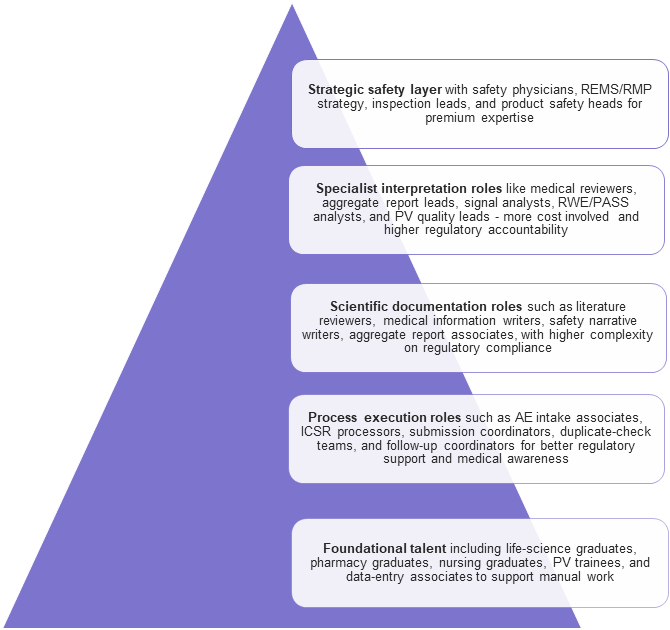
The below pyramid showcases hierarchical talent layers starting from the bottom as foundational skills to the top as a strategic specialized layer.
The pharmacovigilance talent pyramid: foundational, functional and strategic layers
Structured competency frameworks combining theory, practice, and reference materials help define training pathways and assess capability progression across proficiency levels. [4]
How geography changes pharmacovigilance cost, capability and regulatory fit
Geography shapes post-marketing talent through cost, skills availability, regulatory familiarity, language, time-zone fit, digital maturity, and life-sciences ecosystem strength. Many regions are building internal hubs to retain knowledge, improve governance, and develop long-term capabilities. [3] [5]
Talent availability is assessed at three levels;
- Size of the workforce
- Relevance of workforce to post-marketing functions
Country evaluation:
| Country | Talent availability | Cost advantage | PV / post-marketing maturity | Regulatory proximity | Technology / analytics maturity | Language / regional value |
|---|---|---|---|---|---|---|
| United States | 5 | 1 | 5 | 5 | 5 | 3 |
| India | 5 | 5 | 4 | 3 | 4 | 4 |
| United Kingdom | 4 | 2 | 5 | 5 | 4 | 4 |
| Germany | 4 | 2 | 5 | 5 | 4 | 4 |
| France | 4 | 2 | 5 | 5 | 4 | 4 |
| Switzerland | 3 | 1 | 5 | 5 | 5 | 4 |
| Mexico | 3 | 4 | 3 | 3 | 3 | 5 |
| Poland | 3 | 4 | 4 | 4 | 3 | 5 |
| Philippines | 4 | 5 | 3 | 3 | 3 | 5 |
| Singapore | 3 | 1 | 4 | 5 | 5 | 4 |
| Japan | 3 | 1 | 5 | 5 | 4 | 5 |
Legend: 1 -Low; 2 – Low to Medium; 3- Medium; 4 – Medium to High; 5 -High
Source: Beroe Analysis
Each country has different sourcing strengths;
- India provides best overall cost savings balance of scale, cost, and capability
- U.S., UK, Germany, France, Switzerland, Japan, Singapore have high capability and regulatory value, lower cost-savings
- Poland has a strong nearshore balance for EU-facing work
- Philippines is strong for intake, contact-center, and healthcare BPO-oriented post-marketing work
What pharmacovigilance really costs: fully loaded rates versus headline FTE rates
Cost arbitrage remains a key outsourcing driver, but should be assessed on a fully loaded basis, including employment, infrastructure, technology, transition, vendor, and compliance costs. [8] [5]
High-volume standardized work, such as case intake, literature screening, data entry, and quality checks, offers the highest savings potential. Mid-complexity work such as aggregate reporting and medical information writing provides moderate savings but requires stronger oversight. High-complexity activities such as signal management, benefit-risk assessment, QPPV oversight, and senior medical review offer limited direct savings but can benefit from global support models. [8] [5]
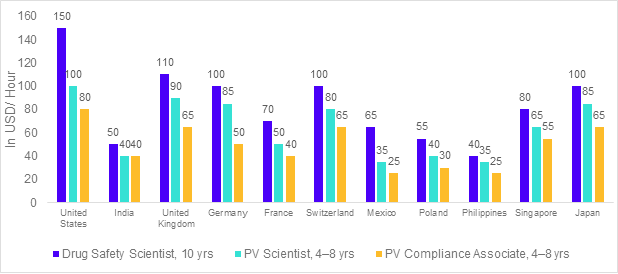
The below is an average comparison of Base FTE rates (In USD/ Hour) for three major job roles in Pharmacovigilance and Safety services across various regions
Source: Beroe Analysis, Hays and Michael Page Salary Guides
Organizations should not look for countries where low salaries are paid but should rather focus on markets which have better capability levels and give better value for money. For instance, it makes sense to hire operational positions in volume for low salaries in countries such as India, but it is never feasible to hire high-level medical and scientists’ positions as inflation for these positions is evergreen. While dealing with the total cost of hiring, organizations should analyze the time taken for hiring, the tenure of the employee, the time required for training, and the actual knowledge level of the employee.
The FTE rates can be directionally indicative in all regions. Hiring costs are multifactorial and include GCC, CRO, Pharma, Consulting, City, Experience, Niche Therapy, and technology skills among others.
Moving ahead, the most successful models will combine global talent with automation, AI, workflow platforms, and real-world evidence capabilities. [9] [4]
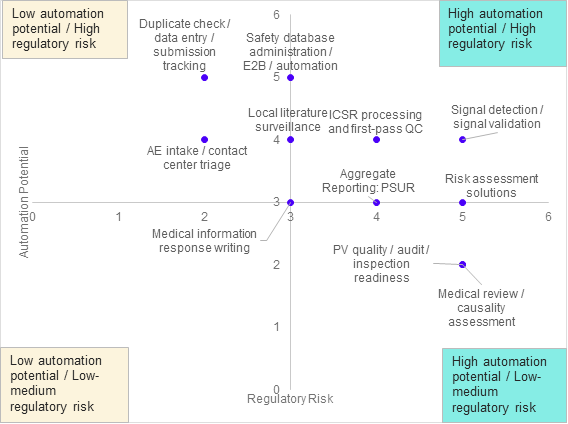
In post-marketing operations, technology supports AE intake, duplicate detection, narrative drafting, literature screening, translation, submissions, reconciliation, quality review, and signal prioritization – shifting, not replacing, human expertise [4]. The chart below compares the need for automation and the regulatory risk impacting the service.
Regulatory risk vs automation potential of pharmacovigilance tasks
Source: Beroe Analysis
The following quadrant inference leads to better decision-making:
| Segment | Example functions | Implication |
|---|---|---|
| High automation / low-medium risk | AE intake, duplicate checks, data entry | Strong potential for automation to improve efficiency, reduce manual effort, and increase scalability |
| High automation / high risk | ICSR processing, literature screening | Automation can significantly enhance productivity, but robust validation, governance, and expert review are required |
| Low automation / medium risk | Medical information, aggregate report support | Human expertise remains important for contextual interpretation and stakeholder communication, with automation serving mainly as a support tool |
| Low automation / high risk | Signal validation, QPPV, benefit-risk | Activities rely heavily on expert judgment, scientific evaluation, and accountability |
The most effective operating models will combine global talent pools, process standardization, automation, AI-enabled workflows, strong medical oversight, and risk-based quality governance.
Automation is affecting the kind of talent that is hired, not reducing the number of people required. Tasks such as AE intake, duplication check, literature screening, and data entry are becoming more amenable to automation. However, firms hire experienced personnel for tasks like medical review, signal detection, benefit-risk assessment, and regulatory decision making. Scientific and accountability considerations are vital for these tasks. Future hiring will depend on how well the candidates are able to collaborate with AI and automation platforms.
How to choose the sourcing model for each post-marketing activity
The key action is to classify each post-marketing activity by volume, standardization, medical complexity, regulatory risk, and technology-readiness before deciding the sourcing model.
- High-volume standardized activities such as AE intake, duplicate checks, data entry, follow-up coordination, submission tracking, reconciliation, and first-pass quality checks are best suited for offshore delivery and automation.
- Knowledge-process activities such as ICSR processing, literature surveillance, medical information writing, aggregate report drafting, safety database support, signal-detection support, and RWE analytics should be centralized in Global Centers of Excellence rather than fragmented vendor models.
- High-risk activities such as signal validation, benefit-risk strategy, QPPV oversight, REMS/RMP strategy, safety labelling decisions, inspection leadership, and final medical review should remain close to sponsor accountability or senior expert hubs.
- Technology should improve productivity, traceability, and consistency, but not replace human judgment in safety-critical decisions. [11]
The future of talent outsourcing will see the following shifts:
- Outsourcing will move toward differentiated global hub capabilities such as medical writing, signal analytics, RWE, safety technology, automation governance, quality management, and benefit-risk support
- Companies will use a portfolio of country roles, with mature markets retaining strategic oversight and senior safety leadership, while nearshore/offshore locations support case processing, analytics, multilingual services, and regional coverage.
- AI, automation, NLP, workflow platforms, and RWE platforms will reduce manual effort in intake, duplicate detection, coding, narrative drafting, and submission tracking.
- Post-marketing safety will move beyond passive AE reporting, requiring epidemiologists, RWE analysts, safety database experts, and AI governance professionals. [4] [3] [5]
AI and automation will reduce manual effort, but they will increase the need for skilled human oversight and regulatory accountability.
Recruitment strategies should be designed depending on the intricacies of each post marketing function. Standardized, high volume activities should be offshored, while unique centers of excellence should be set up for scientific and analytic functions. Simultaneously, companies should engage in continuous upskilling to prepare their personnel for AI-enabled pharmacovigilance, real-world evidence, and safety analytics.
The future recruitment landscape will focus on capabilities, not headcounts. Medical writers, signal management experts, RWE analysts, pharmacovigilance technology specialists, quality management, and AI governance experts are likely to be in high demand. Automation is expected to decrease the number of manual tasks but increase the number of highly skilled professionals who could validate the results, control compliance, and make decisions about patient safety.
What this means for your next pharmacovigilance sourcing decision
Global talent outsourcing in clinical post-marketing functions is entering a new phase – moving from low-cost execution to intelligent capability delivery. High-volume work will move to offshore and automated hubs, while regional language and regulatory work will move to nearshore and local-market pods. Senior medical judgment, benefit-risk decisions, QPPV oversight, and inspection accountability will remain with experienced sponsor and regional safety leaders. [4] [3] [9].
The most successful life-sciences companies’ value will come from combining the right geography, the right skill level, the right technology, and the right governance model for each post-marketing activity.
From a talent management perspective, employee expenses do not constitute the sole criterion for outsourcing success any longer. Organizations will weigh their choice of delivery locations depending on talent quality, regulations know-how, digital readiness, language skills, and scalability. Those countries which will be capable of cultivating skilled PV professionals and continuously training them will continue to be the favored choice for global post-market operations.
Today’s real challenge is finding and retaining experienced professionals who have gained 8-15 years’ experience in Medical Review, Signal Detection, Aggregate Reporting, PV Quality, Risk Management, and Safety Leadership. The greater the expansion of Global Capability Centers becomes, the fiercer the war for experienced professionals grows.
References
[1] World Health Organization, “Regulation and Prequalification,” [Online]. Available: https://www.who.int/teams/regulation-prequalification/regulation-and-safety/pharmacovigilance.
[2] USA Food and Drug Administration, “FDA Adverse Event Reporting System (FAERS) Database,” 06 09 2017. [Online]. Available: https://www.fda.gov/drugs/drug-approvals-and-databases/fda-adverse-event-reporting-system-faers-database.
[3] N. Agarwal, A. Singh and H. Modi, “Reimagining life sciences Global Capability Centers,” August 2025. [Online]. Available: https://www.ey.com/content/dam/ey-unified-site/ey-com/en-in/pdf/2025/ey-reimagining-life-science-s-global-capability-centers.pdf.
[4] A. Astravans, B. Podraza, J. C. Deng, Z. Milner, S. Sachdeva and S. Turben, “Improving health care with global capability centers: The benefits of AI and machine learning in health care,” 2025. [Online]. Available: https://www.deloitte.com/us/en/services/consulting/articles/global-capability-centers-in-health-care.html.
[5] OECD, “Health at a Glance 2025 OECD Indicators,” 2025. [Online]. Available: https://www.oecd.org/en/publications/health-at-a-glance-2025_8f9e3f98-en/full-report.html.
[6] EY India, “India emerges as lifesciences GCC hub; nearly half of top 50 global firms establish presence, with significant entries in past 5 years: EY analysis,” 01 September 2025. [Online]. Available: https://www.ey.com/en_in/newsroom/2025/09/india-emerges-as-life-sciences-gcc-hub-nearly-half-of-top-50-global-firms-establish-presence-with-significant-entries-in-past-5-years.
[7] Polish Investment and Trade Agency, “The life science sector in Poland,” 2025. [Online]. Available: https://www.paih.gov.pl/wp-content/uploads/2025/05/The-life-science-sector-in-Poland-2025.pdf.
[8] HAYS, “HAYS SALARY GUIDES,” [Online]. Available: https://www.haystalentsolutions.com/resources/hays-salary-guides.
[9] A. Hegde, “IQVIA: How AI is reshaping pharmacovigilance through regulatory guidance,” 09 2025. [Online]. Available: https://www.iqvia.com/blogs/2025/09/how-ai-is-reshaping-pharmacovigilance?utm_source=chatgpt.com.
[10] European Medicines Agency, “DARWIN EU,” [Online]. Available: https://darwin-eu.org/.
[11] World Health Organization, “Global Health Workforce statistics database,” [Online]. Available: https://www.who.int/data/gho/data/themes/topics/health-workforce.
Author

Monica Nandagopal


V Srikanth
Related Reading