The productivity paradox of AI in research
Artificial intelligence has moved from prospective to operational in pharma R&D. The IQVIA Institute’s Global R&D Trends 2026 report found that AI-enabled drug development programs at emerging biopharma companies are showing improved clinical success rates relative to non-AI-enabled programs of comparable size and segment. Almost USD 10 billion in AI/ML deals were announced in 2024, with an increasing number of trials involving AI-focused companies, according to the IQVIA Institute. [1,3]
This adoption is real and accelerating, but it has created a paradox for the market intelligence industry. The same large language models that help analysts summarize documents, draft reports, and synthesize published data are equally available to every competitor, every client, and every supplier. When a capability becomes universally accessible, it stops being a differentiator. The question for any intelligence function is therefore not whether AI can do research – it is which kinds of research retain value when AI can perform them instantly and at near-zero marginal cost.
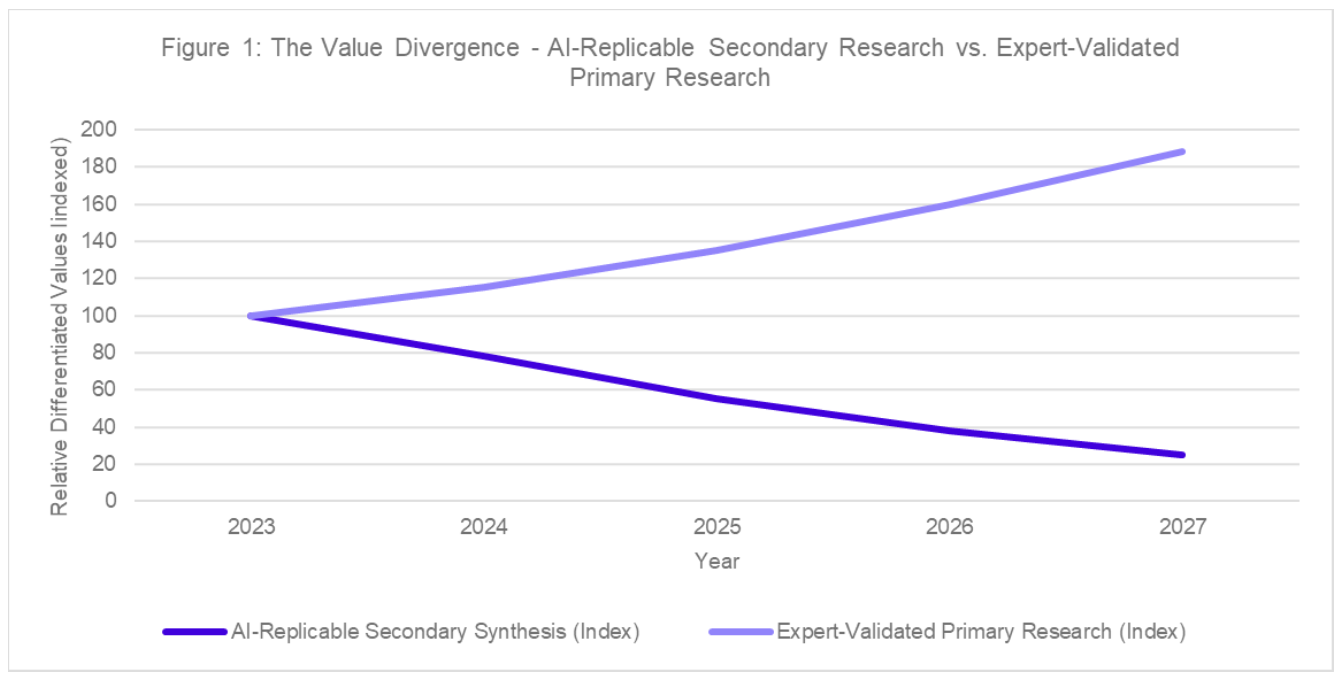
Source: Beroe analysis. Conceptual depiction of directional relationship. Underlying AI-adoption context: IQVIA Institute, Global R&D Trends 2026.
Where AI is strong and where it structurally fails
To understand where human primary research retains value, it is necessary to be precise about the documented limitations of current AI systems. Peer-reviewed research published in 2025 and 2026 has established clear boundaries.[4,5]
A comprehensive survey of hallucination in large language models, published in 2026, defines hallucination as the generation of content that is fluent and syntactically correct but factually inaccurate or unsupported by external evidence – and notes that this undermines reliability specifically in domains requiring factual accuracy. Critically, research on AI hallucination has found that hallucinations persist even when a model is given the source material, because summarization is still a generative act that fills gaps unless tightly constrained. [4]
The fundamental issue is one of information availability. An AI model can only synthesize information that exists in its training data or in documents provided to it. For pharma R&D procurement, the most decision-critical information does not exist in any published form: what a CDMO actually charges per batch, how long a comparator drug genuinely takes to source today, whether a supplier’s stated capacity reflects available trained personnel, or how a contract was really structured. This information lives only in the minds of practitioners and is accessible only through direct human engagement. [4,5]
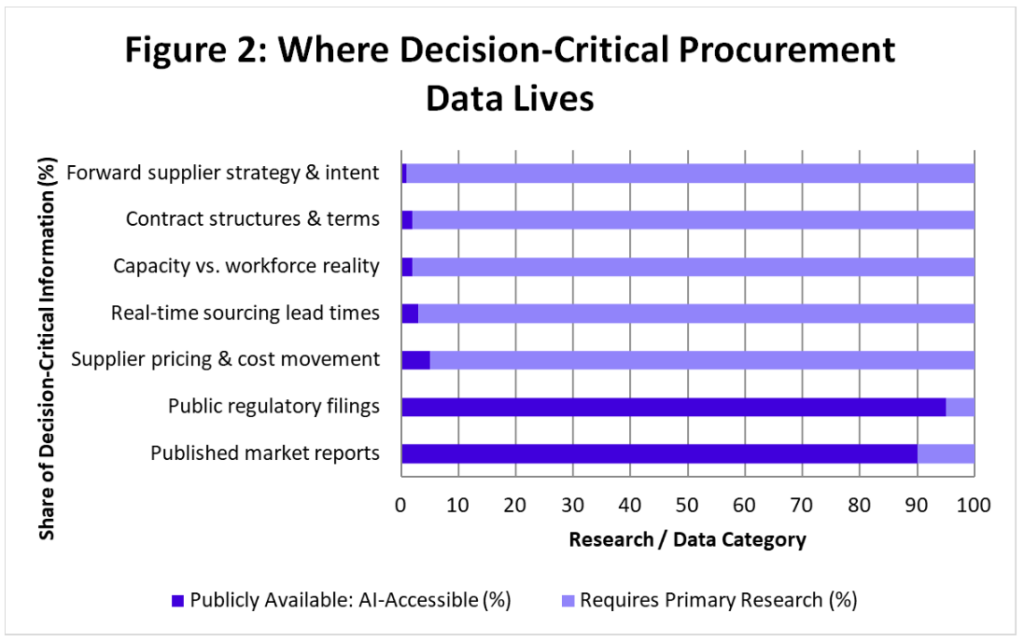
Source: Beroe analysis. AI-limitation context: ScienceDirect (Large Language Models Hallucination: A Comprehensive Survey, 2026); Frontiers in Artificial Intelligence (2025).
Table 1: AI Capability vs. Primary Research Necessity in Procurement Intelligence
| Research Task | AI Capability | Primary Research Necessity |
|---|---|---|
| Summarizing published market reports | High – fast and low cost | Low |
| Synthesizing public regulatory filings | High | Low |
| Current supplier pricing & cost movement | None – data not published | Essential |
| Real-time sourcing lead times | None – data not published | Essential |
| Supplier capacity vs. workforce reality | None – data not published | Essential |
| Contract structures & commercial terms | None – confidential | Essential |
| Forward supplier strategy & intent | None – not yet documented | Essential |
The market is already pricing this in
If primary research were being devalued by AI, the market for accessing primary sources would be contracting. The opposite is happening. The global market for services built around connecting decision-makers with primary human sources: expert networks, primary research panels, and custom sourcing – continues to grow at double-digit rates, even as AI adoption has accelerated across every industry.
Beroe analysis of this market finds a consistent directional pattern: organizations are not reducing their spend on accessing human experts as AI capability improves. They are increasing it – precisely because AI has made undifferentiated secondary synthesis abundant, and abundance reduces value. What remains scarce, and therefore valuable, is verified, current, source-attributable primary intelligence. This is the clearest available market signal that primary research is appreciating in value, not depreciating.
Why pharma R&D procurement is different
Pharma R&D procurement intelligence is a domain where the gap between published data and decision-critical data is unusually wide. Several structural features make it especially resistant to AI substitution.
1. The most important data is structurally private
Comparator drug pricing, clinical packaging cost per kit, CDMO manufacturing slot availability, and core lab turnaround times are commercially sensitive and almost never published. No volume of AI training data contains them, because they do not exist in public text.
2. The market is moving faster than any published source can track
The IQVIA Institute reported that end-to-end clinical development timelines increased in 2025, reversing recent improvements, while oncology trial starts declined overall by 4% between 2024 and 2025. In a market shifting this quickly, by the time information is published it is already dated – primary research is the only way to capture the current state.[1,2]
3. Geopolitical and regulatory resets are redrawing supplier networks
The industry is actively moving away from purely cost-efficient, just-in-time models toward resilience through diversification and regionalization, including multi-region sourcing strategies that extend beyond the established China-plus-one approach, according to industry analysis published in 2026. Each such shift creates new supplier qualification questions that only direct engagement can answer.[6]
The right model: AI as force multiplier for primary research
The conclusion is not that AI is irrelevant to research – it is that AI and primary research are complements, not substitutes. The highest-value intelligence function in 2026 uses AI to handle what AI does well, freeing human capacity to concentrate on what only humans can do.
In practice, this means using AI to accelerate the preparatory and synthesis layers of research – desk scanning, document summarization, interview guide drafting, and structuring of findings – while reserving human effort for the irreplaceable core: designing the right questions, building supplier and expert relationships, conducting the interviews, and validating what is heard against multiple sources. AI compresses the time spent on the commoditized layer so that more time can be spent on the differentiated one.
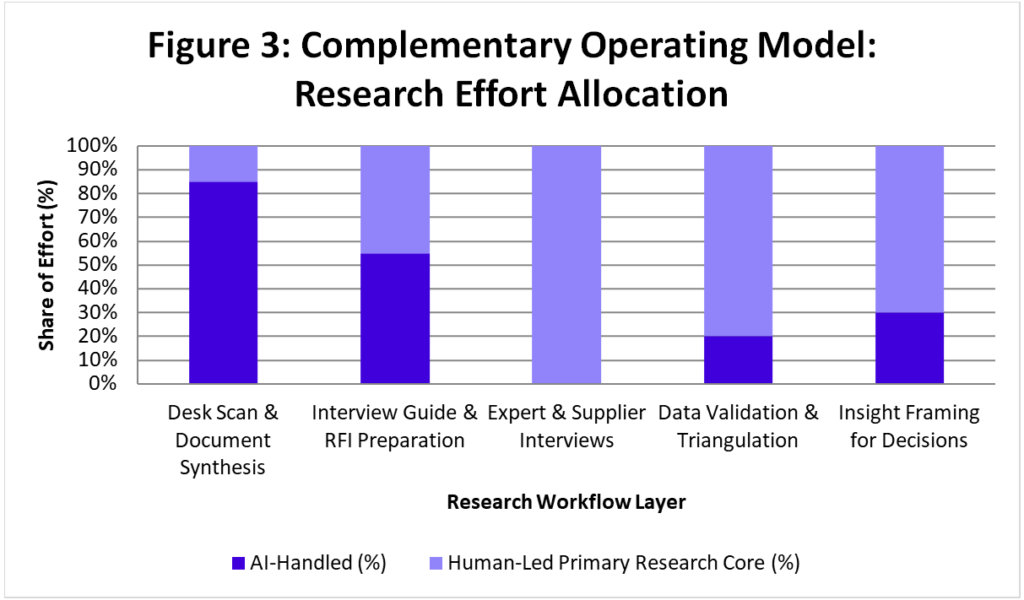
Source: Beroe analysis
Table 2: A Complementary Operating Model for Intelligence Functions
| Research Layer | Primary Owner | Rationale |
|---|---|---|
| Desk scan & document synthesis | AI-assisted | Fast, low cost, no differentiation lost |
| Interview guide & RFI drafting | AI-assisted, human-refined | Speeds preparation; human ensures relevance |
| Expert & supplier interviews | Human only | Relationships and trust cannot be automated |
| Data validation & triangulation | Human-led | Judgment on source reliability is essential |
| Insight framing for decisions | Human-led, AI-supported | Requires domain and client context |
Procurement considerations for AI in pharma R&D
AI will continue to absorb the commoditized layer of research, and it will do so faster and more cheaply every year. For intelligence functions whose value rested on synthesizing public information, this is a genuine threat. For those whose value rests on expert-validated primary intelligence, it is the opposite – a rising tide that makes their distinct contribution more visible and more valuable.
The strategic implication for pharma R&D procurement intelligence is clear. The durable competitive advantage lies not in how quickly an organization can summarize what is already known, but in how rigorously and currently it can capture what is not yet published – through direct, structured, expert-validated primary research. As AI makes the first capability universal, the second becomes the differentiator. The intelligence functions that recognize this early, and reallocate their efforts accordingly, will be the ones that remain indispensable.
References
[1] IQVIA Institute for Human Data Science. Global R&D Trends 2026: Advancing Innovation in a Changing Landscape. IQVIA Institute Report, published 25 March 2026. Available at: https://www.iqvia.com/insights/the-iqvia-institute/reports-and-publications/reports/global-r-and-d-trends-2026. Accessed 21 July 2026.
[2] IQVIA Institute – Global Trends in R&D 2025: Progress in Recapturing Momentum in Biopharma Innovation. https://www.iqvia.com/insights/the-iqvia-institute/reports-and-publications/reports/global-trends-in-r-and-d-2025
[3] IQVIA Institute’s Global R&D Trends 2026 Report Finds Credible Signal on AI-Enabled Programs (May 2026). https://www.iqvia.com/blogs/2026/05/iqvia-institutes-global-r-and-d-trends-2026-report-finds-credible-signal-on-ai-enabled-programs
[4] Large Language Models Hallucination: A Comprehensive Survey (2026). arXiv. https://arxiv.org/html/2510.06265v2
[5] Survey and analysis of hallucinations in large language models. Frontiers in Artificial Intelligence (2025). https://www.frontiersin.org/journals/artificial-intelligence/articles/10.3389/frai.2025.1622292/full
[6] From AI to Smart Factories: How Pharma Is Preparing for 2026 – Pharmaceutical Technology (April 2026). https://www.pharmtech.com/view/from-ai-to-smart-factories-how-pharma-is-preparing-for-2026
Author

Manu Joshi

Related Reading

27 Aug, 2026
Pharmacovigilance outsourcing and global talent arbitrage: A procurement guide to cost, capability, and country choice