
Data center construction is outperforming traditional office developments in 2026
Data center construction is growing as a separate construction segment, rather than just another end-use category inside commercial or industrial structures. The rise of cloud computing, artificial intelligence, and hyperscale infrastructure is altering the size, technological needs, procurement objectives, and competitive structure of construction. Data center construction has evolved from a small technology-sector build type to a unique, census-tracked construction segment that currently outperforms traditional office development and approaches healthcare construction in size. The impact of this growth goes beyond the owners and developers. Construction companies are shifting their market position. General contractors are purchasing expert electrical and mechanical businesses, while specialist and owner-integrated construction firms are diversifying into general contracting and turnkey delivery services. Procurement is thus shifting from fragmented trade purchasing to capability-based sourcing, early capacity reserve, and integrated control of important building packages.
Introduction
Traditionally, construction procurement has been organized around end-use sectors such as commercial, residential, industrial/manufacturing, healthcare, education, hospitality, and infrastructure. Each segment established reasonably stable contractor ecosystems, supplier ties, and specialty trades. Data centers are unique in that their worth is decided less by the structure itself than by the availability, dependability, and density of power, cooling, and digital equipment within it.
As such, data center construction sits in its own procurement category. Its scale, delivery-speed requirements, and power dependency are reshaping two things that procurement leaders directly manage: how construction spend is benchmarked against traditional end-use segments, and how the contractor market itself is restructuring, as the line between general contractor and specialty trade blurs due to mission-critical schedules.
Traditional end-use segments in construction
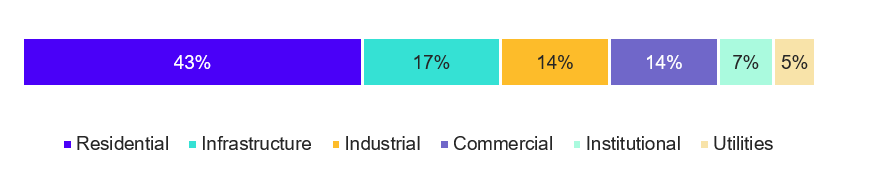
Traditional construction sectors typically have rather clear procurement boundaries. Commercial construction is primarily concerned with structural, architectural, interior, and standard MEP requirements. Residential construction relies on repeatable building components, finishing, and local labor. Industrial construction focuses on process equipment, utilities, and structural requirements. Healthcare increases the MEP and compliance complexity, whereas infrastructure is dominated by civil, transportation, utilities, and heavy engineering. Figure 1 gives the typical percentage of construction spending for various traditional end-use segments as of 2025. [1]
Figure 1 Percentage of construction spending for traditional end-use segments
Source: US Census Bureau, Beroe Analysis
Evolution of data center construction
Data center construction has evolved in three stages. First, data centers focused on specialized construction with dedicated contractors. Second, hyperscale developments by Amazon, Microsoft, Google, and Meta led to standardized designs and long-term partnerships. Third, AI increased the complexity of the sector. By April 2026, US data-center construction investment exceeded $50 billion, representing 2.3% of total US construction spending and surpassing public transportation spending. [2] From June 2024 to June 2026, US data center construction monthly spending rose 92%, prompting contractors to compete on power, MEP skills, procurement, prefabrication, commissioning, supply chain control, and speed, beyond just construction capacity. [3]
Changing dimensions of general and specialist contractors
The data center boom has blurred contractor boundaries, with specialists adopting integrated construction roles and general contractors gaining specialist skills either through mergers, acquisitions or collaborations. Figure 2 illustrates these transformations.
Figure 2: Transformations amongst contractors
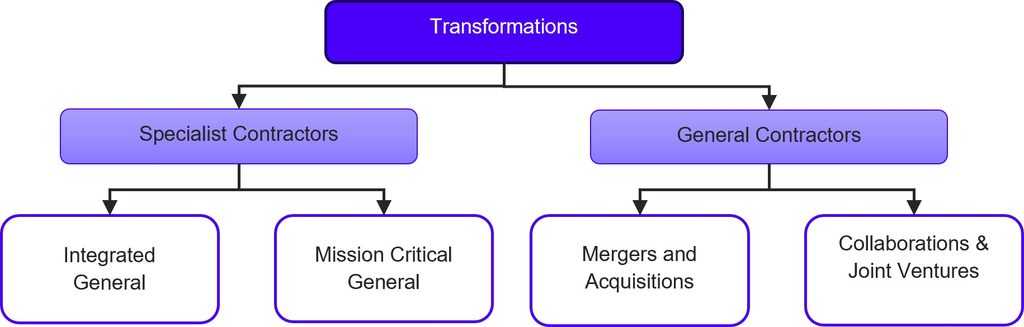
- Specialist to integrated contractor – T5 Construction: T5 Construction evolved from T5 Data Centers into a nationwide general contractor, holding GC licenses in 48 states and completing over 200 projects covering 6 million square feet. By September 2026, projections indicate around 260 projects totaling 12 million square feet. From 2021 to 2025, revenue surged from $87 million to $1.7 billion, with 83% of 2025’s revenue from third-party projects. On September 1, 2026, T5 split its construction division to create EverOn Data Centre Services, highlighting the growth of specialized data-center construction beyond internal needs. [4] [5]
- Specialist-to-mission-critical platform – 3C Industries: 3C Industries has transformed its market identity around mission-critical work, increasing revenue from $2 million to over $300 million since 2020. Management attributes this growth to its focus on mission-critical building and strong relationships with national GCs through data center projects. This competence allows specialists to expand their project scope, customer base, and role in the construction value chain. [6] [7]
- GC acquisition – Turner Construction & Dornan Engineering: Turner agreed to acquire Dornan Engineering Group, an Irish contractor with 1,000 workers and a €1.1 billion backlog of projects such as data centers, in July 2024. The acquisition was completed in January 2025, expanding Turner’s MEP and engineering capabilities. Turner had a $44.3 billion backlog by the end of 2025, with 37% of that coming from data centers, which increased to $48.9 billion by Q1 2026. This acquisition represents a trend toward in-house specialist capabilities. [8] [9] [10]
- GC acquisition –Sundt Construction & Industrial Power Solutions (IPS): In 2026, Sundt Construction acquired Phoenix-based IPS, doubling its electrical workforce and enhancing its capabilities. The demand for electrical contractors in high-demand sectors like data centers led to reduced availability in other markets. IPS then advertised for positions in data-center electrical construction. This reflects a trend where GCs are using acquisitions and self-perform strategies to secure specialized electrical capacity amid competitive demand for skilled labor. [11] [12]
Pros of the data center construction segment
- Counter-cyclical demand: 73% of industry experts believe the data center sector is recession-proof, indicating that demand will remain resilient in the face of economic instability. [13]
- Capability transfer: DfMA, modular MEP, and improved cooling techniques from data center projects are being used in healthcare, pharmaceuticals, and industry. [14]
- Contractor opportunities: Strong data-center demand enables specialty contractors to increase project volumes and services, but returns do not always match general contractor costs. [15]
Cons of the data center construction segment
- Power and critical equipment constraints: Utilities in many markets are quoting 4–10-year interconnection timelines, while average data-center equipment lead times have reached 42 weeks, 83% above 2019 levels. [16] [17]
- Specialist talent constraints: Data-center expansion is intensifying demand for electricians and other skilled trades, tightening specialist labor availability and increasing project-delivery pressure. [18]
- Contractor capacity: Major mission-critical contractors are expanding capabilities and geographic reach, increasing the importance of contractor qualification and capacity allocation.
- Capital-exposure risk: Data-center shell-and-core costs average about $11.3 million/MW, while AI fit-out can reach $25 million/MW. [18]
- Permitting friction: Environmental-review challenges are delaying some projects, including a 167-MW Nevada data-center approval. [19]
Recommendations for procurement teams in construction
Procurement teams in all construction categories should view the data center industry as a leading indicator of structural changes that will eventually influence other segments. Teams should keep an eye on contractor acquisitions, specialist-to-GC expansion, supplier consolidation, and adjustments in self-perform capabilities, since these can all have an impact on competitive intensity before they show up in pricing. Category strategies should also determine which scarce competencies, such as electrical, MEP, commissioning, engineering, or modularization, may become bottlenecks in their respective markets. Long-term capacity relationships, supplier development, and early market participation can help to ensure availability while sustaining competitive tension.
Data center construction exemplifies how rapid demand development can restructure an entire supplier ecosystem, hastening vertical integration, capacity acquisition, and contractor job transition. The broader lesson applies to commercial, industrial, healthcare, infrastructure, and other construction segments: procurement must include capability, capacity, and market structure, not just price. Teams that detect structural alterations early on can anticipate supplier changes, rethink sourcing strategies, and build resilience before limitations become project critical.
References
[1] “US Census Bureau,” [Online]. Available: https://www.census.gov/construction/c30/prexcel.html.
[2] “Bloomberg,” 1 June 2026. [Online]. Available: https://www.bloomberg.com/news/articles/2026-06-01/us-construction-spending-on-data-centers-eclipses-50-billion.
[3] “Our World in Data,” [Online]. Available: https://ourworldindata.org/grapher/monthly-spending-data-center-us?time=2024-06-01..latest.
[4] “Everon,” [Online]. Available: https://everondcs.com/.
[5] D. Swinhoe, “Data Center Dynamics,” 4 September 2026. [Online]. Available: https://www.datacenterdynamics.com/en/news/t5-spins-out-construction-arm-sells-operations-biz-to-salute/.
[6] E. Giroux, “GBQ,” 5 August 2026. [Online]. Available: https://www.gbq.com/resources/client-spotlight-inside-3c-industries-rise-to-a-national-mission-critical-contractor.
[7] “3C Industries,” [Online]. Available: https://www.3cindustries.com/.
[8] “Turner Construction,” 24 July 2024. [Online]. Available: https://www.turnerconstruction.com/insights/turner-construction-company-to-acquire-dornan-engineering-group.
[9] “Hotchtief,” 8 January 2025. [Online]. Available: https://www.hochtief.com/news-media/press-releases/press-release/turner-successfully-completes-acquisition-of-dornan-group.
[10] “Turner Construction,” 3 March 2026. [Online]. Available: https://www.turnerconstruction.com/insights/turner-achieves-record-revenue-and-backlog-in-2025.
[11] “Sundt,” 2026. [Online]. Available: https://www.sundt.com/2026/sundt-construction-acquires-industrial-power-solutions/.
[12] “Sundt,” 6 May 2026. [Online]. Available: https://www.sundt.com/2026/valley-construction-firm-acquires-electrical-contractor/.
[13] P. Barry, “Turner and Townsend,” 2025. [Online]. Available: https://reports.turnerandtownsend.com/data-centre-construction-cost-index-2025/foreword#block-cf9f1e22-ee70-46e0-8515-95871bdaf339.
[14] “Schneider Electric,” 18 February 2026. [Online]. Available: https://www.se.com/in/en/about-us/newsroom/news/press-releases/Schneider-Electric-launches-Motivair-liquid-cooling-solutions-factory-to-accelerate-India%EF%BF%BDs-highdensity-AI-infrastructure-699493fd07a7fbd2c30cbafa/.
[15] S. Yang, “Level,” 3 September 2026. [Online]. Available: https://levelcfo.com/blog/electrical-contractor-profit-margins/.
[16] G. Swain, “Network World,” 15 January 2026. [Online]. Available: https://www.networkworld.com/article/4117329/google-warns-transmission-delays-are-now-the-biggest-threat-to-data-center-expansion.html?trk=article-ssr-frontend-pulse_little-text-block.
[17] “DHL,” 20 August 2026. [Online]. Available: https://www.dhl.com/us-en/home/press/press-archive/2026/dhl-supply-chain-expands-service-logistics-capabilities-to-accelerate-data-center-infrastructure-parts-delivery.html.
[18] “JLL,” 5 January 2026. [Online]. Available: https://www.jll.com/en-ca/insights/market-outlook/global-data-centers.
[19] B. Gottlieb, “Engineering News Record,” 3 September 2026. [Online]. Available: https://www.enr.com/articles/63613-federal-board-halts-167-mw-nevada-data-center-approval.
Author

Kumara Raja Ganesan


Mohamed Abdlattif Osman
Related Reading

20 Oct, 2026
The sulfur trap - How the hydrochloric acid route can cut dicalcium phosphate costs