


Ask most category managers how they feel about writing and updating a category strategy, and you will get a similar reaction to when kids are handed extra homework. It’s a chore – something that all too often isn’t seen as being connected to your assigned objectives.
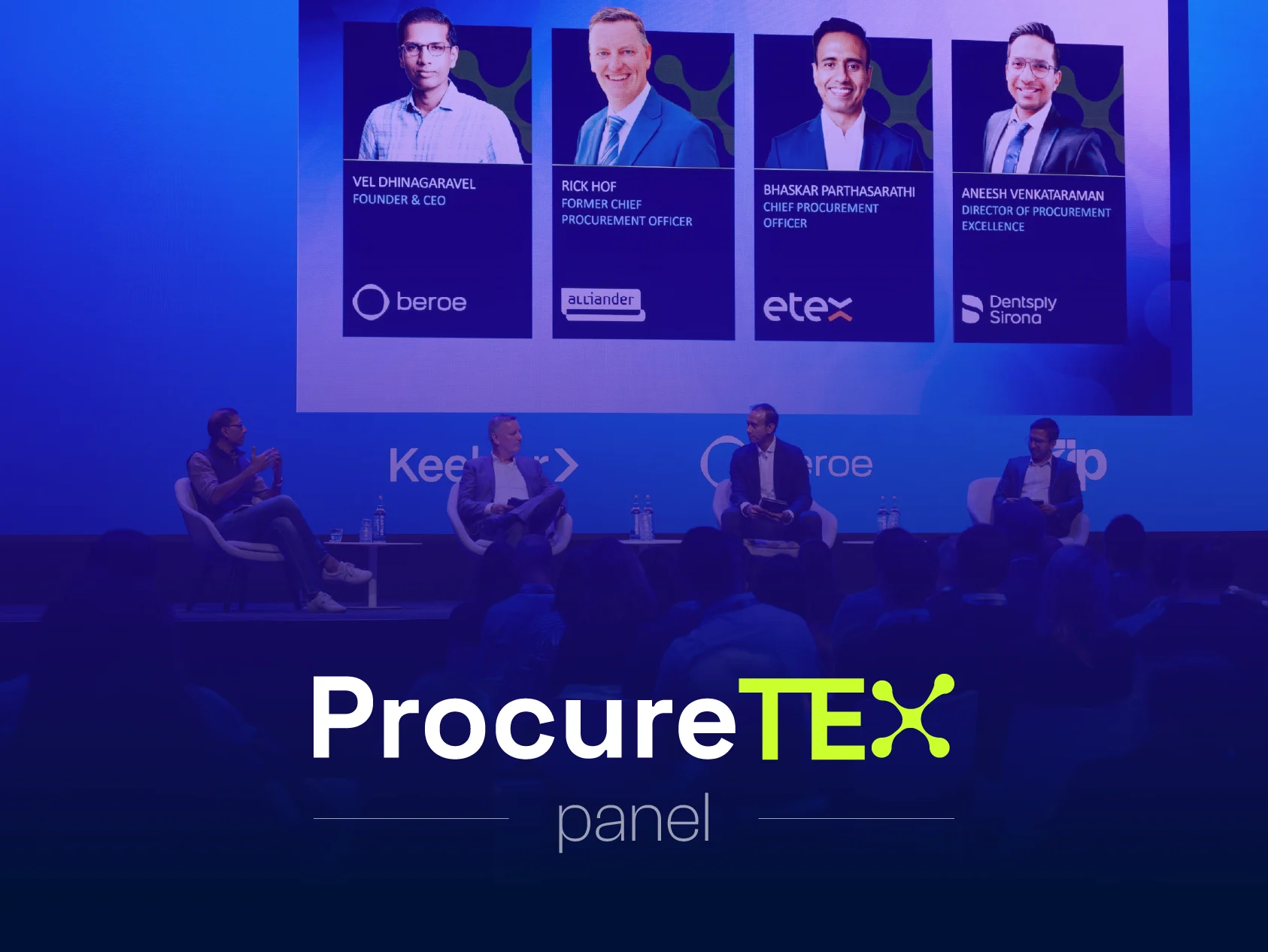
I raised that on my mainstage panel at ProcureTEX in Amsterdam earlier this month. The session was about what makes a procurement decision defensible, and it turned out the two questions are really the same question.
A strategy that feels like homework is usually written once a year, on a pile of data nobody had time to digest. And that is exactly the kind of strategy that falls apart when it meets a live negotiation, a hostile board, or an audit.
More data has not made it easier
When I started Beroe in 2006, the problem was too little information. Today the data available to a category manager, both internal and external, has grown dramatically. Our capacity to absorb it has not grown at anything like the same pace.
So, a lot of it simply leaks away, like water from a bucket with a hole in it. Strategies turn into thick documents that nobody opens between reviews. Most of the market signals don’t make their way into your strategy.
The question therefore is not how much intelligence a team has. It is whether that intelligence is good enough to act on, and to defend when someone challenges the decision. That is what I mean by decision-grade.
Three tests for decision-grade intelligence
We have written before about the six pillars of decision-grade intelligence. Three of them came up again and again on the panel, and each one works as a simple test of what lands on a category manager’s desk.
Relevance. Many market changes need no action at all. A supplier shutting down for two weeks sounds alarming, unless you are holding two months of inventory. A market statement can be true and still not be true for you. Decision-grade intelligence is specific to your situation. Intelligence earns its place when it is read against your contracts, your inventory, and your alternatives, and only reaches a category manager when they need to act.
Timeliness. Telling a category manager a supplier went bust yesterday puts them straight into firefighting mode. The better question is whether you could have seen it coming. Decision-grade intelligence is forward-looking as well as current. It tells you what is changing now, what is likely to happen next, and which signals would change the outlook. Shortages at the third tier, a change of ownership at a key supplier: the signals often sit well upstream of the event. The value is in seeing them early enough to shape a sourcing or negotiation decision, rather than react to one.
Traceability. When a decision is challenged months later, perhaps a contract structure or a price point that ended up costing the company money, can you show where the inputs came from, how current they were, and how you got from them to the call you made? Can you say who stands behind the interpretation? If you cannot, the decision was data-rich. It was not decision-grade.
Making strategy a living thing
Aneesh Venkataraman of Dentsply Sirona described how his team is tackling the homework problem. Start with the simplest parts and automate them. Spend data and supplier data are pre-populated into the standard category strategy template before it ever reaches a category manager.
That hands time back. The category manager then spends it on what isn’t automated, like market intelligence, supplier relationships, and the business context that decides what matters most.
The example that stayed with me came from Aneesh. Earlier this year, when oil prices moved sharply, his team had market intelligence on oil, but no direct line from that to their own spend. So they built one. It was an exposure model covering three sensitivities: transport, the oil embedded in raw materials, and the energy used to make what they buy. They translated it down to detailed category level and connected it to business context, so category managers could adjust it for their own categories.
The model was not the lesson in itself. What mattered was what they did next: instead of leaving it as a one-off crisis exercise, they plugged it into their regular workflows, so the next shock does not catch them starting from zero. That is the difference between a strategy written once a year and one that is living.
The homework you cannot skip
Not all homework is wasted. Bhaskar Parthasarathi of Etex made a point on stage that I keep coming back to. Many suppliers that look like a sole source are really a single source we have never properly challenged. The specification has not been tested, and the alternatives have not been looked for. Our own perception hands the supplier its leverage.
His answer was to build one shared set of facts and get everyone working from it: operations, finance, and supply chain inside the business, and the suppliers across the table. That way, a negotiation becomes a discussion about the facts rather than two sides defending their positions.
Rick Hof (former CPO of Alliander) added the capacity side. In constrained markets, suppliers will promise the world during a tender. The real stress test is whether they can live up to that promise, and what you need to do to help them get there. You cannot run that test on last year’s assumptions.
Where AI fits, and where accountability stays
Every conversation at ProcureTEX came round to AI agents eventually, and ours was no different. The panel was asked a direct question: what is the biggest contract you would trust an agent to negotiate? 10,000 dollars? 10 million?
Nobody would give a number, and I think they were right not to. Bhaskar described it as a pyramid. The more transactional the work, the more comfortable he is automating it with little oversight. The strategic work at the top – aligning stakeholders, bringing suppliers along – stays human.
He also drew a line I found useful, between responsibility and accountability. Executing a strategy can increasingly be handed to an agent. Accountability cannot. You cannot hold an agent to account for a decision that went wrong.
The threshold question can also be reframed entirely. What are the assumptions inside the agent, and can I vouch for them? If you can, use the agent, run the pilot, and if it fails, fail fast and move on.
It all comes back to the inputs. Ralf Garczorz (former 4x CPO) summed up our discussions in one established truth: rubbish in, rubbish out. An agent grounded on intelligence you can defend produces output you can defend. An agent grounded on whatever it found does not.
A test to run before someone else does
The panel promised a test you could run against your own inputs. Here is my Top 5. Pick one important category and ask:
- When did the market assumptions in this category strategy last change?
- If a key supplier stopped shipping tomorrow, would you know within a day whether it actually matters, given your inventory, contracts, and alternatives?
- Is your sole source really sole, or have you simply never challenged the specification?
- Could you show an auditor where every number in the strategy came from?
- If an agent touches this category, do you know which assumptions it is working from, and would you put your name to them?
If you struggle with more than one of these, the problem is probably not your category managers’ attitude to homework. It is that the homework has never given them anything back.
Build the strategy on intelligence they can trust, keep it current, and it stops being something they do for someone else. It becomes the thing they reach for when the board, a supplier, or an auditor starts asking questions.
Related Reading

10 Nov, 2026
Habit is not a strategy: Inside the Beroe Negotiations Customer Masterclass with Intel

24 Sep, 2026
What we have been building at Beroe, and why it matters for your procurement team

19 Aug, 2026
From cost savings to continuous competitiveness: The new procurement imperative