Beroe Live.ai
 Abi - AI Assistant
 1. Category Watch
 Category Insights
 Alerts & Advisories
 Benchmarking
 Geopolitical Alerts
 Sourcing Location Optimizer
 2. Supplier Watch
 Supplier Discovery
 Supplier Risk Monitoring
 Supply Chain Disruptions
 3. Inflation Watch
 Cost & Price Intelligence
 Commodity Analytics
 4. Risk Watch
 Supplier Risk Monitoring
 Supply Chain Disruptions
 Geopolitical Alerts
 DataHub
 Global Sourcing Analyst
 All Resources
 News
News Events
 Webinar
 White Paper
 In The Press
 Leadership
 Beroe Live.ai


I started Beroe 20 years ago with a simple idea. Procurement teams at the world’s largest companies were making decisions worth hundreds of millions of dollars on information that was patchy, out of date, or simply not there. If we could give them intelligence they could trust, checked by people who knew the categories, they could make better decisions.
That idea has not changed. Almost everything around it has.
Over the last two years, we have moved faster than at any point in our history. We launched new products, like Inflation Watch in 2024. In 2025, we acquired two companies, nnamu for competitive negotiations and Forestreet for AI-driven supplier discovery, each of which built on our core intelligence foundation. We closed a funding round the same year, which gave us the capital to pick up the pace. And this June we launched Beroe MAX powered by Kearney, the AI-native decision engine that turns our intelligence into always-on category strategy.
I am proud of every one of those steps. But I will be honest that from a customer’s point of view, Beroe had become a collection of very good products and services that did not yet present as one thing. If you were a category manager, you might use one of them and not know the others existed, or how they connected.
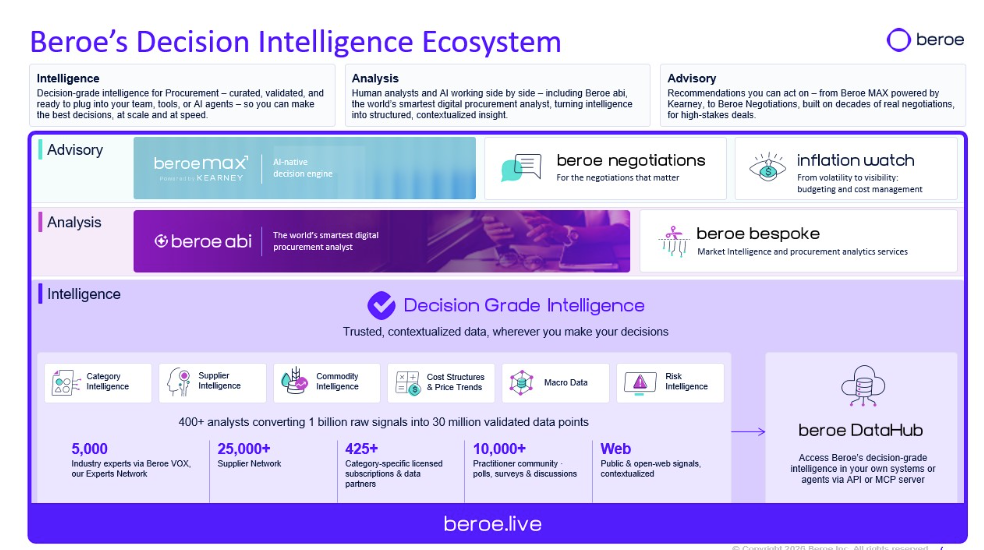
Today we are fixing that. We are introducing the Beroe Decision Intelligence Ecosystem: one system that takes you from what is happening in your markets, to what it means for your categories, to what you should do about it. Three tiers – Intelligence, Analysis, and Advisory – built around how procurement teams actually work, rather than around how we happen to be organized internally.
Let me explain why we did it now.
The problem on your side of the table
If you run a procurement function today, you are being asked for savings, supply continuity, and risk protection all at once, usually with the same team you had last year or a smaller one. Markets move fast enough that the assumptions in your category strategy can be stale within a month. And now AI has raised everyone’s expectations about how quickly you should have an answer.
I think this is the biggest opportunity procurement has had to prove itself as a creator of value and not just a controller of cost. I also see it as a moment when a lot of teams could get burned.
There is a race on to build agentic solutions for procurement. Some of what I see is impressive. But a great many of these tools will fail, and they will fail for the same reason: an agent is only as good as the data it is reasoning over. A model can produce a recommendation in seconds. The category manager still has to stand in front of their boss, a supplier, or a CFO, and explain where that recommendation came from and why it will hold. If nobody can answer that question, the speed is worth nothing.
Our customers should be able to stay ahead of the factors affecting their categories wherever they make decisions, whether that is inside a Beroe product, inside their own S2P platform, or inside an agent they have built themselves. And the intelligence they draw on should be continuous, so that category strategy stops being an annual event and becomes something that improves every month. Teams that work that way outperform the market. That is what we are building for.
Here is how we have framed it
The ecosystem sits on two commitments.
The first is that validation comes before automation. Every data point passes through our 400+ analysts before it reaches a model, a recommendation, or an agent. Traceability is built in at the start, not something we bolt on afterwards.
The second is that we are open by design. Through Beroe DataHub, the same validated intelligence that powers our own products is available inside your environment, by API or MCP server. You keep the tools you already run. The intelligence comes to you.
On those two commitments, three tiers.
Intelligence answers the question what is happening in my markets? This is our decision-grade intelligence, across six domains: category, supplier, commodity, cost structures and price trends, macro data, and risk. Our analysts turn more than a billion raw signals into over 30 million validated data points, drawing on 425+ licensed data sources, a supplier network of 25,000+, and a community of more than 10,000 practitioners. Beroe DataHub carries that intelligence into your systems.
Analysis answers what does it mean for my categories? Beroe abi (announced yesterday) is what we’re calling ‘the world’s smartest digital procurement analyst’, giving every category manager conversational access to Beroe intelligence. You ask a question and get a synthesized answer, rather than assembling one yourself. It’s a full rebuild of Beroe Live.ai, our core market intelligence platform for the past eight years, and existing customers will be upgraded in phases from January 2027. Alongside this, Beroe Bespoke pairs organizations with expert analysts for the problems that need deeper insights, like spend analytics, tariff management, and should-cost modeling.
And Advisory answers, what should I do about it? Beroe MAX powered by Kearney turns validated intelligence into category strategy and negotiation guidance. Beroe Negotiations brings deal-structuring expertise to the negotiations that matter most. Today, that is Beroe Competitive Negotiations powered by nnamu (our new name for nnamu), for deals where suppliers compete for your business. Next week at DPW Amsterdam, we extend it to the deals where they don’t. More on that on September 29. And Inflation Watch gives budgeting and cost management the forward view it has usually lacked.
This ecosystem already fuels the decisions behind $2.2 trillion in procurement spend globally. I mention that because it is proof that the model works at scale.
The people
One more thing, and for me this is the most important.
Our answer to AI is to invest harder in people. Alongside continued investment in Beroe’s team of more than 400 category experts, in the last year our wider Voice of Experts network (VOX) has nearly doubled to 5,000 industry experts, and we are still growing it. The problem with most AI in procurement is not the model. It is that nobody can tell you where the answer came from. Our customers can. Every recommendation traces back to intelligence a human being has validated. In a function that has to defend every decision it makes, that is not a nice-to-have; it is fundamental.
What comes next
Beroe is 20 years old and still runs like a much younger company: agile, quick to adapt, and impatient to get the next great thing into customers’ hands. We have been very busy for the past two years, and the announcements this week and in the coming weeks will show why. If you are in Amsterdam, come meet the Beroe team at DPW, Booth #66. I would love to hear what you think.
Author

Vel Dhinagaravel

Related Reading

19 Aug, 2026
From cost savings to continuous competitiveness: The new procurement imperative


27 Jul, 2026
The one-point win that cost 960,000 euros: Inside the Beroe Negotiations powered by nnamu showcase