Beroe Live.ai
 Abi - AI Assistant
 1. Category Watch
 Category Insights
 Alerts & Advisories
 Benchmarking
 Geopolitical Alerts
 Sourcing Location Optimizer
 2. Supplier Watch
 Supplier Discovery
 Supplier Risk Monitoring
 Supply Chain Disruptions
 3. Inflation Watch
 Cost & Price Intelligence
 Commodity Analytics
 4. Risk Watch
 Supplier Risk Monitoring
 Supply Chain Disruptions
 Geopolitical Alerts
 DataHub
 Global Sourcing Analyst
 All Resources
 News
News Events
 Webinar
 White Paper
 In The Press
 Leadership
 Beroe Live.ai



In the Know – Beroe Product Showcase
Most procurement negotiations still run largely on price. Quality, service levels, lead times, payment terms, supplier relationships, risk: these equally important factors tend to get scored in a spreadsheet before the negotiation or argued over after it. They are rarely negotiated.
That was the problem on the table at our latest In the Know product showcase, where Dr. Christian Paul, VP Negotiation & Agentic AI Products at Beroe, showed how Beroe Negotiations powered by nnamu puts Total Value of Ownership (TVO) at the center of every sourcing event. Snehal Surve, Senior Solution Consultant, demonstrated the supplier experience, and Subul Tanveer from Beroe’s Product Marketing team moderated the discussion.
Christian spent 14 years as a consultant before founding nnamu, and he opened with a story from that career.
A 12 million euro contract, a one-point win, and one awkward question
A team is buying factory machinery on a 12 million euro contract. They do everything by the book: a 20-criterion scoring sheet covering references, project management, and quality, with price and quality each weighted 50 percent. Supplier A scores 85 on quality, supplier B scores 75. Once price enters the calculation, supplier A wins by a single point, 80.5 to 79.5. The outcome mail goes to the executives.
The CFO replies with one question. Supplier A won by one point, and we are paying more for it. How much did that one point of quality cost us?
Christian has witnessed this scene numerous times. In his words: “Needle drop. Nobody can answer, and nobody wants to.”
When someone finally works it out from the scoring sheet, the answer is an uncomfortable one. The 50/50 weighting had priced the 10-point quality gap at 1.2 million euros. But the only substantive difference between the two offers was machine uptime, 99.2 percent against 98.9, and the cost of covering that gap with extra staff came to about 90,000 euros. The model had overpriced quality by a factor of 13. Priced correctly, supplier B wins by 870,000 euros in total value, and by 960,000 euros in cash.
Nobody set out to pay 1.2 million euros for one point of quality. It was baked into the weighting from the start. Every point score carries a hidden price tag, and a team that doesn’t calculate it can follow a rigorous, well-documented process straight to the wrong supplier.
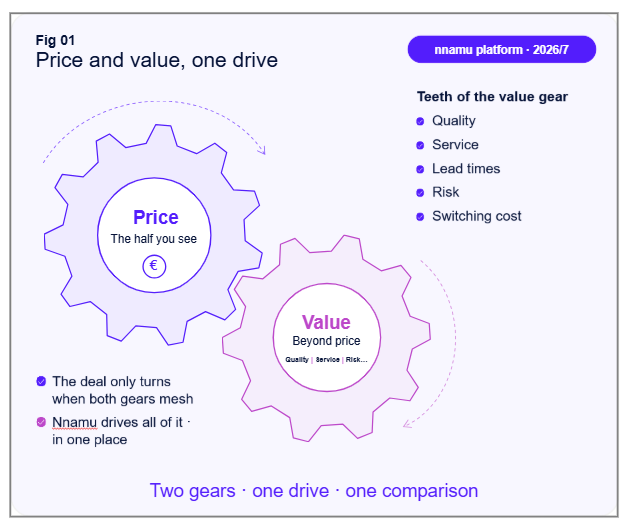
What is TVO?
Some quick terminology definitions:
- Total landed cost is what you pay for the product once it reaches your door.
- Total cost of ownership (TCO) adds elements around it, such as payment terms and duties.
- Total value of ownership (TVO) goes further and folds in everything else the business values: product differences, service levels, quality, risk, and the justified preferences of every stakeholder, each expressed in money.
The way Christian puts it, TCO tells you the cost, and TVO tells you what that cost actually bought.
Once every factor is expressed in euros or dollars, procurement and finance argue in the same units. Stakeholder preferences get priced at the start of the process instead of arriving as a veto at the end, and procurement, holding the pen on an agreed model, can put more spend under genuine competition.
The external effect matters just as much. Once a factor is monetized, it can be negotiated. One buyer on the platform recently monetized supplier lead times: shorter lead times meant less emergency stock to hold, which meant less space and less capital tied up, so suppliers who could commit to faster delivery earned a concrete bonus and competed for it.
Five rules for building a TVO model
1. Check for double counting before anything else. The most common failure Christian sees is the same criterion negotiated four or five times under different names. Skip the fill-in template and ask stakeholders for the three biggest plus points and three biggest minuses per supplier, then build from there.
2. Put a number on every difference. The hardest step, and the one stakeholders already perform silently in every post-negotiation roundtable when someone insists a particular supplier “has to win.” A shortcut when the discussion stalls: would we buy from the weaker supplier if they delivered for one euro? If yes, a monetary value exists somewhere between one euro and today’s price, and the real conversation can start.
3. Frame penalties, not bonuses. If a difference can be expressed either as a bonus for the best supplier or as a penalty for the rest, choose the penalty.
4. Separate what suppliers can change from what they cannot. Most criteria are static. Between one and three are usually dynamic, like the lead-time example, and those are the ones to open up during the negotiation and let competitive pressure work on.
5. Keep the supplier view simple. During the negotiation, suppliers should concentrate on the factors they can influence. On everything else, be transparent about how they are evaluated and give them a path to improve over time. TVO and good supplier management are in the same discipline.
In the platform: strategy first, then automation
Beroe Negotiations powered by nnamu rests on two foundations: a proprietary database covering more than 400 billion euros of negotiated spend, and an engine that combines AI with game theory. It works in two stages:
- First, it recommends how to negotiate: the buyer sees the best approach for their specific event, drawn from 11 negotiation formats, most of them exclusive to nnamu, alongside the second and third best options and the TVO savings at risk of settling for them.
- Then, once the buyer locks in a strategy, the platform runs the negotiation itself, down to auto-generated training that prepares each supplier for the exact format they are entering. Prepared suppliers make for cleaner negotiations, and automation lets negotiators cover far more events than they could manually.
The session’s live case was modeled on a real client engagement: consultancy services for pricing and market entry advisory, held by the same firm for eight to ten years and priced 22 percent above the lowest acceptable competing offer. Christian built the TVO model on screen. The client’s standardized scoring sheet was converted into monetary values through a willingness-to-pay for a perfect score. Transition workload and contracting effort were costed in as additional efforts, including a striking judgment call from the stakeholders: they were willing to pay the incumbent roughly 100,000 euros for one extra month on contract to secure a proper handover, should a challenger win. One criterion was left dynamic, the option for suppliers to shift work packages from time-and-materials to fixed fee.
The result of this real negotiation is that the incumbent kept the business, but improved its total value of ownership by 14 percent. Roughly 11 points came from commercial price and 3 from non-commercial terms, including a move to fixed fees on several work packages that the buyer had wanted for years. The buyer captured the value, kept the relationship, and could defend every number in the outcome mail.
Three questions from the audience
Can this work for complex services like marketing, HR, and professional services? Professional services is the most negotiated category on the platform across its nearly three years in the market, and Christian argued TVO is the reason: the dominant criteria are always the transition period and the extra effort a switch imposes on internal teams. Sometimes the economically correct answer includes paying for two contracts to overlap briefly, and a TVO model is what lets you back this up to senior stakeholders.
How does game theory shape negotiation strategy? The biggest secret of game theory is that you learn during the negotiation. An RFX can be white noise, because suppliers who doubt they can win hold back what they can really do. The remedy is a multi-stage design, using a first round with the right incentives to extract information from the market before setting the anchors and formats for the final round.
Can you maximize deal value and protect long-term partnerships? Yes, and TVO is the mechanism. Pricing a supplier scorecard into the model turns years of reliable performance into a tangible negotiation advantage, which tells strategic suppliers in the most credible way possible that price is not everything. For preferred partners, the platform goes a step further with preferential treatment: attempting to close the deal with the preferred supplier before the business ever goes to open competition.
How does TVO help procurement teams?
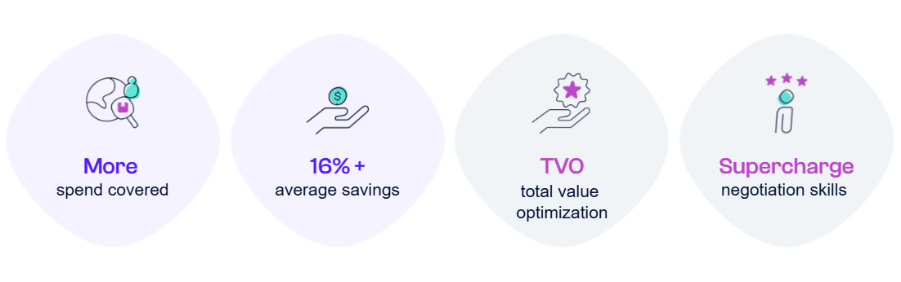
TVO helps teams pick the right supplier, and it makes more of the deal negotiable. But Christian’s closing argument was broader: TVO is the biggest available enabler of competitive negotiation itself, because it takes every justified preference in the organization and turns it into an objective, discussable, defensible number. Teams that do this negotiate more spend, more often, with fewer vetoes and fewer awkward mails to the CFO.
Missed the session or want to rewatch it?
Watch the full webinar on demand
Find out more about Beroe Negotiations powered by nnamu.
Related Reading

19 Aug, 2026
From cost savings to continuous competitiveness: The new procurement imperative


21 Jul, 2026
AI has improved what procurement produces – It hasn't changed how procurement decides