Beroe Live.ai
 Abi - AI Assistant
 1. Category Watch
 Category Insights
 Alerts & Advisories
 Benchmarking
 Geopolitical Alerts
 Sourcing Location Optimizer
 2. Supplier Watch
 Supplier Discovery
 Supplier Risk Monitoring
 Supply Chain Disruptions
 3. Inflation Watch
 Cost & Price Intelligence
 Commodity Analytics
 4. Risk Watch
 Supplier Risk Monitoring
 Supply Chain Disruptions
 Geopolitical Alerts
 DataHub
 Global Sourcing Analyst
 All Resources
 News
News Events
 Webinar
 White Paper
 In The Press
 Leadership
 Beroe Live.ai



Insights from Beroe’s webinar with Jennifer Sieber, Global Procurement Head of Data, Systems & Insights at Gilead Sciences, and Niko Nurmi of Procurement Leaders.
Procurement teams today face a curious paradox. They have more data than ever. They have AI tools that can summarize that data in seconds. And yet too many leaders still walk into negotiations, supplier reviews, or board conversations without the confidence to fully stand behind the intelligence they’re presenting. Speed is not the problem, but a lack of trust is.
That was the central argument of our recent webinar, Your Path to Decision-Grade Intelligence in the AI Era, where Jennifer Sieber from Gilead Sciences joined Beroe’s Chief Product Officer, Prerna Dhawan, and Niko Nurmi of Procurement Leaders for a candid discussion on where AI genuinely delivers, and where procurement teams still need to do more.
The Gap Between Insight and Confidence
Procurement leaders today face a compounding challenge: cost reduction is still their top strategic priority, supply continuity is their top operational one, and they are simultaneously expected to transform how they work using AI. As Prerna put it, it is the same team solving today’s problems while also reinventing how they operate for tomorrow
And while data itself is not the bottleneck (if anything, teams now have too much of it), what they lack is the intelligence they can actually act on. Fragmented sources, unvalidated outputs, and insights that live in one system while decisions get made in another: these are the barriers standing between procurement and meaningful impact.
Jennifer described this tension clearly through a real example at Gilead, where they are working through the AI challenge with partners, including Beroe. The organization runs two different AI chatbots. One draws from a broad, partly unvalidated set of internal and external sources. The other operates on a tightly controlled, validated data set, pointing users toward specific procurement information: PO status, invoices, and training materials. The first created confusion, while the second built trust. The difference was in the data behind the technology and the clarity of its purpose.
Three Words That Define Decision-Grade
Before procurement teams can get the most from AI, they need to agree on a standard. Prerna’s definition of decision-grade intelligence rests on three principles:
Defensibility. Can your team explain and justify the insight if someone challenges it? In a negotiation, in a board presentation, or in a supply risk review, you need to be able to point to how a number was reached, not just what it is.
Explainability. Are the assumptions visible? If a forecast says a commodity price will rise 10%, procurement teams need to know what drove that figure: supply and demand dynamics, weather patterns, and geopolitical changes. “ChatGPT said so” is not a methodology.
Accountability. Is there a named expert, a validated source, or a documented method behind the output? Decision-grade intelligence is traceable. It connects back to something and someone you can hold responsible.
The contrast between general AI outputs and decision-grade intelligence becomes clearest in real examples. Take CDMO capacity in pharma. A large language model might tell a category manager that capacity is available across molecular types – which is technically accurate at a surface level, but missing the detail that most of that capacity is commercial-only, unavailable for Phase II programs, and often reserved for CDMOs’ own internal pipelines. A category manager acting on the first answer could waste months chasing dead ends. A manager acting on the second avoids the false starts and goes into supplier shortlisting immediately and with confidence.
The Right Tool for the Right Decision
Not every question demands decision-grade intelligence, and treating it as such creates unnecessary bottlenecks. Prerna walked through a simple framework for matching intelligence standards to decision stakes.
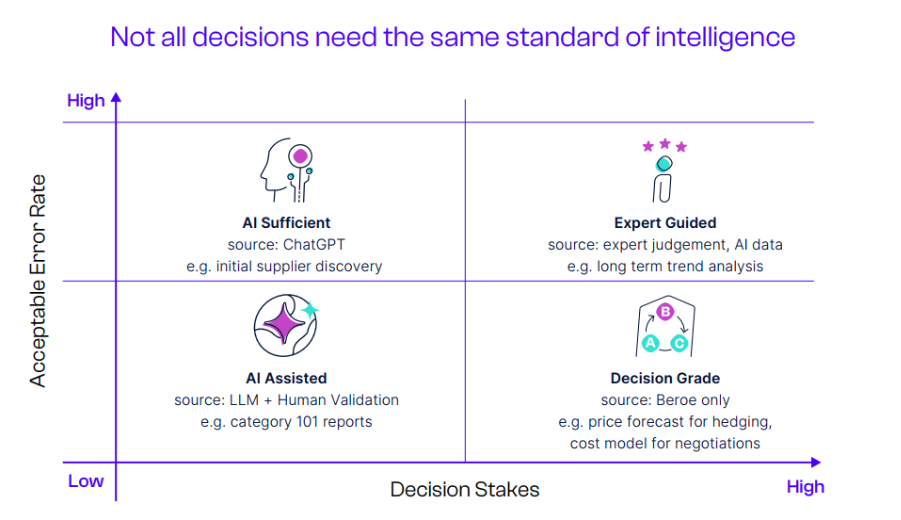
When decision stakes are low and some error is acceptable, such as open-ended market exploration or early-stage discovery, a general LLM is sufficient. Teams get a quick answer and move on.
When the stakes are still moderate, but error tolerance is low, such as preparing for a presentation to senior stakeholders, AI should work as an assistant, with human validation applied on top.
When the stakes are high, and the error margin is tight – such as price forecasting, negotiation preparation, and supply risk calls – teams need decision-grade intelligence. These are the moments where a few percentage points can mean millions, and where procurement leaders cannot afford to carry forward synthetic or unverified data.
Jennifer built on this with Gilead’s own lens on the distinction. At Gilead, the team treats final supplier award decisions, contract and regulatory adjustments, and high-impact compliance calls as inherently human judgment territory. AI can support, but people make the call. Meanwhile, intake validation, guided buying, and structured document generation sit comfortably in a more autonomous AI-driven model.
The key, as both speakers reinforced, is intentionality. Procurement teams need to map their use cases, understand what’s at stake in each one, and choose accordingly, rather than defaulting to whatever tool is closest to hand.
Why Pilots Stall and What to Do About It
Audience polling during the webinar found that most procurement teams are still in the pilot phase of AI adoption for market intelligence, where it is used for “routine tasks with human review”. That is encouraging progress, but significant headroom remains.
Prerna identified the most common reason pilots fail – one of four pillars is missing: people, process, technology, or data. For example, without clean, validated, well-governed data, even a well-designed AI product will underdeliver – or even deliver inaccurate outputs.
Beyond data, she flagged a pattern many leaders will recognize: procurement teams are running too many pilots simultaneously. Tool fatigue is real. The smarter approach is to identify three or four use cases with the highest potential value, match them to the quality of data available, and build confidence sequentially, rather than trying to automate everything at once.
Jennifer echoed this from Gilead’s experience. The organization has deliberately moved through stages, building trust and competency before expanding AI’s role. Teams that lack digital fluency will default to distrust, and distrust compounds. Giving people structured ways to be curious about AI, to test it, and to understand what it is and is not doing is what creates the conditions for trust to develop.
Where Category Managers Fit
One of the more direct takeaways from the session was a reframe on the evolving role of procurement and market intelligence professionals in an AI-enabled world.
Category managers are not becoming obsolete. They are becoming the validation layer – the people who apply context, challenge outputs, and make the judgment calls that AI cannot. That is not a diminished role. It is, in many ways, a more valuable one. It frees up time previously spent gathering and structuring information to focus on the work that actually drives outcomes, like stakeholder engagement, strategic framing, and supplier relationships.
As Jennifer put it, the goal is to understand how AI changes ways of working and to develop the curiosity and confidence to use it well.
The Standard Worth Setting
Procurement teams have spent years building credibility inside their organizations. Decision-grade intelligence protects and extends that credibility. It ensures that when a category manager walks into a negotiation or a CFO conversation, the intelligence they carry is something they, and the people they are presenting to, can fully stand behind.
That standard is achievable today. But it requires choosing the right data sources, applying the right validation, and being honest about where general AI is sufficient and where it is not.
The teams that get this right will not just move faster. They will move with confidence, and that makes all the difference.
Related Reading


07 May, 2026
From Data Overload to Decision-Grade Intelligence: Key Takeaways from Beroe's DataHub Webinar