In 2026, payroll regulations will tighten globally, with changes such as Australia’s Payday Super, growing U.S. state pay transparency laws, and the EU Pay Transparency Directive increasing compliance pressure on employers. [1]
The New Regulatory Hurdles Facing International Teams in 2026
In 2026, payroll teams face tighter oversight as governments strengthen reporting and digital tax rules, making compliance a critical business priority to avoid penalties and maintain trust across industries. [2]
Regionally, major changes are underway:
- In the United States, employers must comply with new reporting rules under the One Big Beautiful Bill Act, including detailed overtime and tip reporting on the 2026 Form W-2, alongside evolving state laws on pay transparency and leave.[3]
- In 2026, payroll teams must act faster as many countries move from quarterly filings to real-time reporting, requiring employers to submit payroll data every pay cycle.
- Payroll compliance also lacks a global standard, with each country and sometimes states having different labor laws, tax systems, and reporting rules.
- Cross-border payroll must meet GDPR and local data privacy laws, as countries like Singapore, Australia, and India follow different rules on sensitive data and data localization.[4]
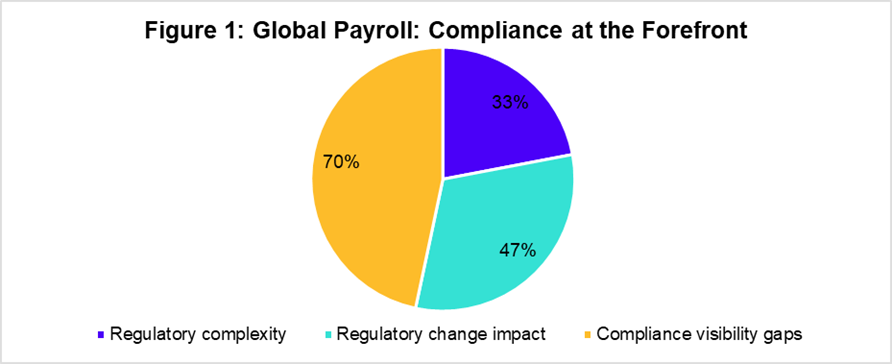
Source ADP
Why In-House Payroll Models Are Breaking in 2026
Payroll today is far more complex than before. Rules change constantly, risks are higher, and companies must manage compliance carefully to avoid penalties. At the same time, payroll now demands strong technology, automation, security, and real-time accuracy, something many in-house teams struggle to handle without heavy investment.
With rising costs, talent shortages, and growing global operations, payroll complexity often outpaces internal capacity. That’s why many businesses are shifting toward flexible, tech-driven outsourcing solutions to stay compliant, scalable, and efficient. [5]
Why Payroll Outsourcing Becomes the Strategic Edge
- Built-In Regulatory Expertise
- Leading payroll providers embed compliance into their core services, offering real-time regulatory monitoring and local expertise, helping companies manage complex payroll regulations more effectively than most in-house teams. [6]
- b) Automation & Real-Time Capability
- Automation in modern payroll platforms improves compliance by enabling real-time processing, automating taxes and filings, reducing manual errors, and strengthening control over complex payroll operations. [6]
- c) Risk Transfer & Accountability
- Managed payroll providers combine technology with compliance expertise, shifting part of the operational and regulatory responsibility through clear contracts, while offering stronger governance, security controls, and accountability than most in-house payroll teams. [6]
Example – Australia’s Payday Super: Real-Time Compliance Becomes Mandatory
Australia’s transition to Payday Super is one of the most significant payroll reforms shaping 2026. While often described as a timing change, moving from quarterly superannuation payments to funding contributions on each payday. It represents a structural shift toward real-time accountability, greater regulatory visibility, and higher execution risk.
The reforms commence on 1 July 2026. From that date, employers must pay superannuation guarantee (SG) contributions at the same time as salary and wages, removing the traditional quarterly buffer.
Under the current framework, super must be remitted within 28 days after each quarter. Failure can trigger liability under the Superannuation Guarantee (Administration) Act 1992, including the SG shortfall, 10% interest, administrative penalties, and additional penalties of up to 200% of the Superannuation Guarantee Charge.
Payday Super does not increase contribution rates; it increases the discipline required to calculate and fund super correctly every pay cycle.
Why This Matters
Australia’s superannuation system holds more than AUD 4 trillion in assets, yet the Australian Taxation Office (ATO) estimated a super guaranteed gap or unpaid super of around AUD 6.2 billion in 2022–23. In 2024–25 alone, the ATO raised nearly AUD 800 million in SGC liabilities through reminders, prompts and audit activity. The message from regulators is clear: super compliance is not optional.
Quarterly reporting allowed errors to remain undetected until due dates. Payday Super removes that operational slack.
Operational Implications
Under the new framework, employers must calculate SG at each pay event, apply the SG rate to Ordinary Time Earnings (OTE), transfer funds through SuperStream clearing houses, reconcile payroll and super payments in near real time, and align treasury funding with payroll payment.
The reform exposes three key risks: tighter treasury discipline, higher OTE interpretation and system configuration risk, and expanded regulatory visibility through STP and SuperStream data. At the same time, enforcement is strengthening. The Closing Loopholes Act 2023 introduced criminal penalties for intentional wage underpayment, reinforcing the policy direction toward stronger accountability.
Strategic Takeaway
Payday Super transforms superannuation from a quarterly obligation into a real-time compliance discipline. For boards and executives, it is not simply a payroll system update but a governance shift requiring assurance over payroll configuration, funding processes, and compliance controls.
In a real-time regulatory environment, compliance is no longer a competitive advantage, it is the minimum standard.
Conclusion
In a fast-changing global payroll environment, companies need to shift from reacting to issues to proactively managing compliance. Organizations should track regulatory updates in real time and regularly review employee classifications. Payroll data must be protected through strong security and storage practices. Simplifying payroll vendors and strengthening contractual accountability can reduce compliance risks. Better coordination between payroll and finance teams also ensures timely payments and smoother compliance. [7]
References
[1] Papayaglobal, “papayaglobal,” 2026. [Online]. Available: https://www.papayaglobal.com/global-payroll/. [Accessed 12 February 2026].
[2] T. Grieveson, Cloud Pay, 22 January 2026. [Online]. Available: https://www.cloudpay.com/blog/predictions-for-2026-turbo-charging-payroll-data-for-competitive-advantage/. [Accessed 10 February 2026].
[3] A. Bhatt, “Multiplier,” Multiplier, 17 February 2026. [Online]. Available: https://www.usemultiplier.com/global-payroll/future-of-global-payroll. [Accessed 23 February 2026].
[4] C. Christopher Wood, “Thomson Reuters,” Thomson Reuters, 3 February 2026. [Online]. Available: https://tax.thomsonreuters.com/news/meeting-the-moment-how-payroll-teams-can-strengthen-tax-compliance-in-2026. [Accessed 16 February 2026].
[5] S. l. Roux, “Employement hero,” 24 October 2025. [Online]. Available: https://employmenthero.com/uk/blog/gdpr-payroll/. [Accessed 16 February 2026].
[6] C. Chadwick, “CIPHR,” Charlotte Chadwick, 16 January 2026. [Online]. Available: https://www.ciphr.com/blog/payroll-trends-2026. [Accessed 16 February 2026].
[7] S. Staff, “Super Staff,” 1 July 2025. [Online]. Available: https://superstaff.com/blog/payroll-compliance-outsourcing. [Accessed 12 February 2026].
Author

Pradeep Martin

Eric Liaw
Related Reading

27 May, 2026
What Makes AI-Powered Intelligence "Decision-Grade"? Lessons from Gilead Sciences

13 May, 2026
Where Market Intelligence Is Heading – and Why Human Expertise Still Matters