A rare earth magnet worth less than 1% of a car’s value halted a Japanese production line for 21 days. The episode shows what procurement intelligence has to deliver when demand, export rules, and supply all move at once.
By Arun M Vijayan, Vertical Head, Metals, Minerals & Mining, Beroe
I presented this story at the 29th ISM Japan Annual Conference in Tokyo, in a session titled “The Hidden 1%: Critical Minerals × AI × Geopolitics.” The exposure it describes reaches well beyond Japan and beyond the automotive sector, so I am sharing the evidence and my conclusions here for the wider procurement community.
The 21-day stoppage that no cost model predicted
On May 26, 2025, a Japanese automaker halted production of one of its models. The line partly restarted on June 13 and returned to full output on June 16. Reuters reported, citing sources, that the cause was China’s April 2025 export controls on rare earths, which would make it the first Japanese automaker to be hit by them. The company declined to comment on the cause.
The material involved barely registers in a cost model. Rare earths make up less than 1% of a car’s value. Beroe analysis of IEA data shows that if rare earth prices tripled, the cost of a car would rise by about 0.1%. Any spend analysis would place the category near the bottom of the priority list, and a price-risk review would wave it through.
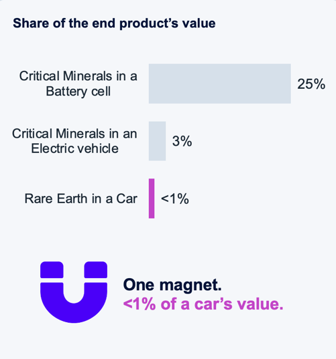
The exposure was availability, and price data has no way of showing it. The same pattern runs well beyond one plant. The IEA’s Global Critical Minerals Outlook 2026 puts about US$6.5 trillion a year of production outside China at risk. The smallest line in a spend cube can carry the largest stop-the-line risk.
Three pressures on the same short list of metals
The stoppage traced back to a single export rule. Three separate pressures are now converging on the same handful of materials, and each one defeats a different assumption in a typical category plan.
1. Demand that does not respond to price
Electric vehicles and AI data centers are buying from one shopping list: copper, rare earths, and gallium. Global electric car sales rose from 11 million in 2022 to 20 million in 2025, and the IEA forecasts 23 million for 2026, or to 28% of new cars sold. Data center copper demand is projected to grow from 1.1 million tons a year in 2025 to 2.5 million tons by 2040, an increase of 127%.
Copper set an LME record of US$14,533 per tonne on September 7, 2026, about 17% higher than a year earlier. A hyperscaler will not delay a data center because copper is expensive, so manufacturers now compete for metal with buyers that have little sensitivity to price. Cost forecasts built on the old link between industrial activity and metal prices will understate what comes next.
The strain shows in refining economics too. The 2026 benchmark copper treatment and refining charge was set at US$0 per tonne, and spot charges have since fallen below minus US$300, which means smelters are paying to secure concentrate. In Japan, the cathode premium reached a record US$330 per tonne in 2026, and Mitsubishi Materials has said its Onahama smelter will stop smelting concentrate in March 2027, removing 230,000 tons of capacity.
2. Export rules that change in days
Mining is diversifying while refining stays concentrated. China holds about 99% of refined gallium capacity, 90% of refined rare earths, 60% of refined germanium, and 50% of copper smelting. That concentration has become an instrument of policy, and it is now applied country by country.
Licensing for gallium and germanium began in July 2023. Seven medium and heavy rare earths were added in April 2025 and remain licensed. In October 2025 the rules were extended to goods made outside China, a measure since suspended, and in January 2026 a dual-use export ban was aimed at Japan. China’s Ministry of Commerce said on January 8, 2026, that civilian users would not be affected. Chinese customs data for June 2026 then showed zero tons of dysprosium, terbium, yttrium, and gallium shipped to Japan. In August and September, magnet shipments to Japan were down 17% to 20% while flows to the EU and US recovered.

Two consequences follow for procurement. The first is price: dysprosium oxide outside China trades at about 15 times the Chinese domestic price, and terbium at about 9 times, so a contract indexed to the wrong market misprices the material from day one. The second is timing. The number of mineral codes under Chinese export control has tripled since 2023, and the next deadlines sit inside a single planning cycle. The suspension of China’s ban on gallium, germanium, and antimony exports to the US is due to expire on November 27, 2026. On November 9, China extended the suspension of its October 2025 package by two months, to January 10, 2027, the same day the US-China truce ends.
3. Supply that takes decades to rebuild
Japan has been preparing for this risk since 2010, which makes its experience the most instructive. After China cut shipments in 2010, when Japan relied on China for about 90% of its rare earths, the country committed sovereign capital and long-term offtake. JOGMEC and Sojitz funded Lynas with US$250 million in 2011. JARE added A$200 million in 2023, Japan put €110 million into Caremag in France in March 2025, and in March 2026 it secured 5,000 tons a year from Lynas to 2038 at a floor price of US$110 per kilogram. Dependence on China has fallen to about 60%.
Japan still ran short. It imported 13 tons of dysprosium in the first half of 2026, down 82%, with none arriving from China in four of the six months. Japanese manufacturers of automobiles, robotics, and industrial durables could secure only about two thirds of the heavy rare earths they needed, according to Argus Media. Beroe analysis shows half of Japan’s heavy rare earth requirement is covered: 30% from the Lynas offtake today and 20% from Caremag from 2027. The other half has no source yet.
The economics explain the gap. Refining capacity outside China costs 20% to 150% more to build and about 50% more to run. By 2035, the IEA expects planned refining capacity outside China to cover about two thirds of expected mine supply outside China, and planned magnet output only about one third. Diversification works on a timescale of decades, and the twelve quiet years between Japan’s 2011 and 2023 investments turned out to be the expensive part.
What the data showed, and what a decision needed
Almost every figure above was public when it mattered. Export control notices, customs statistics, and premium quotes are all published. The exposure went unseen in many companies because nobody had assembled that information into a form a decision could rest on.
That is the idea behind decision-grade intelligence. Most procurement functions hold plenty of data. Far fewer hold intelligence that is fit to make a decision with, and to defend in front of a CFO or a board when the decision costs money. In critical minerals, that asks four things of procurement intelligence.
- It reaches the tier where the risk sits. Spend data stops at the tier-one supplier, and the chokepoint here is a refinery several tiers back. That means knowing where your suppliers’ suppliers refine, and tracing rare earth and gallium content down to the part number.
- It moves at the speed of the rules. About 1,100 items sit on China’s dual-use list, and suspension dates now fall weeks apart. A quarterly category report will be out of date before it is read.
- It is interpreted by experts. The official statement in January 2026 said civilian users would not be affected, and the customs data five months later showed zero shipments. Choosing between a China domestic price and an ex-China price that is 15 times higher takes the same kind of judgment. Expert-led analysis is what separates a signal from an announcement.
- It ends in a decision with an owner. Intelligence that describes a risk without naming who acts, by when, and at what cost leaves the organization where it started.
On all four counts, a spend cube and a price index gave the automaker’s peers an accurate answer to the wrong question. They reported that the magnet was cheap. Nobody had asked them whether it would arrive.
Resilience is bought before the shock
Security for these materials costs less than most leadership teams assume. The IEA estimates the net cost of stockpiling the 11 high-risk materials it assessed at less than US$900 million a year for countries outside the dominant supplier. For an automaker, even tripled rare earth prices add about 0.1% to the cost of a car. That makes supply security an insurance premium, and it is one that contracts and design choices can buy.
Two governments working separately reached the same conclusion. In July 2025 the US Department of Defense took a US$400 million equity stake in MP Materials with a 10-year NdPr and a commitment that all output from a new magnet plant would be bought. In March 2026 Japan’s JARE secured a firm 5,000 tons a year of NdPr from Lynas, under a deal running through 2038, plus half of its heavy rare earth output. Both deals guarantee a floor price of US$110 per kilogram for NdPr, the feedstock for every EV magnet.
Manufacturers have five moves available, and they differ mainly in how long they take to work.
| Move | What it means in practice | Evidence | Time to effect | Typical owner |
| Map | Trace rare earth and gallium content to part-number level, starting with the top 20 parts | About 1,100 items on China’s dual-use list to screen against | Weeks | Category and supplier management |
| Buffer | Put export-license lead time into MRP and set trigger-based safety stock | Stockpiling 11 high-risk materials would cost countries outside the dominant supplier less than US$900 million a year (IEA) | Months | Planning |
| Pay the premium | Move from spot buying to floor-price, long-term offtake; track China and ex-China prices separately and name the index in the contract | Tripled rare earth prices add about 0.1% to the cost of a car | 1 to 2 years | Procurement and legal |
| Engineer out | Qualify reduced and zero heavy rare earth designs | Proterial’s new magnet line uses no dysprosium or terbium | 2 to 3 years | R&D and engineering |
| Recycle | Add take-back clauses to new magnet and battery agreements | Recycling is projected to rise from 10% to 20% of rare earth supply by 2040 | 3 years or more | Category and legal |
(Time to effect is Beroe’s assessment for a typical manufacturer, and owners will vary by organization.)
The order is important. Mapping takes weeks and tells a company which of the other four moves it needs, in which categories, and how urgently. The remaining moves take one to three years or longer, which means the decisions that protect production in 2028 have to be made in this budget cycle.
The quiet years are the ones that count
Japan started in 2010 with sovereign capital behind it, and 16 years later it was still short of dysprosium. Most manufacturers are starting later and with less. Critical minerals have become a board-level supply risk, and the control point is processing, well downstream of the mine.
The next shock will also begin in a line of spend too small to have an owner. Finding that line, and putting a decision against it while the market is calm, is the work decision-grade intelligence exists to support. The control calendar already shows when the calm could end.
Sources
All figures are from Beroe Analysis; IEA Global Critical Minerals Outlook 2026; IEA Global EV Outlook 2025 and 2026; Reuters (June 5, 2025; January 8 and 22, 2026; July 2026); China customs data via Reuters; Fastmarkets; SMM; Mysteel; S&P Global; Argus; ICSG; Cochilco; Project Blue; JOGMEC; Mitsubishi Materials; Nikkei and Japan Ministry of Finance; East Asia Forum; Benchmark Mineral Intelligence; China Briefing; Pillsbury.
Author

Arun Vijayan

Related Reading