Beroe Live.ai
 Abi - AI Assistant
 1. Category Watch
 Category Insights
 Alerts & Advisories
 Benchmarking
 Geopolitical Alerts
 Sourcing Location Optimizer
 2. Supplier Watch
 Supplier Discovery
 Supplier Risk Monitoring
 Supply Chain Disruptions
 3. Inflation Watch
 Cost & Price Intelligence
 Commodity Analytics
 4. Risk Watch
 Supplier Risk Monitoring
 Supply Chain Disruptions
 Geopolitical Alerts
 DataHub
 Global Sourcing Analyst
 All Resources
 News
News Events
 Webinar
 White Paper
 In The Press
 Leadership
 Beroe Live.ai


Why do procurement teams with more data than at any point in the function’s history still struggle to act on it in time?
That was the question Prerna Dhawan, Chief Product Officer at Beroe, and Markus Vejvar, Principal at Kearney, set out to answer in their recent joint session, Procurement Reimagined: Getting Under the Hood of Beroe MAX. Their diagnosis, and the product built to address it, points to a specific shift: procurement’s problem has stopped being access to intelligence and become the delay between a market signal and a trusted decision.
The real gap sits between signal and decision
Fifteen years ago, procurement was largely measured on clear, year-on-year cost-down targets that teams executed against. Category managers worked to annual calendars, took categories to market on a fixed schedule, and were evaluated primarily on cost reduction. As Markus put it, that model worked because the world around us was relatively stable – and a disciplined annual rhythm was exactly what a stable market rewarded.
Markets now move in hours: tariffs shift overnight, commodity indices swing in weeks, and supplier risks can emerge without warning. At the same time, the CPO mandate has expanded well beyond savings to encompass resilience, risk, ESG, and co-innovation with suppliers, often with the same resources or fewer. And the pressure is not only external. Inside the business, priorities change too, with new requirements emerging between planning cycles faster than the annual plan can absorb them.
When the webinar audience was polled on what was really stopping them from making high-quality decisions at speed, to match the pace of the market and the business, one answer led clearly: data spread across too many pools. Close behind came lengthy alignment processes, distrust of the data, and simply not having the capacity to separate signal from noise.
Data is available in abundance. The missing capability is turning all those signals, external and internal, into trusted category decisions fast enough to matter.
Why the existing toolkit doesn’t close the gap
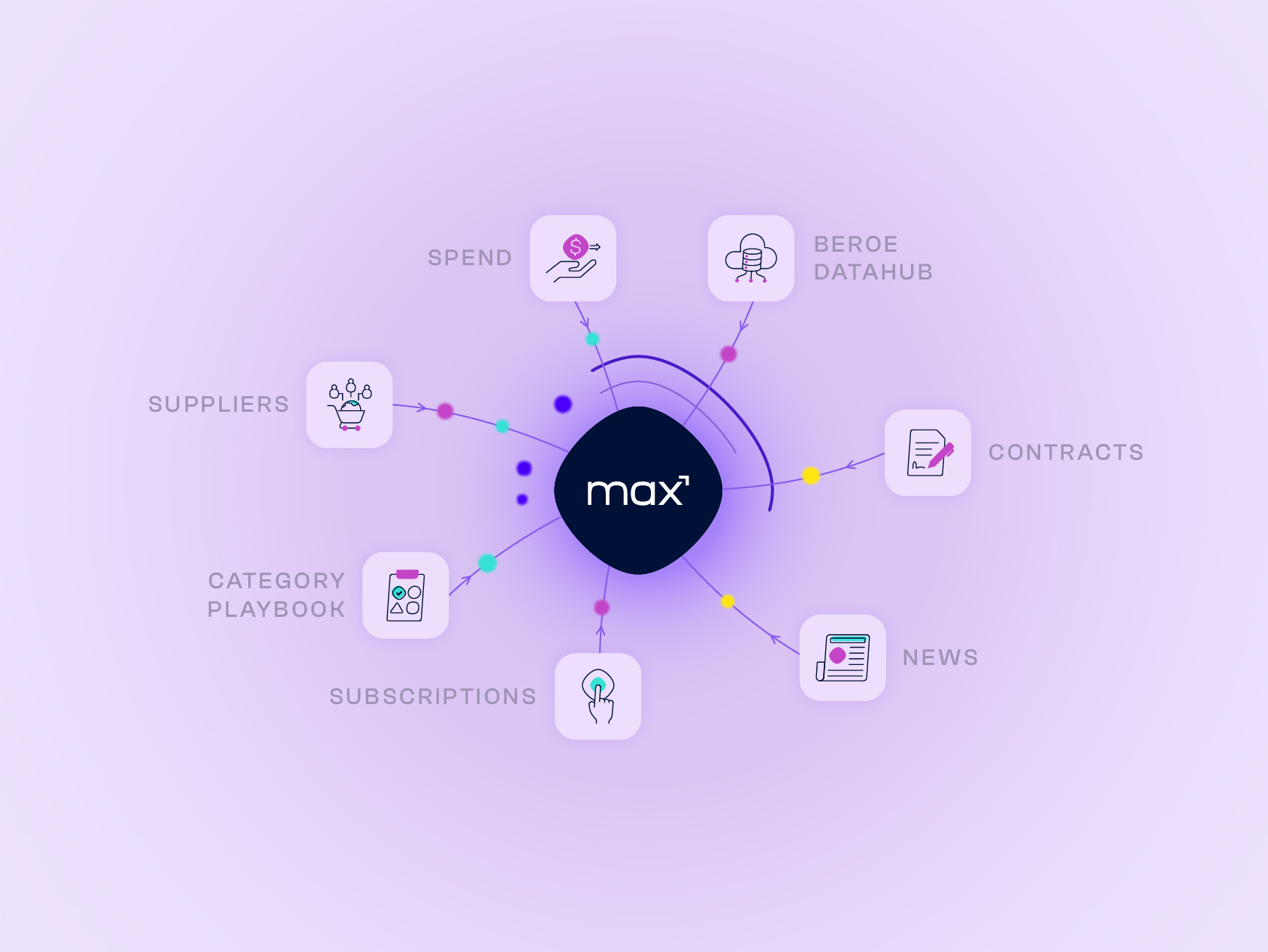
The procuretech landscape is crowded. But as Prerna and Markus described it, the market has largely split into two camps: tools that generate insight (analytics, risk monitoring, ESG, performance tracking) and tools that help execute (sourcing, supplier management). What has been missing is the connecting layer, the system that takes all the data, links it to your specific spend, contracts, and supplier base, applies procurement logic, and tells you what to do about it. Today, that connecting layer is almost entirely human. Analysts and category managers assemble the picture by hand, and that manual effort is where the lag between a market signal and a decision builds up.
Here, Markus explained, good consultants can come in and make improvements: look at the context, look at the market, draw on what has and hasn’t worked in a similar context, and come back with a prioritized set of actions. The catch is that this kind of help is often limited in scope and time. Beroe and Kearney asked why it could not run continuously instead, as an AI-native capability open to every category manager rather than the few with a consultant on hand.
Beroe MAX is their answer.
From episodic to always-on
The central idea behind Beroe MAX, is what Beroe and Kearney call continuous competitiveness: moving procurement from periodic sourcing to always-on opportunity, risk, and value sensing.
When a market event, trigger, or change in business data comes in, Beroe MAX assesses relevance: does this impact one of your initiatives, create a new opportunity or risk, or change a previous recommendation? Thresholds are built in to filter for relevance because, as Prerna stressed, the aim is to separate the signal from the noise, reducing cognitive overload rather than adding to it.
Beroe MAX surfaces the decisions needing attention before teams have to go looking for them, which is a very different experience from logging into yet another dashboard to check for updates. By continuously screening internal data and external signals, Beroe MAX also adds capacity that never sleeps, so teams can finally examine the spend pockets that used to go untouched for lack of time.
As Prerna put it, the aim is to open up consultant-grade decisions to the whole procurement community. It doubles as a category companion: a newer category manager can chat with it to learn the levers that tend to work, while an experienced one can use it as a brainstorming partner grounded in their own spend, Beroe’s market intelligence, and Kearney’s methodology.
What the demo revealed
The live walkthrough, logging in as a corrugated category manager, anchored the concept in a concrete example. Rather than presenting raw charts, Beroe MAX opened on a personalized summary: opportunities in the portfolio, impacted by market signals detected in the preceding hours.
How does Beroe MAX do this?
It thinks like a procurement consultant. Instead of trying to analyze everything at once, Beroe MAX starts from a pre-configured industry and category view and the levers and opportunities that tend to drive value in that specific context, then runs diagnostic “proof point” checks: is the price trend in line with the market? Is the supply base concentrated? Is the contract structure appropriate? Each opportunity is then qualified on four parameters: savings size, risk and resilience impact, implementation complexity, and confidence.
It is transparent about what it doesn’t know. Every recommendation carries a confidence score, and Beroe MAX is explicit when it needs more context, prompting the user with targeted questions instead of faking certainty. Recommendations are split into qualified opportunities, where there is enough data and context to be confident, and potential ones, which are historically effective but not yet validated for the current situation.
It connects the market to the user’s exposure. Rather than showing a generic tariff alert, Beroe MAX marries that event to actual contracts, supply corridors, and the supplier base, doing the analysis a category manager would otherwise have to assemble manually across multiple systems.
And it compresses the time to action. Beroe MAX can generate editable outputs on demand, including a stakeholder-ready PowerPoint, a contract improvement checklist, or a phased implementation roadmap, shrinking the time between a market trigger and a defensible decision.
What makes Beroe MAX trustworthy: the architecture
A recurring theme was that Beroe MAX goes well beyond an LLM wrapper. It runs on a neurosymbolic architecture, a deliberate combination of symbolic AI and neural generative AI, working in concert across three layers.
The symbolic layer holds the knowledge graph and the codified Kearney methodology, including the Purchasing Chessboard™ framework, proof points, and decision logic, as deterministic rules. Give it the same input, and it returns the same output, every time. The neural layer handles language, reasoning, and interpreting what a user is asking in natural terms, drawing on different LLMs depending on which performs best for each use case. An orchestration layer runs the loop between them, and critically, every neural output is checked against the symbolic rules before it reaches the user.
The result is a system whose recommendations are traceable to the evidence and method behind them, underpinned by Beroe’s 30 million proprietary, validated data points, 400+ category analysts, and a network of 2,500 experts, plus Kearney’s benchmarks built on real-world outcomes rather than theory. Customer data is not used to train or fine-tune shared models.
Where Beroe MAX adds value today
Traditional, calendar-driven procurement can no longer keep pace with the markets it buys from. Beroe MAX is designed to change that operating model: continuously reading internal and external signals, translating them into evidence-backed opportunities, and giving category teams a clear path from insight to action.
For category managers, that means less time assembling data and more time making decisions. For CPOs, it means greater visibility into where value is being created, where risk is building, and where the organization needs to act next. That is the shift at the heart of continuous competitiveness: procurement is no longer competing once or twice a year, but every day.
Want to see how Beroe MAX could work for your team? [Get in touch] or [watch the full webinar on demand].
Related Reading

19 Aug, 2026
From cost savings to continuous competitiveness: The new procurement imperative


27 Jul, 2026
The one-point win that cost 960,000 euros: Inside the Beroe Negotiations powered by nnamu showcase