Beroe Live.ai
 Abi - AI Assistant
 1. Category Watch
 Category Insights
 Alerts & Advisories
 Benchmarking
 Geopolitical Alerts
 Sourcing Location Optimizer
 2. Supplier Watch
 Supplier Discovery
 Supplier Risk Monitoring
 Supply Chain Disruptions
 3. Inflation Watch
 Cost & Price Intelligence
 Commodity Analytics
 4. Risk Watch
 Supplier Risk Monitoring
 Supply Chain Disruptions
 Geopolitical Alerts
 DataHub
 Global Sourcing Analyst
 All Resources
 News
News Events
 Webinar
 White Paper
 In The Press
 Leadership
 Beroe Live.ai


Power availability is no longer an afterthought
Power availability has become the defining constraint on global data center expansion. AI adoption is pushing rack densities beyond the assumptions of legacy facilities, while grids in established hubs face congestion, stricter licensing and multi-year interconnection queues. The result is a market where deliverable megawatts now shape siting, design, supplier risk, and time-to-revenue.
This blog reframes the issue for procurement and infrastructure leaders: time-to-power is now the new time-to-market. Projects that secure firm, clean, and grid-deliverable capacity early will gain advantage over projects that treat power as a late-stage utility input.
How is power emerging as a critical bottleneck?
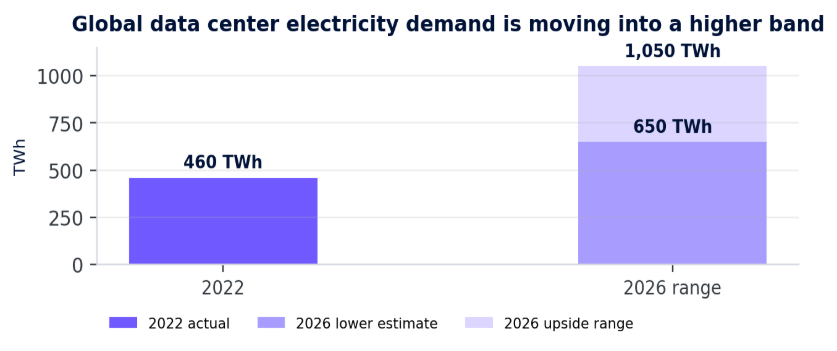
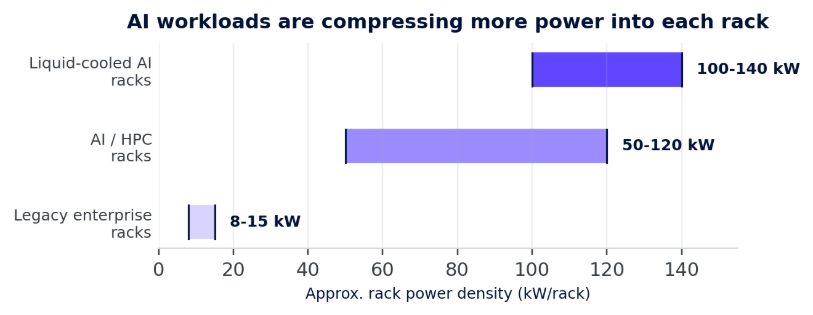
Power availability has emerged as the critical bottleneck shaping global data center expansion, fundamentally altering how organizations plan, source, and deploy digital infrastructure. As AI adoption accelerates, data center power demand is projected to reach 650–1,050 TWh by 2026, while rack densities surge to 100–140 kW in advanced AI environments, far exceeding legacy design assumptions.
This rapid escalation is colliding with structural constraints in power systems, including grid congestion, multi-year interconnection delays, regulatory restrictions, and extended lead times for critical electrical infrastructure (often 24–48 months). The result is a fundamental market shift: access to deliverable megawatts, and not land, capital, or connectivity is now the primary determinant of project viability and speed to market.
| Demand band | AI rack density | Grid queues | Equipment lead time | Policy direction |
|---|---|---|---|---|
| 650-1,050 TWh by 2026 [1][2] | 50-120+ kW/rack; 100-140 kW in liquid AI [12][13] | ERCOT / PJM large-load pressure [3][5] | 24-48 months for key electrical gear [18] | Moratoria, selective licensing, renewable matching [6][9] |
Between 2023 and 2026, data center planning shifted from a demand-led model to a power-constrained model. Land, capital and fiber remain important, but they no longer determine whether a campus can be delivered on schedule. The primary test is whether a developer can demonstrate firm interconnection, credible energy sourcing, and electrical infrastructure availability.
The shift is strongest in AI-oriented deployments. Training and inference clusters require much higher power density than conventional enterprise computing, and the supporting cooling architecture must be designed from the outset. This has changed how operators evaluate markets.
From the old development model to the AI-era model
| Planning dimension | Earlier market assumption | AI-era reality |
|---|---|---|
| Primary bottleneck | Land, connectivity and capital | Firm, deliverable and decarbonized megawatts |
| Facility design | Air-cooled halls with moderate density | Liquid-ready halls for 100-140 kW/rack clusters |
| Energy procurement | Grid power plus renewable certificates | Long-term firm clean power: nuclear, geothermal, renewable + storage |
| Approval logic | Planning consent and utility service | Grid stability, ESG reporting, heat reuse and renewable matching |
Implications for sourcing teams
• Power due diligence should begin before land shortlisting, not after site selection.
• Commercial evaluation should include interconnection date, transformer availability and local policy risk.
• A low-cost site without firm power can become a stranded capital commitment.
What are the structural constraints limiting data center capacity?
The core problem is a structural mismatch between AI-era power requirements and the speed at which electricity systems can deliver new capacity. The constraint is not one issue; it is a combination of higher rack density, interconnection backlog, policy limits, equipment shortages, and tougher sustainability obligations.
Five structural constraints
| Constraint | What is changing | Why it matters |
|---|---|---|
| 1. AI density surge | 50-120+ kW per rack is becoming common; liquid-cooled AI racks can approach 100-140 kW. | Legacy electrical and cooling designs may not support new deployments. |
| 2. Grid queue congestion | ERCOT and PJM are seeing large-load growth tied heavily to data centers. | Interconnection uncertainty can delay revenue and alter siting decisions. |
| 3. Policy controls | Dublin, Amsterdam and Singapore are linking growth to grid stability and sustainability. | Approvals increasingly depend on energy strategy, not only construction readiness. |
| 4. Equipment bottlenecks | Large transformers and high-voltage switchgear can require 24-48 months. | Supply chain timing can become the longest path in the project plan. |
| 5. ESG and reporting pressure | EU reporting, heat reuse, water efficiency, and tax changes are becoming material. | Compliance readiness must be designed early to avoid retrofit cost. |
Criteria for evaluating solutions
In a power-constrained market, site selection should be evaluated through a grid-and-power readiness lens.
Table-1: Grid and Power Readiness Criteria for Site Selection
| Criteria | Decision question | Procurement / planning implication |
|---|---|---|
| Interconnection deliverability and date | Are megawatts firm, scheduled, and supported by transformer / HV equipment milestones? | Determines time-to-revenue and reduces capital at risk [18]. |
| Local policy regime | Are moratoria, selective licensing, renewable matching or efficiency rules in force? | Avoids locations where approval risk can block or delay projects [6][9]. |
| Firm and clean power pathways | Can the site access nuclear PPAs, geothermal, renewable + storage or tariff innovation? | Improves license competitiveness and sustainability alignment [14][15]. |
| Cooling and density readiness | Can the facility support liquid cooling, CDU distribution and high delta-T operation? | Enables 100-140 kW/rack AI environments without efficiency loss [12][13]. |
| Grid growth outlook | Do ISO/TSO forecasts, transmission plans and queue reforms support future load growth? | Reduces curtailment and congestion risk across the facility life cycle [3][4]. |
| Policy-driven ESG alignment | Are heat reuse, energy reporting, tax treatment and environmental disclosures built in? | Reduces compliance risk in Europe and similar regulated hubs [16][17]. |
Which data center markets have the edge in 2026?
Power constraints are changing the relative attractiveness of global data center markets. Mature hubs still offer demand proximity and network depth, but approval and interconnection risk has increased. Emerging or secondary markets may benefit only where grid deliverability, clean power and transmission plans are credible.
Table-2: Selected Market Snapshots – Power Policy and Access
| Market | Power access situation | Policy / operator signal | Constraint level |
|---|---|---|---|
| Dublin, Ireland | Grid access reopened under strict conditions requiring on-site generation/storage and 80% renewable matching. | Regulatory reset focused on grid stability and energy alignment [6][7]. | High |
| Amsterdam, Netherlands | Electrical grid capacity remains constrained; new construction is limited. | Restrictions linked to power availability and land-use priorities [8]. | High |
| Singapore | Controlled expansion with around 300 MW near-term release plus 200 MW for green pathways. | DC-CFA awards capacity to efficient, sustainability-ready operators [9][10]. | High |
| Northern Virginia / PJM | Rapid data center demand is increasing capacity pressure and transmission planning needs. | Operators report record demand and ongoing queue reform [3][19]. | High |
| Texas / ERCOT | Large-load requests surged, with more than 70% tied to data centers. | Planning and regulatory coordination underway to manage queue growth [4][5]. | High |
| Nordics | Strong renewable resources, but tax and reporting policy changes affect planning. | Renewables remain attractive; policy economics require review [16][17]. | Medium |
Solutions for procurement teams
The recommended response is a three-track power strategy. The tracks should be assessed together because grid access, energy sourcing, and density design are interdependent. A site that succeeds on only one track can still fail commercially if the other two are weak.
Table-3: Three-Track Power Strategy for AI Era Data Centers
| Track | What it involves | Key levers | Expected outcome |
|---|---|---|---|
| A. Secure the Megawatts | Treat power procurement as the first site selection variable. Prioritize verifiable, deliverable capacity. | Advance ordering of transformers and HV gear; co-funded grid upgrades; permits and equipment POs aligned with queue milestones. | Lower time-to-power risk and stronger position in selective approval processes [18]. |
| B. Lock Firm and Clean Supply | Integrate nuclear PPAs, geothermal, renewable + storage and tariff innovation into the sourcing plan. | 15–20-year PPAs; offtake-linked licensing; firm-resource focus in PJM and ERCOT. | More resilient operating cost profile and stronger sustainability compliance [14][15]. |
| C. Build for Density and Efficiency | Design for AI-ready density and emerging environmental obligations from day one. | Liquid cooling, warm-water loops, high delta-T operation, water efficiency and heat reuse. | Ability to support 100-140 kW/rack loads while improving PUE/WUE and ESG alignment [12][13][16][17]. |
Organizations planning new capacity should make power a board-level sourcing issue. The following checklist translates the analysis into an execution playbook for procurement, real estate, engineering, and sustainability teams.
Executive Action Checklist
| Priority | Action | Procurement implication |
|---|---|---|
| 1 | Make power availability the first site-selection filter. | Avoids stranded land, delayed builds, and unfunded grid dependencies. |
| 2 | Secure long-lead electrical equipment early. | Reduces 24–48-month transformer and switchgear schedule exposure [18]. |
| 3 | Prioritize firm clean energy procurement. | Improves reliability, license viability, and ESG alignment [14][15]. |
| 4 | Design for high-density AI from the outset. | Supports 100-140 kW/rack density with better cooling and water performance [12][13]. |
| 5 | Build compliance reporting into operations. | Prepares for EU energy reporting, heat reuse and policy-driven disclosures [16][17]. |
| 6 | Engage utilities, ISOs and regulators directly. | Improves queue visibility and creates options for co-funded grid upgrades [3][4]. |
Time-to-power is the new indicator of success
Power availability is now the central factor shaping data center strategy. AI demand, grid congestion, long electrical equipment lead times, and stricter policy regimes have made deliverable megawatts the foundation of market access. Operators that secure power early, contract firm clean supply, and build for density will reduce schedule risk and improve long-term competitiveness.
The strategic lesson is direct: in the AI-era data center market, time-to-power is the new time-to-market.
References
- International Energy Agency (IEA), “Electricity 2026,” [Online]. Available: https://www.iea.org/reports/electricity-2026. [Accessed: March 2026].
- DatacenterDynamics, “Global data center electricity use to double by 2026 – IEA,” [Online]. Available: https://www.datacenterdynamics.com/en/news/global-data-center-electricity-use-to-double-by-2026-report/. [Accessed: March 2026].
- U.S. Energy Information Administration (EIA), “We expect rapid electricity demand growth in Texas and the mid-Atlantic,” [Online]. Available: https://www.eia.gov/todayinenergy/detail.php?id=65844. [Accessed: March 2026].
- DatacenterDynamics, “EIA: Retail electricity sales in PJM and ERCOT set to soar…,” [Online]. Available: https://www.datacenterdynamics.com/en/news/eia-retail-electricty-sales-in-pjm-and-ercot-set-to-soar-over-next-two-years-driven-by-data-center-growth/. [Accessed: March 2026].
- HVDC America, “ERCOT’s Large Load Queue Jumped Almost 300% in 2025,” [Online]. Available: https://www.hvdcamerica.org/post/ercot-s-large-load-queue-jumped-almost-300-in-2025. [Accessed: March 2026].
- Energy Connects / Bloomberg, “Ireland Ends Moratorium on New Power Links to Data Centers,” [Online]. Available: https://www.energyconnects.com/news/utilities/2025/december/ireland-ends-moratorium-on-new-power-links-to-data-centers/. [Accessed: March 2026].
- KPMG Ireland, “Ireland’s data centre policy reset,” [Online]. Available: https://kpmg.com/ie/en/insights/energy-utilities-telecoms/irelands-data-centre-policy-reset.html. [Accessed: March 2026].
- NL Times, “Amsterdam not allowing any more data centers in the municipality,” [Online]. Available: https://nltimes.nl/2025/04/18/amsterdam-allowing-data-centers-municipality. [Accessed: March 2026].
- Infocomm Media Development Authority (IMDA) Singapore, “Green Data Centre (DC) Roadmap,” [Online]. Available: https://www.imda.gov.sg/how-we-can-help/green-dc-roadmap. [Accessed: March 2026].
- Singapore Economic Development Board (EDB), “Four data centre proposals selected as part of pilot DC-CFA,” [Online]. Available: https://www.edb.gov.sg/en/about-edb/media-releases-publications/four-data-centre-proposals-selected-as-part-of-pilot-data-centre-call-for-application.html. [Accessed: March 2026].
- The Register, “Power shortages threaten to cap datacenter growth,” [Online]. Available: https://www.theregister.com/2026/01/14/datacenter_expansion_power_limit/. [Accessed: March 2026].
- TrendForce via TechPowerUp, “Liquid Cooling to Scale in AI Data Centers…,” [Online]. Available: https://www.techpowerup.com/340164/liquid-cooling-to-scale-in-ai-data-centers-penetration-to-surpass-30-in-2025. [Accessed: March 2026].
- NVIDIA, “Blackwell Platform Boosts Water Efficiency by Over 300x,” [Online]. Available: https://blogs.nvidia.com/blog/blackwell-platform-water-efficiency-liquid-cooling-data-centers-ai-factories/. [Accessed: March 2026].
- The Register, “Three Mile Island may return to service earlier than thought,” [Online]. Available: https://www.theregister.com/2025/06/26/microsoft_tmi_nuclear/. [Accessed: March 2026].
- ThinkGeoEnergy, “Nevada approves first-of-its-kind geothermal power supply agreement,” [Online]. Available: https://www.thinkgeoenergy.com/nevada-approves-first-of-its-kind-geothermal-power-supply-agreement/. [Accessed: March 2026].
- European Data Centre Association (EU DCA), “Energy Efficiency Directive – Data Centre Reporting,” [Online]. Available: https://www.eudca.org/energy-efficiency-directive. [Accessed: March 2026].
- Swedish Tax Agency, “Sweden abolishes tax incentives for data centers,” [Online]. Available: https://knowledge.sdialliance.org/policies/sweden-abolishes-tax-incentives-for-data-centers. [Accessed: March 2026].
- Erena, “Data center land rush meets grid bottlenecks,” [Online]. Available: https://erena.me/2025/09/06/data-center-land-rush-meets-grid-bottlenecks-power-access-decides-sites/. [Accessed: March 2026].
- FactSet Insight, “Data Center Power Demand Begins to Surge Across the U.S.,” [Online]. Available: https://insight.factset.com/data-center-power-demand-begins-to-surge-across-the-u.s. [Accessed: March 2026].
Author

Abhishek Garg


Kannan Ramachandran
Related Reading

27 Aug, 2026
Pharmacovigilance outsourcing and global talent arbitrage: A procurement guide to cost, capability, and country choice