
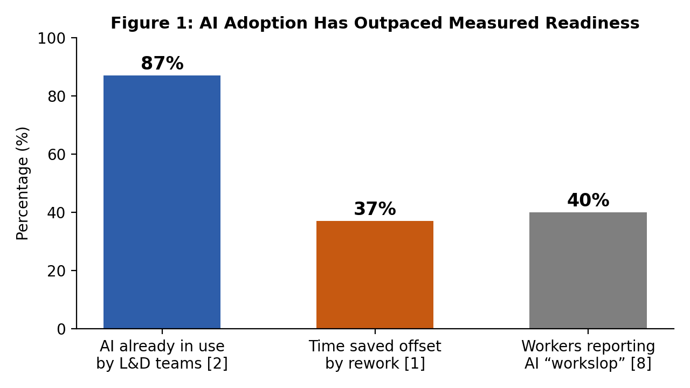
This blog examines a structural shift in Learning & Development (L&D) procurement, from paying for training consumption to paying for verified, AI-era capability. Drawing on primary insight, it traces how AI adoption, now reported at 87% among L&D teams [2], is outpacing the infrastructure organizations have built to measure what that AI-assisted work actually delivers. Independent research corroborates the gap: Workday finds 37% of AI-driven time savings lost to rework [1], while a separate study finds a comparable share of employees managing AI-generated “workslop” [8]. Beroe’s analysis frames this as Capability Debt, the widening distance between how fast organizations adopt AI tools and how slowly they build the data and governance needed to prove capability and offers L&D buyers a practical lens for closing it.
Artificial intelligence is changing how organizations design, deliver, and measure learning. But for L&D procurement, the more consequential shift may be happening underneath the technology, what exactly are organizations paying suppliers to deliver?
For years, learning contracts have largely measured consumption, courses delivered, learners reached, completion rates, and satisfaction. As AI becomes embedded in everyday work, however, the relevant question is increasingly whether employees can apply learning, exercise judgment around AI outputs, and produce better business outcomes.
Workday’s 2026 research illustrates the problem. While 85% of employees surveyed reported saving one to seven hours a week through AI, 37% of that saved time was estimated to be offset by rework, with employees spending an average of 1.5 weeks per year fixing AI outputs [1].
For L&D buyers, this creates a new procurement question. Should training be valued by how much learning is consumed, or by what employees can reliably do after learning?
Beroe analysis: How much does AI rework really cost?
Workday’s finding sits inside a wider pattern. Independent research from BetterUp Labs and the Stanford Social Media Lab found that 40% of US desk workers received AI-generated “workslop”, content that looks complete but lacks the substance to move work forward, in the past month, at an estimated cost of $186 per affected employee per month [8]. Table 1 places these independently run studies side by side; the consistency across methodologies is itself a signal that the rework problem is structural rather than anecdotal.
Table 1: Two independent studies, one pattern
| Source | Study focus | Key finding |
|---|---|---|
| Workday (2026) [1] | Time saved vs. time spent on correction | 37% of AI time savings offset by rework |
| BetterUp & Stanford (2025) [8] | AI output quality in daily work | 40% of desk workers received low value “workslop” in the past month ($186/employee/month in lost time) |
Source: Based on Workday [1] and BetterUp/Stanford [8]
Source: Based on Synthesia [2], Workday [1], and BetterUp/Stanford [8]
How AI in L&D is moving from content production to capability
AI adoption within L&D is no longer hypothetical. Synthesia’s 2026 AI in L&D Report, based on 421 L&D professionals and more than 20,000 data points, found that 87% of respondents were already using AI. Current applications are concentrated around production, voice generation, content and quiz drafting, video creation, and translation while the next wave is moving toward personalized learning, assessments, adaptive pathways, skills mapping, and AI tutors [2].
The architecture is changing too. Only 47% of Synthesia respondents expect the LMS to remain the backbone of their learning ecosystem over the next three years. AI capabilities are increasingly expected to sit across LMS/LXP platforms, productivity tools, standalone systems, and cross-system agentic layers [2].
This direction is visible among major learning-technology providers. Cornerstone, for example, has expanded its platform around AI-powered skills intelligence, personalized learning, AI coaching, and workforce data, positioning learning as part of a broader workforce-readiness ecosystem rather than a standalone course catalog [3].
From the service-provider perspective, this evolution also exposes a gap between what the industry discusses and what contracts can currently prove.
Beroe analysis: Capability debt and the AI readiness gap behind adoption
Adoption figures alone can overstate how prepared the workforce actually is. Study.com’s 2026 workforce research found that 35% of employees had received no AI training at all, and that among those who had, only 18% felt it prepared them to work independently, with just 32% reporting a clear standard for what good AI use looks like in their role [9]. Table 2 summarizes this readiness gap, which helps explain why the distinction Tarique Anwar draws below, between operating an AI tool and developing the judgment to challenge its output, is becoming central to how buyers evaluate L&D providers.
Table 2: The AI readiness gap
| Metric | Finding |
|---|---|
| Employees with no AI training | 35% |
| Trained employees who felt prepared to work independently | 18% |
| Employees with a clear standard for “good” AI use in their role | 32% |
Source: Based on Study.com [9]
Tarique Anwar, InfoPro Learning, explains:
“On measuring errors and rework contractually, the honest answer is most contracts are not there yet, because most MSAs still lean on training effectiveness clauses built around quizzes, surveys, and completion checks. What is changing is where the data comes from. We built OneGuru specifically because completion data alone was never going to answer this question, it pulls in something like 44 signals per employee across six systems, including performance platforms like Workday, Cornerstone, and Lattice, not just the LMS. Once you are pulling from performance data rather than course completion, tying training to something closer to error rate or rework becomes realistic instead of aspirational. So contractually measuring these outcomes is practical when the vendor’s platform is already wired into the client’s performance systems, and much harder when it is not.”
The underlying procurement implication is straightforward, outcome-based L&D contracting requires outcome-ready data infrastructure.
Outcome-based L&D contracts: Why the commercial model needs to catch up
ATD’s 2026 State of the Industry report shows that 55% of organizations provide practical AI-skills training, compared with 45% providing technical AI-skills training. ATD also highlights the growing need for employees to rethink and redesign work processes rather than simply optimize individual tasks [4].
That distinction matters. Training employees to operate an AI tool is different from developing the judgment required to challenge, validate, or override its output.
Yet commercial models have not fully made that transition.
“On the shift from paying for learning consumption to paying for verified capability, we have written about this gap ourselves and it is real. Most of the industry still talks outcomes in the sales conversation and then contracts on outputs, courses built, modules delivered, completion rates, because attribution is hard and most L&D teams have never connected their learning data to performance data in the first place. Where we have moved the needle is our Performance Guarantee, a public commitment to a minimum cost reduction while expanding learner reach, which is a step toward outcome tied commercial terms even though it is not yet a full pay for verified capability model. The honest path there runs through our platforms like OneGuru, building the shared dashboards and baseline data that would make a true outcome-based contract defensible for both sides, rather than promising it before the infrastructure exists.”
InfoPro Learning’s own published case material reports 50% faster onboarding and 25% higher conversions from an AI-powered sales-enablement program [5]. These figures are supplier-reported case results, not independent market benchmarks, but they illustrate the direction procurement is moving toward connecting learning interventions with operational measures rather than stopping at completion.
Beroe analysis: How L&D procurement criteria are shifting from consumption to capability
Reading Tarique Anwar’s commentary alongside the data above, Beroe sees this shift reshaping four dimensions of how L&D is bought and evaluated, summarized in Table 3.
Table 3: Shift in L&D procurement criteria
| Dimension | Traditional approach | Emerging approach |
|---|---|---|
| Primary metric | Completion rate, seat time | Error / rework rate, applied capability |
| Data source | LMS only | LMS + performance platforms (e.g., Workday, Cornerstone, Lattice) |
| Commercial model | Fee per learner / course | Performance guarantees, outcome-linked terms |
| Governance focus | Privacy policy reference | Model inventory, data lineage, bias testing |
Source: Beroe analysis, informed by Tarique Anwar (InfoPro Learning) and ATD [4]
AI governance in L&D procurement: What RFPs now need to cover
The expansion of AI into learning also changes what buyers need to evaluate. Synthesia found security, accuracy, integration, and legal constraints among the leading barriers to AI adoption in L&D, while 63% of respondents said they needed support in measuring impact rather than simply measuring speed [2].
Tarique captures the provider-side shift in procurement requirements:
“What that means for L&D procurement in practice is RFPs asking for a lot more than a privacy policy link, they want to see model inventory, training data lineage, and how bias gets tested before content or assessments go live.”
This aligns with the broader AI-governance direction. NIST’s AI Risk Management Framework identifies validity and reliability, safety, security, accountability, transparency, explainability, privacy, and fairness as key characteristics of trustworthy AI [6].
The regulatory context is evolving as well. Under the EU AI Act, AI-literacy obligations have applied since February 2025, while high-risk rules covering specified education and employment use cases are currently scheduled to apply from December 2027 [7].
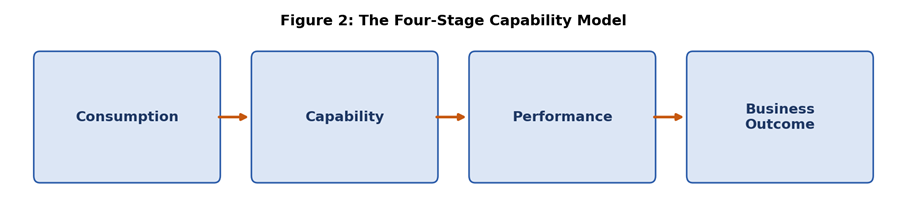
For procurement, this means AI-enabled learning should increasingly be evaluated across four dimensions:
Source: Beroe analysis, visualizing the framework described by Tarique Anwar, InfoPro Learning
The first remains measurable through traditional L&D metrics. The latter three require stronger assessments, performance data, governance, and agreed baselines.
The opportunity for L&D procurement is therefore not simply to buy more AI-enabled learning. It is to redefine what a successful learning engagement proves not just that people completed training, but that they developed capability, applied it responsibly, and produced a measurable difference in the work.
References
[1] Workday, “Measuring the Real Value of AI,” 2026.
[2] Synthesia, “AI in Learning & Development Report 2026,” 2026.
[3] Cornerstone, “Cornerstone Unveils Advanced AI and Skills Intelligence for Workforce Agility,” 2025. –
[4] ATD, “2026 State of the Industry Report Indicates Latest TD Trends,” May 2026. [ATD source]
[5] InfoPro Learning, “50% Faster Onboarding, 25% Higher Conversions: AI-Powered Sales Enablement.” [InfoPro Learning case material]
[6] E. Tabassi, Artificial Intelligence Risk Management Framework (AI RMF 1.0), NIST AI 100-1, National Institute of Standards and Technology, 2023.
[7] European Commission, “AI Act: Shaping Europe’s Digital Future,” 2026. [European Commission — AI Act]
[8] BetterUp Labs and Stanford Social Media Lab, “Workslop: The Hidden Cost of AI-Generated Busywork,” BetterUp, Sept. 2025.
[9] Study.com, “State of AI Jobs and Skills Report 2026,” Study.com, 2026.
Author

Ganthimathi S.


Tarique Anwar
Related Reading

12 Nov, 2026
Rig reactivation vs. newbuild: Which offshore drilling strategy makes economic sense?