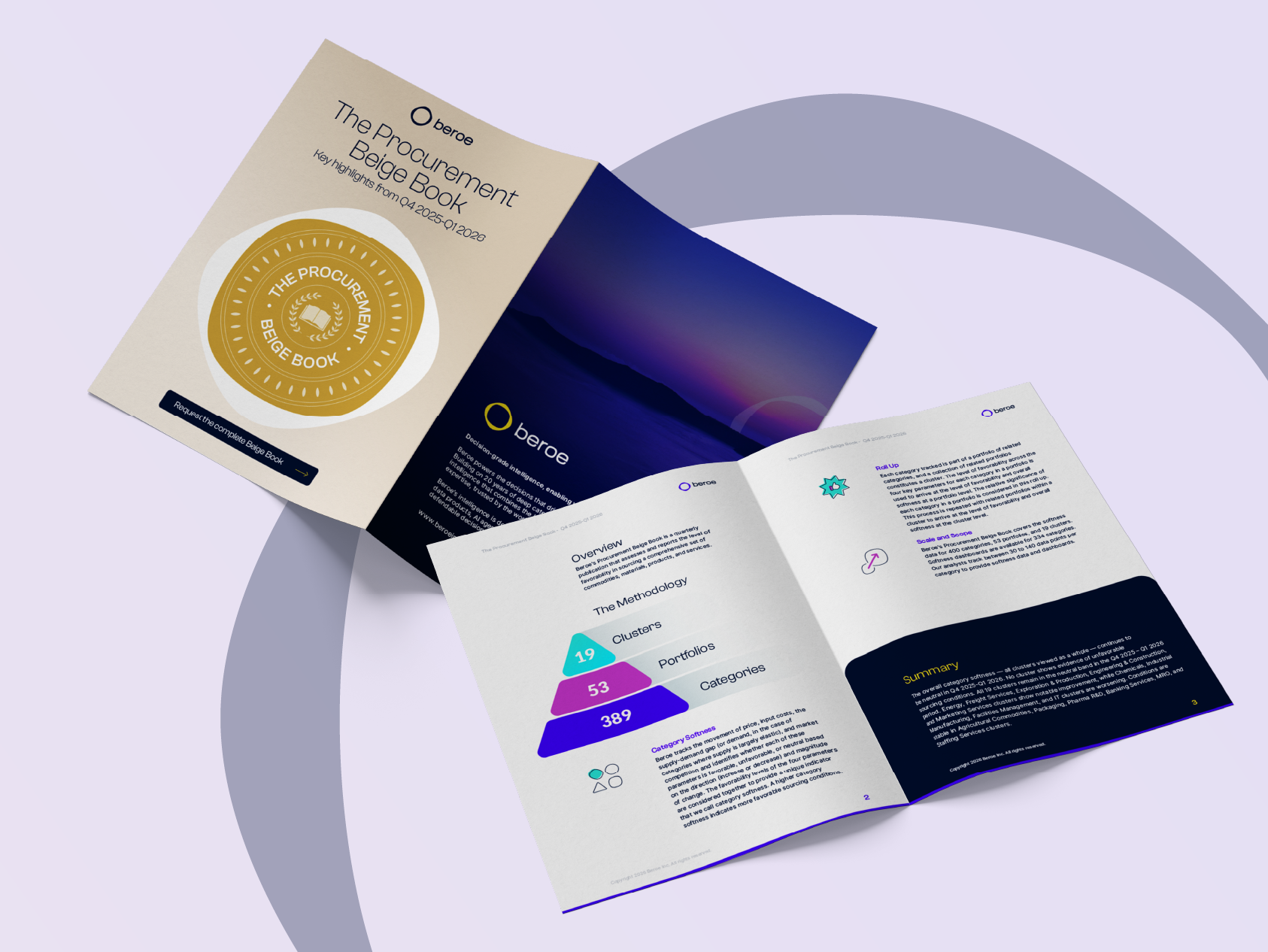
In our new whitepaper – Market Intelligence in the Age of AI: Why decision-grade intelligence matters when anyone can ask an LLM – we explore how AI is transforming market intelligence in procurement and what organizations should expect from it.
In the coming weeks, this blog series will look at the limitations of traditional market intelligence models, where AI adds value and where it introduces risk, what “decision-grade intelligence” looks like in practice, and how procurement teams can apply the right level of intelligence to the right decisions.
Today’s procurement leaders are being asked to make bigger decisions than ever before with less room for error. Category strategies have to hold up against volatile input costs, shifting regulations, geopolitical disruption, and increasingly complex supplier ecosystems. At the same time, procurement teams are expected to move faster, cover more, and deliver greater value – often with leaner resources.
The result is a tension that will be familiar to procurement specialists around the world: more data, more tools, more noise but, crucially, not more clarity.
Against this backdrop, generative AI is being added into the mix. Today, it can take just seconds to generate a market summary, draft a category narrative, or synthesize a trend using freely available GenAI tools. There is no escaping that they are rapidly becoming embedded in procurement workflows and market intelligence activities.
But this naturally raises a fundamental question: if market insight can be generated instantly, what is market intelligence actually worth? To answer this effectively, we need to separate speed from certainty and differentiate information from decision support.
Generic large language models (LLMs) are useful for breadth and pace. They can help teams get oriented, explore unfamiliar topics, and synthesize public information quickly. But the procurement decisions that materially affect margin, resilience, and continuity, must meet a higher standard. Business-critical tasks such as evaluating major supplier shifts, hedging strategies, engaging in high-value negotiations, and mitigating risk for critical categories, require intelligence that is accurate, explainable, defensible, and accountable.
Decision-grade market intelligence is that ‘higher standard’. It is the delta between AI-generated content and trusted intelligence that improves decision quality. Market intelligence should function as the foundation for all decisions in modern procurement. It underpins how organizations anticipate market shifts, engage the right suppliers, manage key risk factors, and proactively shape category strategy. The emergence of AI has changed the way some organizations think about market intelligence, but it has not removed the requirement for trusted data, procurement context, and human validation.
Our latest whitepaper explores how AI is reshaping market intelligence, where generic LLMs fall short (or break down entirely) for procurement use cases, and how an AI-enabled, human-validated model delivers trusted intelligence at scale. It also examines the concept of decision-grade intelligence in detail and outlines how this provides a fit-for-purpose framework for knowing when generic AI is sufficient and when specialist, validated, trusted market intelligence is essential.
Why does market intelligence matter today more than ever?
Procurement has progressed from being a function optimized for efficiency to one expected to manage uncertainty. In many enterprises, it now sits at the intersection of financial performance, supply assurance, ESG delivery, and enterprise risk. Volatility and disruption are no longer episodic events that teams “manage through.” They are persistent conditions, and they increasingly compound a range of factors: a regulatory shift affects a material input; a regional disruption changes logistics economics; a currency move alters supplier viability; a labor constraint reduces capacity; a climate event challenges both availability and demand.
Traditional approaches to market intelligence often struggle to connect those second- and third-tier factors quickly enough to protect decisions in flight. At the same time, procurement teams face the classic squeeze: do more with less, across more markets and categories, while stakeholder expectations become more immediate.
In this environment, market intelligence is not an optional input or a ‘nice to have’. It is becoming the strategic operating layer for modern procurement – powering how organizations anticipate market shifts, engage the right suppliers, manage risk, and shape category strategy with confidence. AI has accelerated this trend. It has also raised the stakes on what “trusted” must mean, because the fastest answer is not necessarily the safest one.
If you’re evaluating how AI is changing market intelligence in your organization:
Because in a world where anyone can generate an answer, the real advantage comes from knowing which answers you can trust and which ones you can act upon.
Related Reading