Physical AI marks a pivotal shift in robotics, enabling machines to perceive reason, and act intelligently within real-world environments. Moving beyond deterministic programming, these systems integrate advanced perception models, simulation learning, and real-time feedback to operate safely in dynamic, unstructured settings. Unlike traditional automation, Physical AI-driven robots continuously improve through data and software updates, redefining autonomy and adaptability across manufacturing, logistics, and industrial operations. For procurement and category managers, this transformation reshapes sourcing priorities. Robotics investments are no longer purely hardware decisions but strategic, software-driven ecosystems requiring evaluation of AI maturity, compute infrastructure, cybersecurity, and lifecycle scalability. As of 2026 organizations that align procurement strategies with Physical AI adoption will enhance operational resilience, optimize Total Cost of Ownership, and secure long-term competitive advantage in an increasingly autonomous industrial landscape.
Introduction
Industrial robotics has long been associated with precision, repetition, and efficiency. However, traditional robots operate within deterministic boundaries. They excel in structured environments but struggle when variability increases such as mixed SKUs, unpredictable layouts, or last-minute production changes. Physical AI changes this equation. Instead of relying purely on fixed programming, Physical AI systems combine advanced simulation environments, generative AI models, real-world sensor fusion, and reinforcement learning. The result is embodied intelligence, robots that understand context, interpret language-based instructions, and execute tasks with situational awareness.
The global Physical AI market is rapidly expanding, driven by advances in robotics, sensors, and intelligent systems that enable machines to sense, learn, and act in the physical world. It is estimated to be valued at approximately USD 7 billion in 2026 and is projected to reach around USD 25 billion by 2031, reflecting a ~32 to 35 % CAGR over the forecast period. Growth is fuelled by broad automation adoption across manufacturing, logistics, healthcare, and service sectors. North America leads the market, while Asia-Pacific and Europe show strong growth potential due to industrialization and supportive policies. Increasing deployment of cobots and AI-enabled robotics further amplifies market demand. [1]
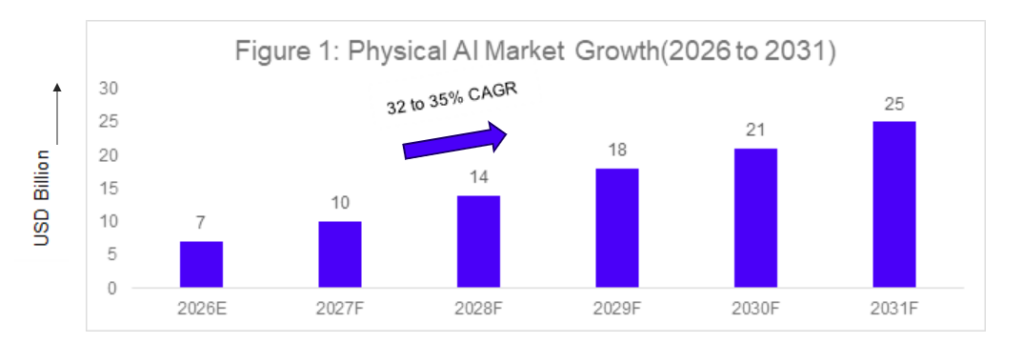
Source: International Federation of Robotics(IFR), Cervicorn [1] [2]
How Does Physical AI Work
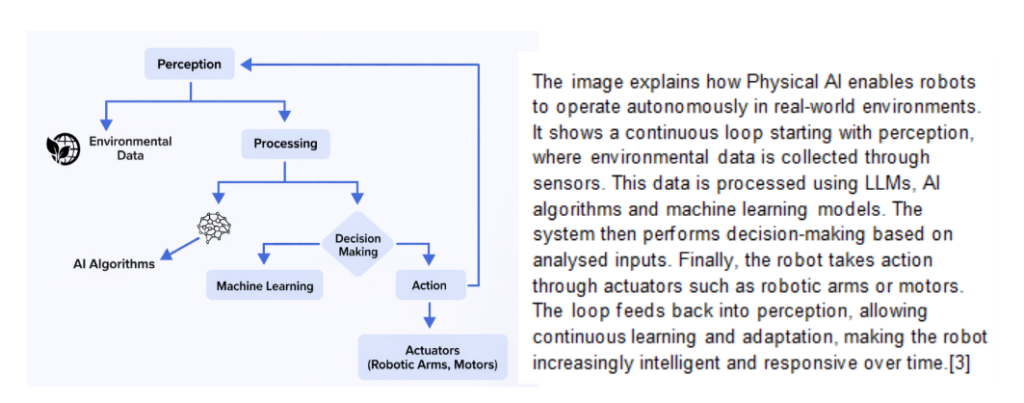
Source: Appinventiv [3]
Table 1 – Why Category Managers Need to Consider Physical AI in 2026 and Beyond
| Decision Area | Why It Matters | What to Target / Expect | Procurement Focus |
| Autonomy & Task Adaptability | Physical AI enables robots to perform variable tasks without rigid reprogramming | Faster changeovers; mixed-model production; reduced downtime | Evaluate AI learning capability, simulation tools, retraining cost |
| Risk & Reliability | AI-driven autonomy introduces new operational and cyber risks | Improved MTBF if well-governed; potential cyber exposure if unmanaged | Include cyber audits, fail-safe redundancy, model validation testing |
| TCO & ROI Structure | Cost shifts from labor savings to technology lifecycle management | Payback < 18–24 months; reduced rework; improved throughput | Conduct lifecycle cost modeling including compute, updates, training |
| Supply Chain Resilience | Adaptive robots reduce dependency on manual labor variability | Stable throughput during labor shortages; flexible SKU handling | Align robotics sourcing with regionalization and nearshoring strategy |
Source: NVIDIA,Adlittle,Beroe Analysis [4] [5]
Supplier KPI Scorecard with Review Cycle
Now once this model has been onboarded it becomes very important to identify metrics to evaluate the success of this model. The Supplier KPI Scorecard with Review Cycle is a structured framework designed to help procurement and category managers evaluate supplier performance across financial, operational, scalability, and sustainability dimensions. By setting clear targets (e.g., ROI and payback period within 12–18 months, MTBF > 95-99% uptime) and linking them to a defined review cadence (monthly, quarterly, semi-annual, or annual), organizations can ensure that supplier agreements remain measurable and accountable over time.
Table 2: KPI Scorecard for Physical AI Concept Related to Robotics
| KPI Category | What it Measures | Typical Targets | Review Cycle |
| Task Autonomy Rate | % of tasks completed without human intervention | ≥ 85–95% autonomy in defined workflows | Monthly review during first 6 months; quarterly thereafter |
| Mean Time Between Failure (MTBF) | System uptime and reliability | > 95–99% uptime | Real-time monitoring; SLA-based quarterly evaluation |
| AI Model Update Effectiveness | Performance gain post model/software update. | Measurable improvement per update cycle | Semi-annual technical audit |
| Cybersecurity & Data Compliance | Data integrity, system vulnerability exposure | Zero critical breaches; ISO/IEC alignment | Annual audit; continuous monitoring. |
| ROI / Payback Period | Financial return vs investment | Payback < 24 months | Annual board-level review. |
Source: KPI Depot, International Federation of Robotics(IFR) [6] [7]
Key Implications on the Supply Chain
1. Structural Shift from Labor-Driven to Intelligence-Driven Operations
Physical AI reduces dependence on manual and repetitive labor by enabling autonomous task execution in dynamic environments. This improves throughput stability during labor shortages, seasonal spikes, or geopolitical disruptions. For supply chains, this translates into predictable cycle times, reduced bottlenecks, and higher operational continuity. Procurement leaders must therefore rebalance cost structures from labor-heavy Opex models toward investments in computer infrastructure, software licensing, sensor ecosystems, and long-term AI service agreements.
2. Greater Flexibility and Responsiveness
Unlike traditional automation that requires rigid programming and tooling changes, Physical AI enables adaptive production and warehousing. Robots can interpret variable product types, layouts, and workflows without significant reconfiguration. This supports mass customization, shorter product lifecycles, and volatile demand cycles. From a sourcing perspective, buyers should prioritize modular robotics platforms and vendors offering scalable software updates, ensuring operational agility without repeated capital reinvestment or lengthy integration projects.
3. Emergence of Ecosystem-Based Supplier Models
Physical AI solutions rarely come from a single vendor. They involve robotics OEMs, AI model providers, simulation platforms, edge-compute suppliers, and systems integrators. This creates interconnected supplier ecosystems rather than standalone contracts. Supply chain governance must therefore evolve toward multi-vendor risk assessment, cybersecurity validation, interoperability standards, and shared performance accountability. Category managers must evaluate ecosystem resilience, upgrade compatibility, and long-term support capability to minimize integration risk and ensure sustained performance improvements. [8][9]
Conclusion
Physical AI is not just another upgrade in robotics, it changes how we think about buying automation altogether. For procurement teams, this means moving beyond evaluating motors, payload, and cycle times. We now need to understand AI capability, software updates, cybersecurity safeguards, and how well the system integrates into our broader digital ecosystem. Contracts should reflect that these robots will evolve over time, not remain static assets. Total Cost of Ownership must include licensing, compute power, retraining, and long-term support and not just the purchase price. Ultimately, Physical AI should be treated as a strategic capability investment. Those who approach it thoughtfully will build more resilient, adaptable, and future-ready supply chains.
References
[1] AI in Robotics: https://ifr.org/ifr-press-releases/news/ai-in-robotics-new-position-paper
[2] Physical AI market: https://www.cervicornconsulting.com/physical-ai-market
[3] Use case, Benefits and examples of Physical AI: https://appinventiv.com/blog/benefits-and-use-cases-of-physical-ai/
[4] https://www.nvidia.com/en-in/glossary/generative-physical-ai/
[5] https://www.adlittle.com/en/insights/viewpoints/physical-ai
[6] Robotics KPI: https://kpidepot.com/kpi-industry/robotics-393
[7] Robotics performance and benefits: https://ifr.org/industrial-robots
[8] Convergence of AI and Robotics: https://www.deloitte.com/us/en/insights/topics/technology-management/tech-trends/2026/physical-ai-humanoid-robots.html?
[9] Integration of robotics and automation in supply chain: https://www.extrica.com/article/23349
Author

Vijith Bhargavan

Related Reading

23 Mar, 2026
How Geopolitical Shock and Supply Discipline Are Reshaping Petrochemical Procurement in 2026