In this week’s blog taken from Beroe’s guide, An Introduction to Real Autonomous Negotiation, we explore the real-world challenges that autonomous negotiation can solve. Despite the rapid digitization of procurement, negotiation itself has remained largely manual, inconsistent, and time intensive. Autonomous negotiation reimagines this process from the ground up, with the potential to bring speed, scale and intelligence to every supplier interaction. By addressing the common barriers to automating negotiations – inconsistent outcomes, missed value opportunities and disconnected systems – autonomous negotiation can empower procurement teams to unlock higher value, secure stronger supplier engagement (and have better supplier relationships!) and drive measurable efficiency gains across the sourcing lifecycle.
What challenges does autonomous negotiation address?
Despite significant digital transformation in procurement, negotiation remains one of the most complex and under-optimized processes in the sourcing lifecycle. Traditional tools often digitize and automate parts of the process, but do not rethink the negotiation cycle itself. Autonomous negotiation changes that, addressing a range of persistent and systemic challenges:
9 challenges met by autonomous negotiation solutions
- Inconsistent negotiation outcomes
Establishes best practices and raise the baseline for all buyers – not just the most experienced
- Missed value opportunities
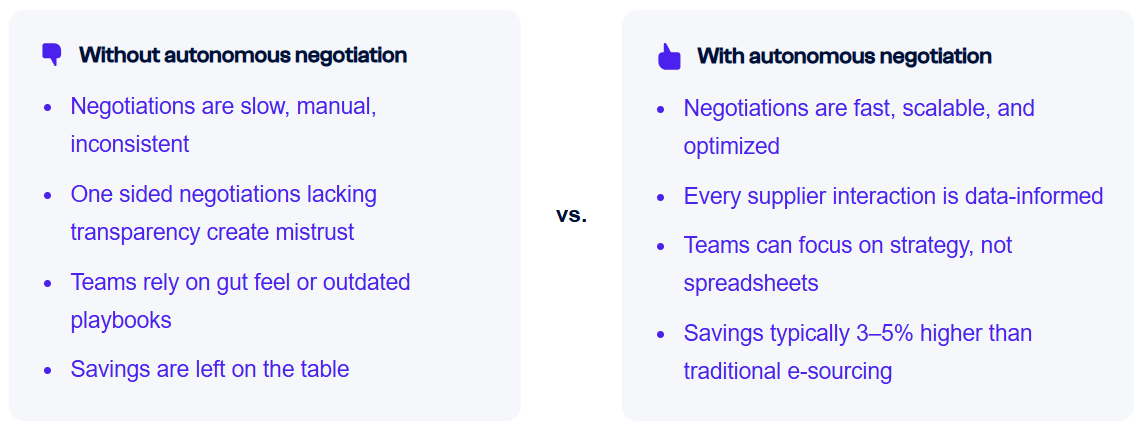
Identifies hidden levers and trade-offs, delivering 3-5% higher Total Value Optimization (TVO)
- Cognitive overload and time pressure
Handles complexity at scale, freeing up time for strategic thinking
- Slow and manual sourcing cycles
Cuts sourcing time by up to 50% through automation and pre-configured deal structuring
- Supplier fatigue and engagement decline
Improves clarity, fairness, and engagement through structured, transparent processes
- Scalability gaps
Extends strategic negotiation to tail and tactical spend
- Limited strategic foresight
Logs every decision, trade-off, and supplier response for auditability and learning
- Disconnected tools and data silos
Integrates with sourcing, risk, and supplier systems to unify execution
- Change management and governance hurdles
Embeds strategy within governance frameworks, ensuring compliance and transparency
The autonomous negotiation difference
To learn more, download our complete guide, An Introduction to Real Autonomous Negotiation here.
Author

Christian Paul

Related Reading

10 Mar, 2026
AI That Actually Works: Why MCP Integration is a Turning Point for Procurement Data

02 Mar, 2026
Why are Category Management Platforms a Gamechanger for Modern Procurement Teams