Beroe Live.ai
 Abi - AI Assistant
 1. Category Watch
 Category Insights
 Alerts & Advisories
 Benchmarking
 Geopolitical Alerts
 Sourcing Location Optimizer
 2. Supplier Watch
 Supplier Discovery
 Supplier Risk Monitoring
 Supply Chain Disruptions
 3. Inflation Watch
 Cost & Price Intelligence
 Commodity Analytics
 4. Risk Watch
 Supplier Risk Monitoring
 Supply Chain Disruptions
 Geopolitical Alerts
 DataHub
 Global Sourcing Analyst
 All Resources
 News
News Events
 Webinar
 White Paper
 In The Press
 Leadership
 Beroe Live.ai


Abstract
Contingent workforce management is undergoing a fundamental shift as enterprises rely more heavily on external talent to deliver agility, access scarce skills, and manage cost volatility. Traditional Managed Service Provider (MSP) models, originally designed to centralize staffing suppliers and streamline administration, are under growing pressure from today’s workforce realities. Fragmented talent channels, expanding Statement of Work engagements, rising regulatory scrutiny, and growing expectations for insight and visibility have exposed structural limitations in legacy MSP operating models.
This blog examines the forces driving the evolution toward next-generation MSPs and why enterprise confidence in traditional approaches has declined. It outlines how leading MSP models are redefining value by integrating workforce governance across contingent labor and services-based work, embedding advanced analytics and automation, and shifting from transactional execution to strategic workforce orchestration. Discover what this transition means for procurement and HR leaders as they reassess how managed services should support workforce design, risk management, and long-term business outcomes.
Contingent workforce management is at a strategic crossroads
Contingent workforce management has moved far beyond staffing administration. As organizations rely more on external talent to stay flexible and access scarce skills, procurement and HR teams are expected to bring stronger control, faster execution, and clearer visibility across contingent labor programs. At the same time, many enterprises are strengthening oversight in under-managed areas such as Statement of Work engagements and fragmented tail spend that often sits outside standard sourcing cycles.
Managed Service Providers have traditionally helped organizations reduce the operational burden of managing contingent labor by aligning suppliers, standardizing processes, and improving cost control. Increasingly, MSPs are also expected to provide decision-support through workforce and supplier insights, offering a clearer view of spend patterns, talent channels, performance, and compliance risks.
This shift is accelerating the move toward next-generation managed services programs – designed to manage multiple service channels under one framework. The goal is simple: deliver better governance, faster outcomes, and more useful visibility while freeing internal teams to focus on higher-value priorities.
Why traditional MSPs are no longer fit for purpose
Managed Service Providers have been the primary mechanism for managing contingent workforce programs. This approach was well suited to a workforce environment characterized by predictable demand, longer-term assignments, and supplier-led staffing models. However, as work has become more flexible and digitally enabled, the assumptions underpinning traditional MSP designs have weakened. Enterprises now operate in environments that demand faster hiring cycles, more specialized skills, and greater flexibility in how talent is engaged, exposing limitations in legacy MSP operating models [1].
This relevance gap is driven by a combination of structural shifts in how talent is sourced and deployed. The rise of freelance and project-based work, broader acceptance of remote delivery, and increasing reliance on alternative talent channels have changed both enterprise expectations and worker behavior. At the same time, legacy MSPs have struggled to adapt their technology, sourcing reach, and engagement models at the same pace, contributing to inefficiencies in talent acquisition and business outcomes. These pressures are further reflected in declining satisfaction levels reported by enterprise buyers, reinforcing the view that traditional MSP models are becoming misaligned with current workforce realities [1].
Table 1: Key Challenges in Legacy MSP Models
| Challenge area | What it typically looks like in legacy MSP programs | Business impact on contingent workforce management |
|---|---|---|
| Lack of agility | Rigid processes and long approval cycles that do not match fast-changing demand | Slower time-to-fill, delayed project starts, reduced responsiveness |
| Transaction-first operating model | Focus on processing requisitions rather than workforce planning and outcomes | Limited strategic value, weaker linkage to business goals |
| Outdated technology and manual effort | Workflow-driven VMS reliance and manual coordination across stakeholders | Administrative overhead, errors, limited real-time insight |
| Limited access to global and niche talent | Restricted supplier networks and limited use of newer talent channels | Reduced access to specialized skills, slower hiring |
| Compliance and risk management gap | Difficulty keeping pace with worker classification and cross-border or remote requirements | Higher compliance exposure and audit risk |
| Supplier frustration | Rate caps and process constraints reduce supplier incentive to prioritize quality | Lower candidate quality and slower supplier response |
| Contingent worker experience gap | Slow communication and fragmented onboarding driven by process-first design | Lower acceptance rates and higher c |
Source: AMS, Contingent Compass
Declining enterprise confidence in MSPs
According to global research and advisory firm SIA’s Net Promoter Score, enterprise buyers have become less willing to recommend MSP solutions over the past decade. The pattern points to broader concerns about whether today’s MSP operating models and supporting technology are keeping pace with how contingent workforce programs are evolving. Recent results from SIA’s annual Workforce Solutions Buyer Survey indicate that both the platform layer and the service layer are facing increasing scrutiny from enterprise stakeholders.
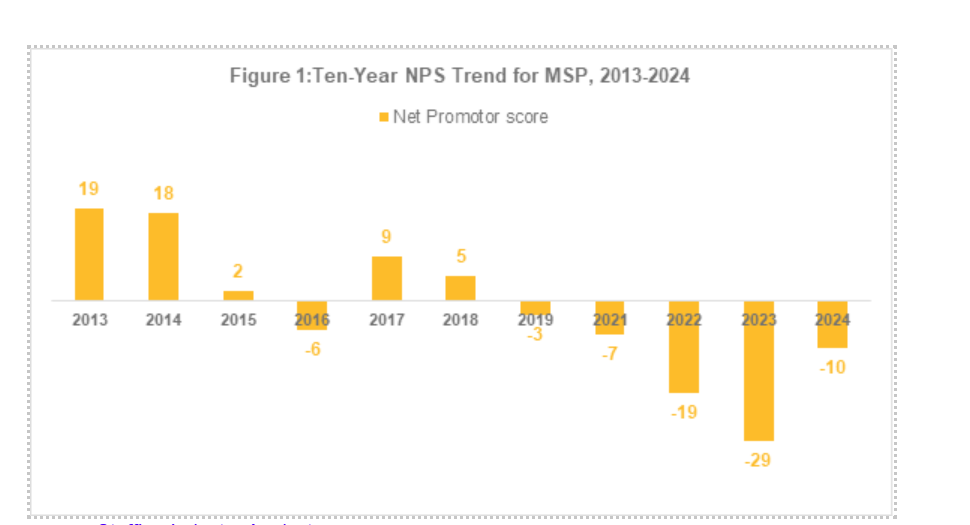
Source: Staffing Industry Analysts
Redefining MSPs for the next generation
A next-generation MSP supports a shift from vendor coordination to workforce orchestration. These providers combine governance, integrated technology, and real-time intelligence to manage contingent labor alongside services-based engagements such as Statement of Work and selected tail spend within a single operating framework. The objective is consistent control, and clearer accountability across workforce and procurement outcomes [10].
What differentiates these models is disciplined end-to-end delivery supported by insight-led governance. Automation reduces manual effort across supplier onboarding, requisition workflows, approvals, and compliance checks, while supplier management expands beyond basic coverage toward higher-performing ecosystems that can include qualified and diverse suppliers were aligned to enterprise objectives. Analytics then provides real-time visibility into workforce and spend dynamics to uncover cost leakage, operational inefficiencies, and compliance risk in fragmented sourcing and unmanaged SOW activity, enabling smarter consolidation, stronger compliance confidence, and better outcomes beyond process efficiency [8].
Technology is the catalyst for MSP reinvention
Technology is the primary driver reshaping MSP operating models – AI, machine learning, and automation are being embedded into delivery to address long-standing gaps in visibility and scalability. Leading programs use AI to forecast demand for critical skills, improve candidate matching, benchmark rates, flag compliance risk, and deliver real-time dashboards that strengthen workforce and spend visibility. By end of 2025, over half of organizations are expected to adopt AI-driven workforce management solutions [3].
Capabilities such as resume parsing, job description creation, candidate communication, and interview scheduling are increasingly AI-enabled, while process automation reduces manual effort in onboarding checks, timesheet validation, invoicing, and data reconciliation. The result is faster hiring cycles and more consistent execution, with delivery teams freed to focus on supplier optimization, stakeholder alignment, and program design.
How leading service providers are leveraging AI and automation
- AMS has embedded AI, automation, and predictive analytics within its AMS One platform to support faster hiring decisions, conversational candidate engagement, and unified data across permanent and contingent talent programs.
- AGS uses its Acumen platform with intelligent sourcing, stack ranking to automate screening, onboarding, audits, and workflows.
- AMN Healthcare applies AI for credential-based candidate matching, predictive supplier selection, and large-scale recommendation engines for healthcare staffing.
- Hays focuses on generative AI, PowerApps to streamline recruitment workflows and recruiter productivity.
- KellyOCG leverages AI, NLP, and RPA through its Helix and KellyFusion platforms to automate routine tasks, onboarding, compliance, and digital workforce delivery.
- Magnit embeds AI across job matching, skills intelligence, rate optimization, predictive analytics, and RPA-driven workflows to enable data-led workforce decisions.
- Pontoon uses AI for candidate matching, offer prediction, and onboarding automation via PontoonON, supported by GenAI initiatives with Microsoft.
- Randstad Sourceright deploys conversational AI, resume parsing, automated onboarding, and enterprise-scale automation to improve candidate experience and reduce manual effort.
- TAPFIN applies explainable AI and machine learning for sourcing, skills matching, job taxonomy mapping, job description simplification, and RPA-driven analytics, invoicing, and performance reporting across the MSP lifecycle.
Key trends reshaping contingent workforce management
- Transactional delivery evolves to true partnership: The MSP model is increasingly defined by its ability to reduce friction across the contingent workforce lifecycle and operate as a trusted partner. The focus is moving away from managing requisitions and transactions toward enabling outcomes by aligning workforce execution with client priorities and business objectives.
- End to end workforce supply chain ownership as a standard: Managed service delivery is expanding from coordination into broader supply chain ownership, covering vendor management, program oversight, analytics, compliance, and safety governance. This approach supports faster program stabilization, quicker realization of savings, and stronger process consistency across regions and business units.
- Expansion into SOW and services procurement to improve visibility: The MSP model is extending beyond contingent staffing into Statement of Work and services procurement. This expansion improves unified visibility across external labor categories and enables more consistent governance, reporting, and decision making across workforce spend that was previously fragmented.
- Compliance and governance become a primary value pillar: Regulatory complexity and worker classification scrutiny are elevating the importance of compliance and governance. The MSP model is increasingly expected to embed stronger controls, improve oversight, and reduce risk exposure, especially in large, multi-region programs.
- Data transparency and analytics for better decisions: Organizations are placing greater emphasis on structured data sets, benchmarking insights, and performance visibility to support workforce reviews and executive decision making. Strong analytics improves accountability and strengthens confidence in program outcomes.
- Strategic advisory as a core MSP capability: The MSP model is evolving into a workforce advisory function that supports strategy as well as execution. This includes guiding workforce optimization, shaping external labor approaches, and aligning workforce design to business priorities as complexity increases.
- Worker experience and relationship management gain importance: Contingent workforce programs are placing more emphasis on worker experience alongside tactical end to end workflow management. Engagement and satisfaction are being treated as important because they influence client outcomes.
- Total Talent Management becomes the organizing model: MSPs are becoming the coordinating layer to unify permanent hiring, contingent labor, Statement of Work engagements, and freelance talent under a single workforce framework. This reduces silos, improves coordination across talent channels, and enables organizations to deploy the right mix of skills more effectively. The result is a more integrated workforce strategy that supports agility, scalability, and long-term competitiveness.
Table 3: Legacy vs. Next-Gen MSP outcomes
| Dimension | Legacy MSP Model | Next-Generation MSP Model |
|---|---|---|
| Core orientation | Process and supplier administration focused on compliance and cost control | Workforce orchestration focused on outcomes, agility, and talent access |
| Role and value delivered | Operates as an operational service provider focused on process execution | Acts as a strategic workforce partner aligned to productivity, quality, and delivery outcomes |
| Technology approach | Legacy VMS and manual processes used primarily for tracking and reporting | Integrated digital platforms using AI, automation, and task management across channels |
| Speed and adaptability | Rigid processes and approval cycles that limit responsiveness | Agile workflows that scale up or down with changing business demand |
| Talent access and workforce scope | Relies mainly on staffing suppliers with limited or no direct sourcing and focuses primarily on contingent labor staffing | Embeds direct sourcing and hybrid models with integrated oversight across contingent labor, SOW, and the broader talent ecosystem |
| Data usage | Historical reporting and periodic performance reviews | Predictive insights and real-time intelligence to support proactive decision-making |
| Candidate Experience | Uniform, recruiter-driven candidate engagement with limited customization, manual touchpoints, and heavy dependence on recruiters for updates and coordination | Digitally enabled candidate engagement that dynamically adjusts to individual profiles and interactions, enabling candidates to independently manage applications, scheduling, and receive contextual guidance in real time |
Source: Talent Works, AMS, Talent Solutions
What the MSP model looks like in 2026 and beyond
These trends represent a structural shift rather than a continuation of existing practices. While the trends above reflect how MSPs are evolving today, the 2026 model signals a fundamentally different way of designing, governing, and operating the extended workforce.
In practice, the MSP will function as an orchestration layer across a blended workforce, connecting contingent labor, freelance and gig talent, and services-based work into one governed ecosystem. Differentiation will come from how effectively the provider applies AI-enabled intelligence for workforce planning and delivers modular support that integrates with mature in-house capabilities, without sacrificing control, compliance confidence, or visibility.
How to choose the right next generation MSP
- Prioritize customization and strategic partnership: Avoid one-size-fits-all solutions; choose MSPs that tailor services to your business and act as invested, long-term partners.
- Ensure modern technology and innovation: Select MSPs that leverage AI-driven platforms and demonstrate a forward-thinking, improvement-oriented mindset.
- Focus on candidate experience: Partner with MSPs that prioritize a seamless, engaging experience to attract and retain top contingent talent.
- Seek vendor and talent network diversity: Look for MSPs with access to broad, specialized talent pools beyond traditional staffing vendors.
- Leverage data and insights: Choose MSPs that provide actionable analytics and workforce intelligence to support strategic planning and decision-making.
Key takeaways
As external labor becomes more central to enterprise operations, MSPs can no longer succeed by focusing solely on process efficiency or supplier coordination. Organizations now expect greater transparency, stronger compliance controls, faster execution, and meaningful insight into how workforce decisions impact productivity, risk, and delivery. Legacy MSP models, built for a more predictable staffing environment, are no longer aligned with these expectations.
By 2026, the MSP model will be defined by its ability to orchestrate a blended workforce across contingent labor, freelance talent, gig work, and services-based engagements under a unified strategy. Technology will remain a critical enabler, but differentiation will come from how effectively MSPs apply data, analytics, and flexible service models to support forward-looking workforce decisions. For procurement and HR leaders, the decision ahead is not whether the MSP model must evolve, but whether their current provider can support a workforce that is increasingly blended, skills-driven, and outcome-focused. MSPs that remain anchored in transactional delivery will struggle to stay relevant, while those that operate as strategic workforce partners will play a critical role in enabling agility, managing risk, and sustaining long-term enterprise performance.
References
[1] O. Becker, “Are traditional Managed Service Provider (MSP) models broken?,” AMS, 18 August 2025. [Online]. Available: https://www.weareams.com/expert-insights/are-traditional-managed-service-provider-msp-models-broken/. [Accessed 2025].
[2] AMS, “Future-ready Contingent Workforce Management: The 7 pillars of program excellence,” October 2025. [Online]. Available: https://www.weareams.com/whitepapers/contingent-workforce-management-modern-framework-everest-ams/. [Accessed 2025].
[3] AMS, “Contingent Workforce Trends in 2025: 8 Must See Insights,” 2025. [Online]. Available: https://www.weareams.com/blog/8-contingent-workforce-trends-in-2025/. [Accessed 2025].
[4] F. Enriquez, “Righting the ship: VMS/MPS providers tackle waning satisfaction,” SIA, July 2024. [Online].
[5] “The State of MSP in 2025: Key Trends Shaping Contingent Workforce Management,” Broadleaf results, 9 December 2025. [Online]. Available: https://broadleafresults.com/blog/managed-service-programs/the-state-of-msp-in-2025-key-trends-shaping-contingent-workforce-management/. [Accessed 2025].
[6] K. Scally-Carde, “Do MSP’s Have a Future?,” Contingent Compass, April 2025. [Online]. Available: https://www.contingentcompass.co/p/articles. [Accessed October 2025].
[7] “Bloated MSP Models Are Dead: Why Lean Is the Future of Workforce Management,” The Outsourced Recruitment Company, August 2025. [Online]. Available: https://www.letstorc.com/blog-and-resources/2025/08/bloated-msp-models-are-dead-why-lean-is-the-future-of-workforce-management/. [Accessed November 2025].
[8] “How a Next-Gen MSP Can Deliver an Agile Workforce,” Tapfin, 2021 August 2025. [Online]. Available: https://www.mpgtalentsolutions.com/us/en/insights/how-a-next-gen-msp-can-deliver-an-agile-workforce. [Accessed November 2025].
[9] “What the future holds for Managed Service Provision,” Talent Works, 2025. [Online]. Available: https://www.talent-works.com/2025/11/what-the-future-holds-for-managed-service-provision/. [Accessed 2025].
[10]”Unlock the Future of Workforce Management with Next-Generation MSPs,” 2025. [Online]. Available: https://www.hcmworks.com/understanding-next-generation-msp. [Accessed 2025].
Author

Balakrishnan B

Related Reading

27 Jul, 2026
When power becomes a bottleneck: How energy constraints are reshaping global data center markets

27 Jul, 2026
Buying ABS Smarter: A 2026 procurement playbook for contracts, forecasting, and supplier negotiations