Actionable mitigation strategies for category managers to gain cost and time savings
Despite ongoing challenges, the global construction market is expected to grow around 4-5% in 2026 in comparison to 2025. The industry is evolving with digitalization, automation, and modular and sustainable methods to address challenges faced due to construction cost volatility, skilled labor shortages, and supply chain disruptions across the globe. The demand from infrastructure, renewable energy, and data centers is outpacing the demand from other end-use industries. These trends are shaping the contractual and procurement practices.
Introduction
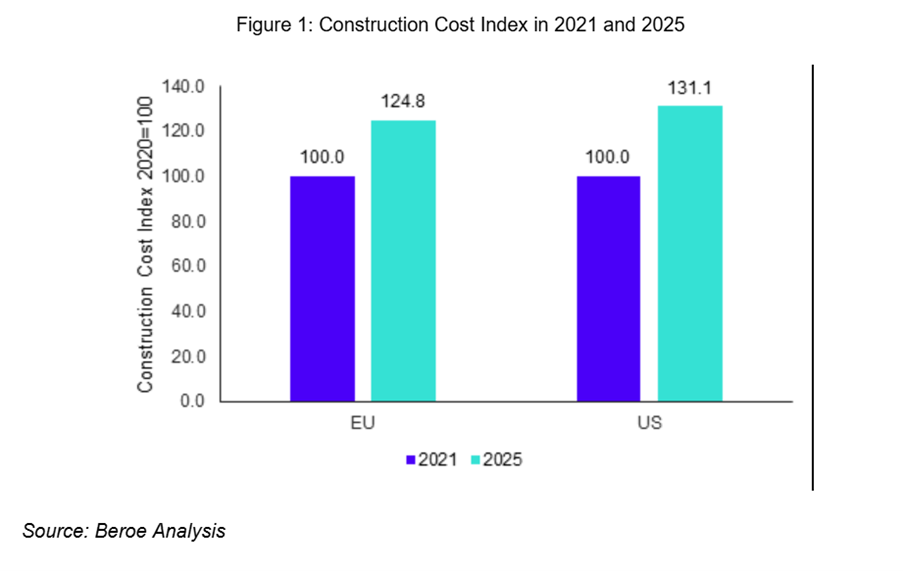
In 2026, the global construction industry is expected to grow steadily but experience increased volatility. Major markets like the U.S. and Europe have experienced a significant increase in the cost of construction by around 31% and 25% respectively in 2025 compared to 2021, as represented in Figure 1. Looming US trade tariffs and regulatory policy shifts, tight financing, new ESG regulations, and unstable material costs contribute to uncertainty in the industry. A shortage of construction labor is another major threat, with the U.S. alone in short supply of 350,000 workers per month. Building standard codes of practice and technology are changing rapidly, and digital tools like BIM, AI, digital twins, and IoT present major efficiency benefits, but in turn require additional labor skills. In 2026, construction procurement teams should place a focus on technology and prefab techniques to manage supply risks, price fluctuations, and regulatory pressure. [2] [3]
Key trends, their impacts, and drivers
1. Modular and prefabrication construction
Modular construction is gaining traction in residential, commercial, warehouse development, and recently in the construction of nuclear and data centers. The market is expected to grow around 8-10% in 2026, compared to 2025. In North America alone, modular and off-site methods were used in more than 28% of the new buildings in 2025. The emergence of industrialized building design (IBD) is one of the key developments influencing modular construction in 2026. This method completely incorporates quality-engineering standards, automation, robotics, and digital planning tools into the construction process.
Modular construction reduces timelines by around 50% and improves budget predictability by avoiding cost overruns. Rapid onsite assembly ensures quick turnaround, especially beneficial for larger projects or complex sites. In addition to improving safety during installation, it also provides long-term savings through reduced maintenance and increased energy efficiency.
Modular construction shifts the focus from labor sourcing to raw material sourcing and logistics and needs a stringent framework of risk allocation. Large data centers, nuclear reactors, and airports now combine traditional building methods with modular modules.
Modular construction necessitates creating solid partnerships with knowledgeable suppliers and ensuring contracts address logistics, quality, risk allocation, and compliance. Early collaboration through design-build partnerships maximizes project value, lowers risks, reduces disputes, speeds up schedules, minimizes expenses, and fosters innovation.
2. Digital transformation and automation
Data is becoming the driving force in construction. Construction projects are more regularly incorporating robotics, Building Information Modeling (BIM), AI, digital twins, and drones. BIM is expected to have a year-on-year growth of around 10-12%. AI-powered scheduling can identify delays early, and digital twins make it possible to track projects in real time. Robotics is being used increasingly on construction sites, including 3D printing, bricklaying bots, and plastering bots. Construction safety and efficiency is greatly improving using AR and VR,
3. Sustainability and green building
Global environmental regulatory standards are growing increasingly stringent. Building standards and RFPs are progressively mandating the use of low-carbon materials, increased energy efficiency, and waste reduction. It is advised to include carbon reporting requirements, such as mandated Environmental Product Declarations, as well as pledges to net-zero targets in the contracts to tackle the drive by government initiatives such as the EU’s Carbon Border Adjustment Mechanism (CBAM) and Buy Clean laws in the United States. Transparency on embodied carbon is also being demanded in public sector projects, particularly for commodities such as steel and cement. The green building construction market is anticipated to have a CAGR of 10 to 12% from 2024 to 2028. [10]
Low-carbon materials are usually more expensive but provide considerable savings over the entire lifecycle due to lower energy consumption and maintenance, as well as longer durability. There are also subsidies provided by governments to facilitate implementation.
Procurement teams should:
- Verify eco-friendly suppliers and integrate carbon expenses into the bidding process.
- Incorporate sustainability conditions like EPDs and recycled content minimums into RFQs and require suppliers to report carbon footprints verified with technologies like One Click LCA.
- Track supplier emissions with AI-powered platforms, regularly conduct audits, and consider ESG factors in bids.
- Use a green procurement scorecard that factors in carbon, recycled content, social compliance, and governance.
Challenges to procurement:
1. Material supply and cost volatility
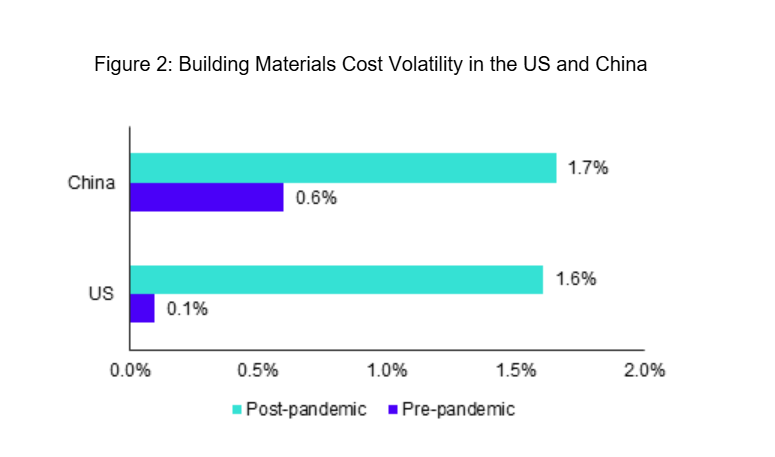
Key commodity prices such as steel, lumber, and cement remain volatile. Figure 2 represents the volatility of the cost of building materials in the U.S. and China, pre- and post-pandemic. New shocks, such as trade tariffs and geopolitical tensions, exacerbate the uncertainties in the construction. Additionally, continuous logistical constraints and long lead times for crucial inputs like semiconductors, structural steel, and key Mechanical, Electrical and Plumbing (MEP) equipment, impact procurement and project timeframes. Contractors are increasingly being obliged to include larger contingencies in their budgets and design flexible contracts to offset these risks.
Pandemic reshoring and “Buy Local” policies are driving construction supply chains toward shorter, localized networks, reducing reliance on global sources but tightening supplier pools. Climate events and transportation labor shortages further constrain material flow, causing inflationary pressures and unpredictable budgets. Over-reliance on single or distant suppliers increases procurement risks, while long-term contracts face higher chances of delays. Stakeholders must balance cost savings with contingency measures to manage these disruptions effectively.
Procurement teams can respond by adding price contingencies and negotiating flexible contracts to adapt to market volatility. Real-time data analytics help monitor prices and supply risks, enabling faster responses. Best practices include diversifying sources between local and international suppliers, using hedging clauses, index-based contracts, and digital supply chain management tools for alerts. These strategies enhance resilience and reduce disruption risks amid ongoing uncertainty in construction procurement and supply chains.
2. Workforce and skills transformation
The construction industry in the United States is experiencing a significant labor crisis, with a demand for roughly 500,000 new workers by 2026. This is due to retiring workers, low youth engagement, and increased demand from huge infrastructure and renewable energy projects. Immigration restrictions and lengthy vocational training exacerbate the divide, leaving businesses scrambling to recruit competent, tech-savvy staff required for today’s sophisticated builds.
Rising pay and benefits increase project costs as companies compete for talent, with contractors reporting hiring issues. Delays, cancelled bids, and budget overruns are prevalent when workforce levels are inadequate. The shortage isn’t only about numbers, but also about hybrid skills that combine traditional construction knowledge with digital technology, forcing businesses to reconsider their training, recruitment, and retention plans.
In response, contractors and clients are raising wages, investing in apprenticeships, and implementing labor-saving technology such as modular construction and AI scheduling. Supplier training partnerships also improve capabilities across the supply chain, allowing projects to stay on track despite manpower issues.
3. Cybersecurity and data risks
As the construction industry quickly adopts digital technology, cybersecurity has become an increasingly important consideration in procurement processes. More than one-third of contractors have reported an increase in cyber dangers such as phishing attempts, data breaches, and ransomware events. These assaults target supplier-related digital platforms, such as those used for tender submissions, invoicing, and supply chain management, turning procurement systems into vulnerable entry points for cybercriminals. A successful cyber-attack can paralyze procurement procedures, interrupt project timetables, and expose critical business information like pricing tactics.
Countermeasures include thoroughly evaluating suppliers’ cybersecurity safeguards, with a focus on cloud service providers that hold important data and apps. Contracts should include cybersecurity clauses that clarify obligations, impose strict data privacy requirements, and demand incident response processes.
Recommendations for procurement:
1. Embrace smart sourcing strategies: Predictive analytics will be helpful to forecast steel, fuel, and labor patterns. Reduce exposure and prevent single-source failure by negotiating index-linked escalation clauses, staggering renewals, diversifying suppliers, and using stocks or consignment for scarce supplies.
2. Develop collaborative partnerships: Transition from purchasing based on price to forming partnerships based on value. Use shared risk-reward models and clauses for long-lead products, co-fund R&D on low-carbon materials, secure modular capacity through preferred vendors, and involve suppliers early in the design process, like IPD or ECI.
3. Invest in digital and data enablers: Create real-time material visibility by integrating ERP, BIM, and e-procurement. Use AI for contract risk and tendering. To avoid rush purchases, delays, and unchecked spending, and enable mobile field ordering.
4. Strengthen governance: Establish an interdisciplinary Supply Risk Council to keep an eye on volatility. Assign owners based on cyber risk and sustainability. Incorporate ESG and cyber checks into every bid process, and train buyers in analytics and green sourcing. Dispute Avoidance Boards ensure communication and collaboration, thereby addressing disputes at any point in time in project execution.
5. Drive cost efficiency: For volume leverage, standardize materials across projects. Increase recycling and reuse of inputs. Use controlled JIT to optimize logistics. Reduce waste by using lean scheduling.
6. Formulate flexible contractual frameworks and defined contractual clauses: Start engaging with contractors through more collaborative contracts like Engineering, Procurement, and Construction Management (EPCM), IFOAs, Alliance Contracts, and IPD with well-defined clauses either from the start or by adding an addendum to existing contracts.
How to win at construction procurement in 2026:
Construction companies that combine speed and strategic vision will lead the sector by 2026. Businesses that plan, create flexible procurement methods, invest in personnel and digital capabilities, and integrate sustainability into every aspect of business will be the strongest. Procurement teams need to be data-driven and resilient, always monitoring labor dynamics, regulatory changes, and commodity trends. Rapid course correction will be made possible by deep collaboration across suppliers, stakeholders, and internal departments, supported by real-time analytics. Proactive teams who foresee risk, make investments in cutting-edge technologies like AI, digital twins, and modular building, and include ESG in regular sourcing will have a competitive advantage.
Industry to be impacted.
| Engineering and Construction | Chemicals | Metal, Mining & Minerals | Food, Beverage & Tobacco |
| Oil & Gas | Personal Products | Bank & Financial Services | Hi-tech |
Domain to be impacted.
| Construction | Engineering | Materials |
Focus Area
| Sourcing Opportunity | Supplier Intelligence | Technology | Price Outlook |
| Supply Chain Risk | Contractual Framework | Market Trend | Sustainability |
References
[1] A. Macias, “Fox News,” 2 December 2025. [Online]. Available: https://www.foxnews.com/politics/construction-labor-crunch-drives-up-costs-deepens-americas-housing-affordability-crisis.
[2] “FBR Recruitment,” 24 October 2025.
[3] B. Nuzio, “Construction business Owner,” 10 October 2025. [Online]. Available: https://www.constructionbusinessowner.com/cbizoutlook#:~:text=As%20we%20settle%20into%20the,that%20demands%20adaptability%20and%20resilience.
[4]“Parkland Modular,” [Online]. Available: https://parklandmodular.com/blog/permanent-modular-construction-trends-2025-2026-building-for-the-future-with-innovative-technology/.
[5] “Building Talk,” 12 November 2025. [Online]. Available: https://buildingtalk.com/the-economics-of-modular-construction-saving-time-and-money-without-sacrificing-quality/.
[6] C. V. Theriot, “Jones Walker,” 22 September 2025. [Online]. Available: https://www.joneswalker.com/en/insights/blogs/perspectives/modular-constructions-big-boom-new-risks-outpacing-standard-contracts-in-indust.html?id=102l6bl#:~:text=higher,ENR%2C%20February%2016%2C%202024.
[7] “Air Sys North America,” 20 November 2025. [Online]. Available: https://airsysnorthamerica.com/the-new-data-center-blueprint-why-modular-is-winning-in-the-ai-era/.
[8] “SB Animation,” [Online]. Available: https://sbanimation.com/how-vr-and-ar-is-transforming-the-construction-industry/.
[9] S. Liu, “FieldEx,” 2 December 2025. [Online]. Available: https://www.fieldex.com/en/blog/top-18-construction-industry-trends-and-innovations-to-watch#:~:text=,gaps%20and%20keep%20projects%20moving.
[10] “Construction Wire,” [Online]. Available: https://www.buildcentral.com/greenbuild-2025-recap-what-contractors-should-do-now-to-win-2026-sustainable-projects/#:~:text=,photovoltaics%20to%20energy%20management%20platforms.
[11] “Green Leaves Logistics,” 4 December 2025. [Online]. Available: https://greenleaveslogistics.com/why-carbon-clarity-will-matter-more-than-ever-in-2026-and-how-to-get-ahead-now/#:~:text=,documentation%20needs%20to%20match%20what.
[12] “PIKECS,” [Online]. Available: https://pikecs.com/wp-content/uploads/2025/08/Pike_Construction_Market_Report_Aug-2025-1.pdf.
[13] “Marsh,” 1 September 2025. [Online]. Available: https://www.marsh.com/en/industries/construction/insights/cybersecurity-a-growing-focus-as-construction-industry-digitizes.html#:~:text=should%20be%20paying%20significant%20attention.
[14] “The Brimingham Group,” [Online]. Available: https://thebirmgroup.com/construction-industry-outlook-2026-projects-trends-and-workforce-demand/#:~:text=The%20most%20urgent%20story%20inside,to%20compliance%E2%80%94is%20feeling%20the%20pinch.
[15] “Buildmate,” 20 March 2025. [Online]. Available: https://www.buildmate.com/resources/top-construction-procurement-trends-in-2025-ai-automation-sustainability-and-more.
[16] “Stone Building Solutions,” 2025. [Online]. Available: https://stonebldg.com/5-emerging-trends-in-construction-procurement/.
Author

Kumara Raja G

Related Reading

10 Mar, 2026
AI That Actually Works: Why MCP Integration is a Turning Point for Procurement Data


02 Mar, 2026
Why are Category Management Platforms a Gamechanger for Modern Procurement Teams