
Should-Cost Modelling
A data-driven view of what a product or service ought to cost
Talk to our team
Should-Cost Modelling
Turn cost complexity into cost clarity
Assessing whether a quoted price is reasonable requires an independent view of what the product or service in question costs to produce. That is what a should-cost model provides, and it underpins negotiation, savings identification, and sourcing location decisions.
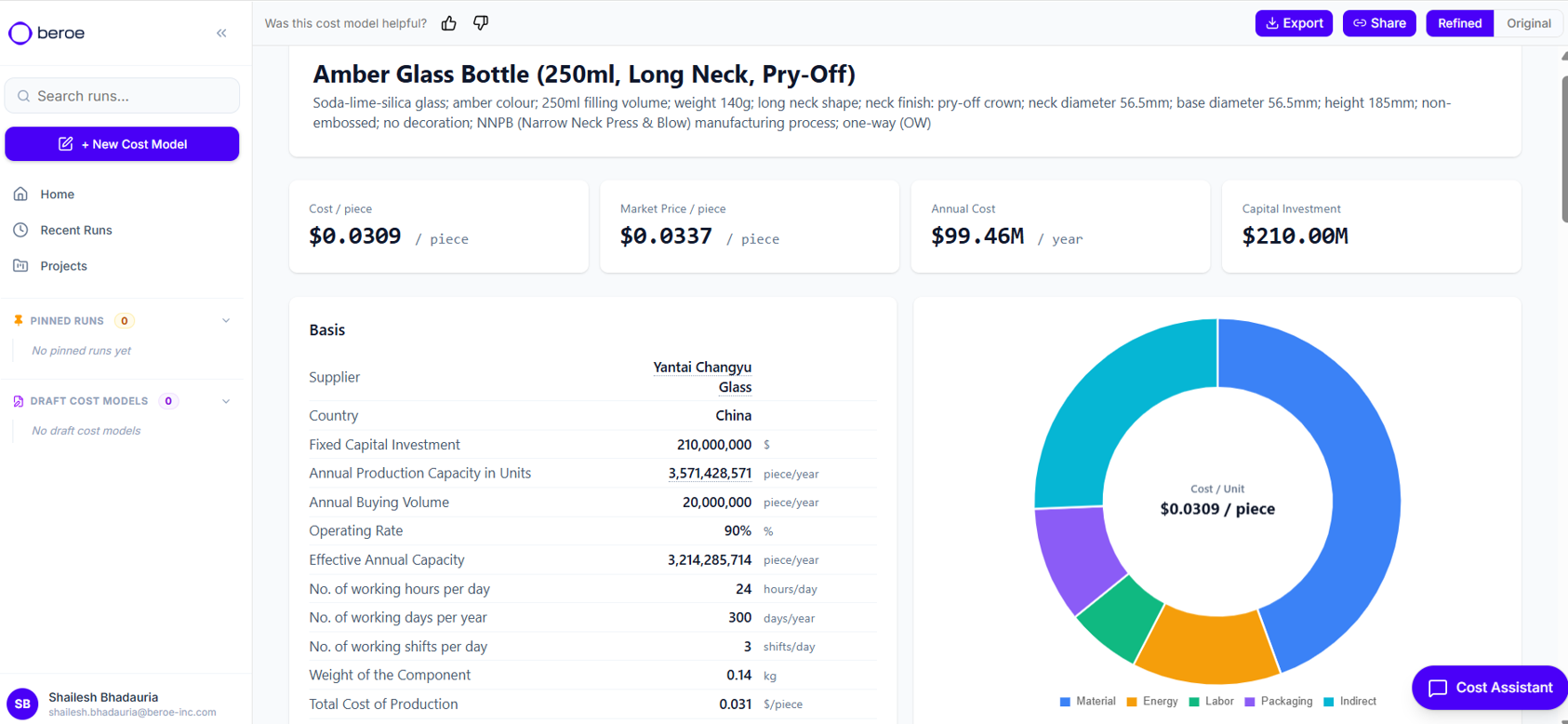
Beroe’s should-cost models are built bottom-up, identifying the cost drivers of a product or service and combining them with current prices for feedstock, labor, energy, process, packaging and freight, before adding overheads and margin. The output is a price per unit, validated through expert inputs and built to your specifications, purchase volumes and geographies.
20+
3,000+
30+
What our should-cost models cover

Full cost build-up

Multi-level BOM decomposition

Regional cost variation

Scenario and sensitivity analysis

Make vs buy and TCO benchmarks

18-month forward view
Three ways to get a cost model
Models generated on demand and enhanced via conversational AI interface on a client-specific instance, to help teams build cost models at scale, but at fraction of cost. Refine outputs through our Cost Assistant feature, upload your own cost data, and export the result.
AI output validated by Beroe’s cost modelling analysts using enhanced datasets, market sources, industry benchmarks, and supplier and expert inputs on specific cost elements.
Validated models with each cost component linked to its driver index, giving an 18-month forward price. Connected to Beroe DataHub for a monthly refresh and delivered through Power BI or Inflation Watch.
Why Beroe

Extensive experience in cost modelling
Knowledge gained from delivering 10,000+ cost models over two decades provides significant expertise that helps deliver better results.

AI speed with analyst validation
In-house AI cost modelling tools generate models in minutes. Beroe analysts validate them against internal datasets, market sources, and expert inputs.

Independent of the supplier’s quote
The model is built from the cost of producing what you buy, so it stands as an independent reference in a negotiation.

Confidentiality by design
The AI tool runs on a separate instance for your organization, with its own hosting and processing capacity, so your specifications and volumes stay yours.

Engagement that fits the decision
Three delivery options, from models generated in minutes to analyst-validated models refreshed monthly, so the depth matches what the decision requires.

